





























Content ITV PRO
This is Itvedant Content department
Learning Outcome
6
Prepare a structured test plan for effective test execution.
5
Plan automation coverage for important user workflows.
4
Identify testing resources, timelines, and responsibilities.
3
Define test scenarios, test cases, and required test data.
2
Identify test objectives, scope, and requirements.
1
Understand the purpose and importance of test planning
Recall
Software Testing Basics
Test Scenarios and Test Cases
Requirements Analysis
Test Data
Test Execution and Validation
Defect Reporting
Automation Testing Basics
Planning a software test is like planning a trip.
Destination
Testing objective
Places to visit Test scenarios
Travel route
Test execution steps
Tickets & documents
Test data and resources
Travel schedule
Testing timeline
Travel budget
Testing effort and resources
Backup plan
Risk and contingency planning
Just as proper trip planning helps complete the journey smoothly, test planning helps organize testing activities, resources, timelines, and objectives before execution begins.
Why Test Planning Is Required ?
Define what needs to be tested and why.
01
Ensures accurate evidence collection by using the correct settings
01
Identify the scope, objectives, and testing approach.
02
Determine required resources, tools, and test environment.
03
Improves investigation efficiency by preparing the tool before analysis
03
Plan test data, scenarios, and execution activities.
04
Identify potential risks and dependencies in advance.
05
Define timelines, responsibilities, and priorities.
06
Ensure testing is organized, consistent, and measurable.
07
What is Test Planning?
Test Planning is the process of deciding what to test, how to test, when to test, and what resources are required before starting the actual testing.
It defines the testing scope, objectives, test scenarios, resources, tools, schedule, risks, and execution approach.
Example:
For an online shopping application, test planning determines which features such as login, product search, cart, checkout, and payment will be tested, what test data is needed, who will perform the testing, and when the testing will be completed.
Understanding Test Objectives and Scope
Test Objectives define what we want to achieve through testing.
Verify that login works correctly.
Validate the checkout process.
Identify functional defects.
Ensure important workflows meet requirements.
Test Scope defines what is included and excluded from testing.
Example – Online Shopping Application:
Out of Scope: Admin module and third-party delivery system.
In simple terms:
Test Objective = What we want to achieve
Test Scope = What we will and will not test
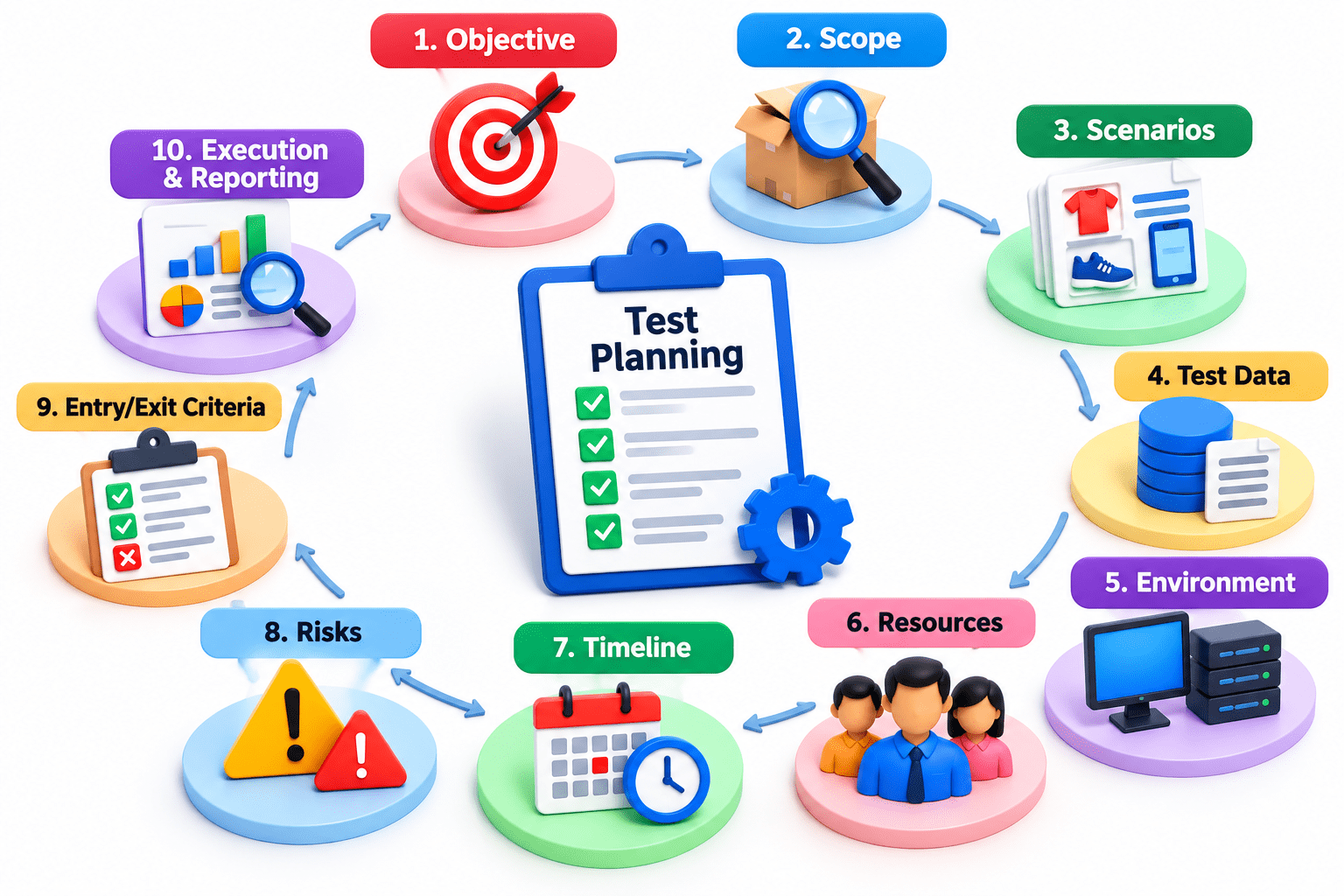
Test Planning Components
Test Objectives & Scope
Defines what testing aims to achieve and which features or modules are included or excluded.
1
Testing Requirements
Identifies the functional and technical requirements that need to be verified through testing.
2
Test Scenarios & Test Cases
Defines the user workflows and detailed conditions that will be tested.
3
Test Environment & Tools
Specifies the hardware, software, browsers, devices, and testing tools required for execution.
4
Test Data Planning
Identifies and prepares the data required to execute different test scenarios.
5
Resource & Role Planning
Defines who will perform testing and assigns responsibilities to team members.
6
Test Schedule & Timeline
Defines testing activities, milestones, and expected completion dates
7
Risk Identification & Mitigation
Identifies possible testing risks and plans actions to reduce their impact.
8
Entry & Exit Criteria
Defines the conditions required to start testing and the conditions required to complete it.
9
Test Execution & Reporting
Defines how tests will be executed, tracked, and reported with their results and defects.
10
Practical Test Planning Example
Scenario: Test an Online Shopping Application
Define Test Objective
Verify that users can successfully log in, search for products, add products to the cart, and place an order
Define Test Scope
In Scope: Login, product search, product details, cart, checkout, and order confirmation.
Out of Scope: Admin features and third-party delivery services.
Identify Test Scenarios
Verify valid and invalid login.
Verify product search.
Verify adding/removing products from cart.
Verify checkout process.
Verify order confirmation.
Prepare Test Data
Prepare valid/invalid login credentials, product names, customer details, and payment test data.
Define Environment & Tools
Environment: Chrome, Firefox, Windows.
Tools: Playwright, Java, TestNG, Maven, and reporting tools.
Assign Resources
Define responsibilities for test planning, automation development, execution, defect reporting, and result analysis.
Define Timeline
Plan activities such as test preparation → automation → execution → defect fixing → retesting → final reporting.
Identify Risks
Possible risks include unavailable test data, application changes, environment issues, and unstable third-party services.
Define Entry & Exit Criteria
Entry: Application and test environment are ready.
Exit: Planned tests are executed, critical defects are resolved, and test results are documented.
Overall Test Plan
Advantages of Test Planning
Provides a clear testing direction and approach.
Helps define scope, objectives, and priorities
Ensures proper use of resources, tools, and test data.
Helps manage time and testing activities effectively.
Identifies risks and dependencies early.
Improves team coordination and responsibility sharing.
Ensures important features are covered systematically.
Makes test execution and result tracking easier.
Supports better defect identification and reporting.
Provides a structured basis for test completion and reporting.
Summary
4
Ensures structured and effective testing.
3
Plans test data, timelines, and risks.
2
Organizes scope, requirements, and resources.
1
Defines what, how, when, and who to test.
Quiz
A team is starting testing for a new application. What should be defined first in the test plan?
A. Test execution results
B. Test objectives and scope
C. Defect closure report
D. Production deployment
A team is starting testing for a new application. What should be defined first in the test plan?
A. Test execution results
B. Test objectives and scope
C. Defect closure report
D. Production deployment
Quiz-Answer
By Content ITV