









Content ITV PRO
This is Itvedant Content department
Learning Outcome
5
Explain how the 'C' parameter (Soft Margin) prevents overfitting.
4
Recognize the limitation of flat data and how the "Kernel Trick" solves it.
3
Distinguish between Linear and Non-Linear SVMs.
2
Identify the anatomy of SVM (Hyperplane, Margin, and Support Vectors).
1
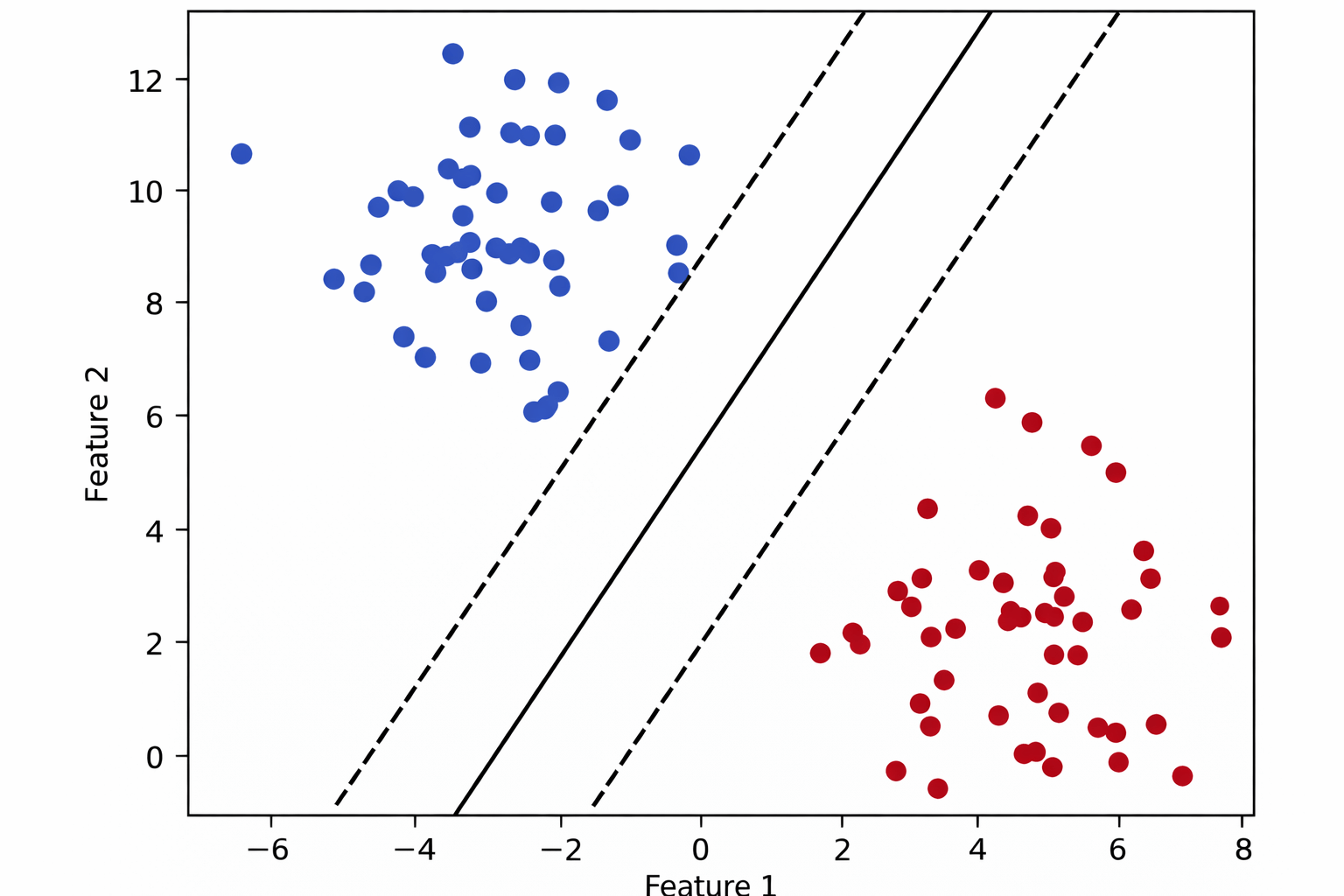
Understand the core goal of SVM: maximizing the margin.
Two rival medieval factions (Red Knights and Blue Knights) set up camps in a massive field
Scenario:
Human Intuition
A thin chalk line? Dangerous if someone steps over.
The Safest Border
A wide, empty "No Man's Land" (DMZ) between camps
Machine's Logic
SVM Maximizes the Margin
Not just separation—maximum safety for future predictions
Core Concepts (Slide 6)
Core Concepts (Slide 7)
Core Concepts (.....Slide N-3)
Summary
4
C parameter controls fit vs generalization (hard vs soft margin)
3
Kernel trick handles non-linear data
2
Boundary depends on support vectors (edge points)
1
SVM finds a hyperplane that maximizes margin
Quiz
In a Support Vector Machine, what happens to the optimal hyperplane if you delete 50% of the data points that are situated far away from the margin boundary?
A. The hyperplane shifts dramatically
B. The algorithm crashes due to missing data
C. Absolutely nothing changes
D. The model switches from Linear to Non-Linear
Quiz-Answer
In a Support Vector Machine, what happens to the optimal hyperplane if you delete 50% of the data points that are situated far away from the margin boundary?
A. The hyperplane shifts dramatically
B. The algorithm crashes due to missing data
C. Absolutely nothing changes
D. The model switches from Linear to Non-Linear
By Content ITV