

























Content ITV PRO
This is Itvedant Content department
Learning Outcome
5
Analyze impact on share price and investors.
4
Learn automatic credit through depositories.
3
Understand key corporate action dates.
2
Learn dividends, bonus issues, and stock splits.
1
Understand Mandatory Corporate Actions.
What is a Mandatory Corporate Action
A Mandatory Corporate Action automatically applies to eligible shareholders.
Investors do not need to give approval or instructions.
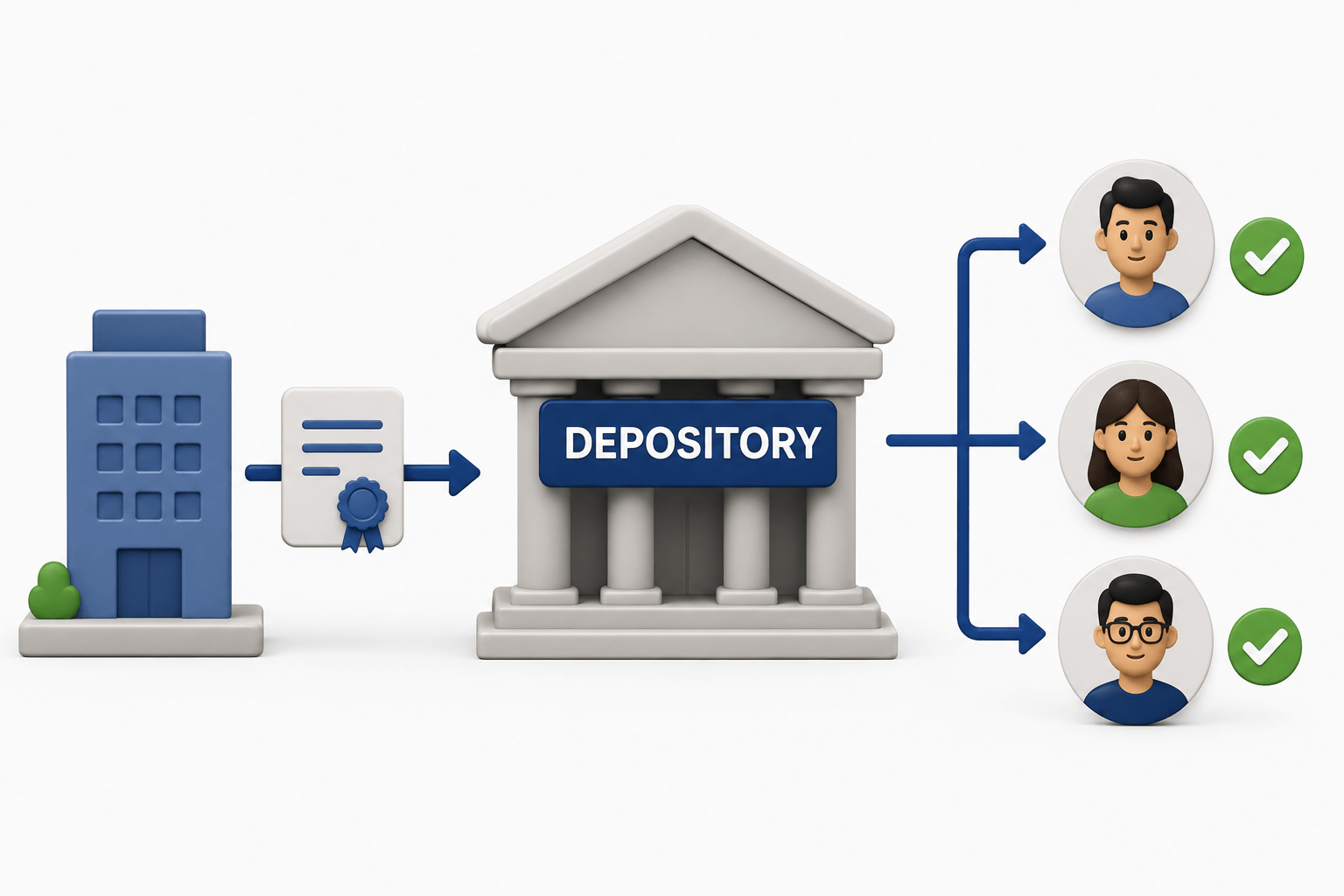
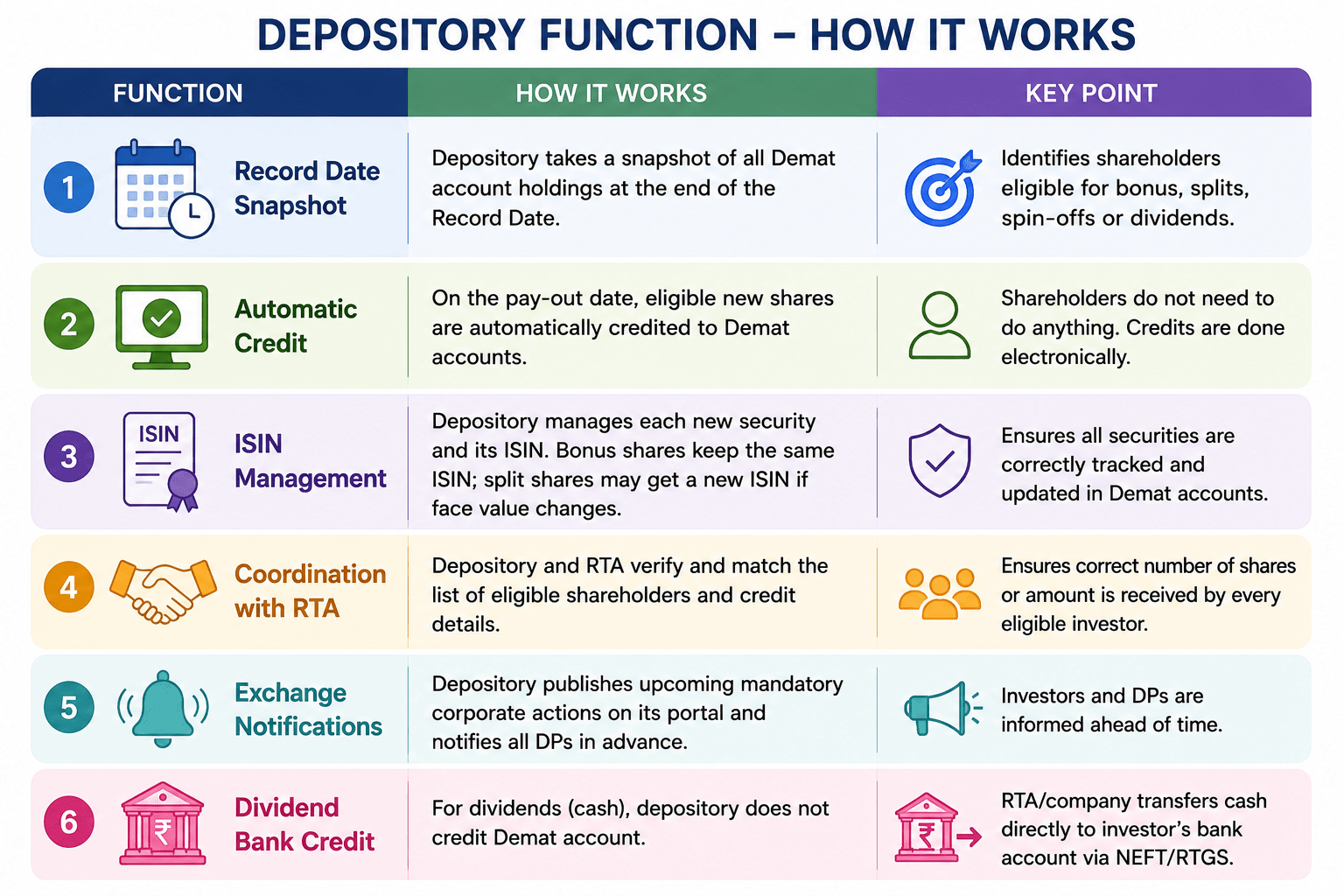
Benefits are directly credited to Demat accounts by depositories.
Key Characteristics
Automatic: No action, instruction, or election is required from the investor.
Universal: Applies to 100% of eligible shareholders holding securities on the Record Date.
Board-driven: Decided unilaterally by the Board of Directors. Shareholders approval may or may not be required.
Key Characteristics
Depository-processed: NSDL/CDSL credits the benefit automatically to Demat accounts on the pay-out date.
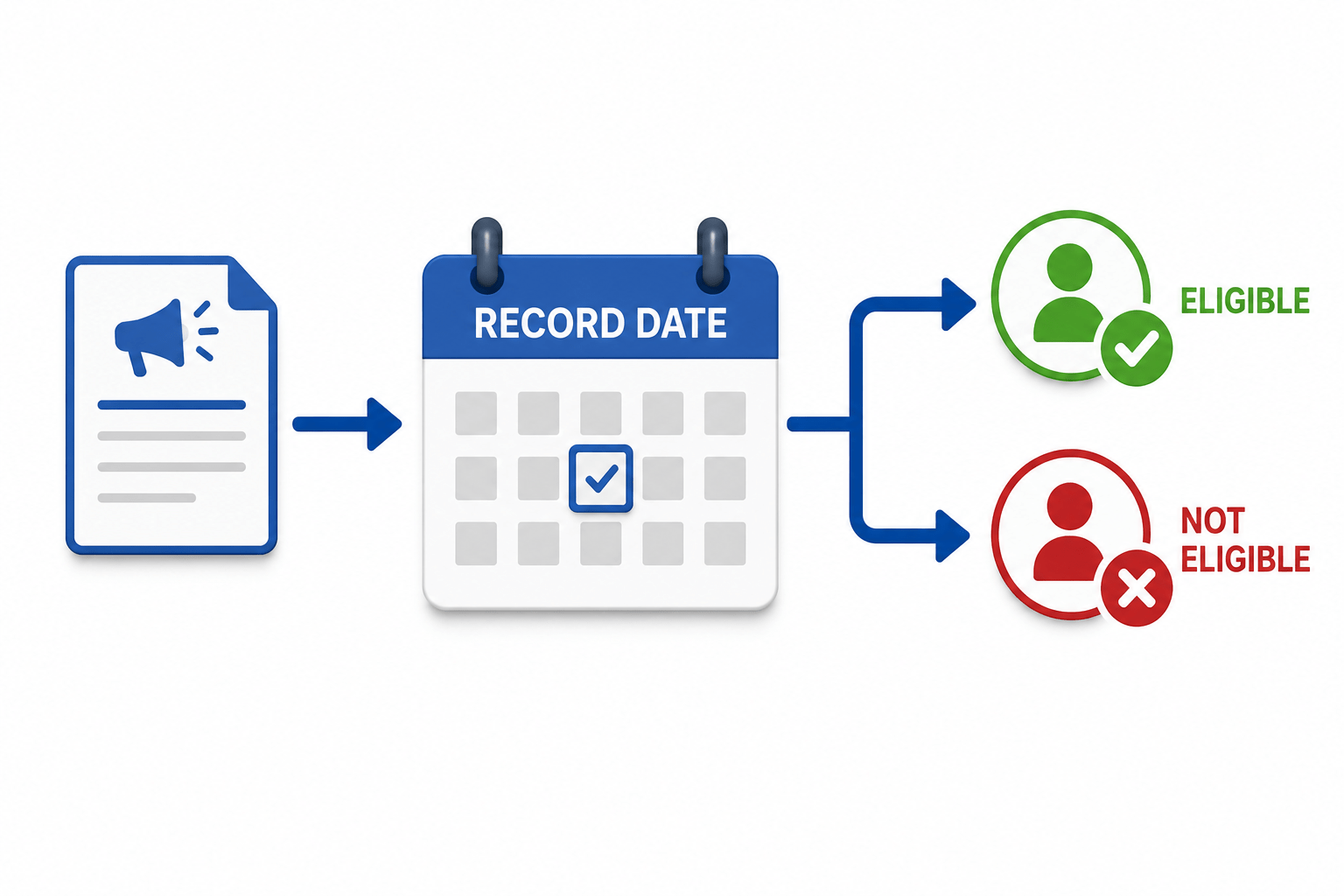
Record-Date-dependent: Only shareholders holding the security on the Record Date are eligible.
Price-sensitive: Most mandatory actions are price-sensitive events disclosed to stock exchanges under SEBI LODR.
Key Dates You Must Know
Key Date
What It Means & Why It Matters
1
Announcement Date
The date the company's Board of Directors announces the corporate action. Markets react to this news immediately
2
Ex-Date (Ex-Dividend / Ex-Bonus Date)
The Ex-Date is the date from which shares trade without the corporate action benefit, and buyers on or after this date are not eligible.
3
Record Date
The Ex-Date is the date from which shares trade without the corporate action benefit, and buyers on or after this date are not eligible.
Key Date
What It Means & Why It Matters
4
Book Closure Date
Book Closure is the period when shareholder records are closed to identify eligible investors.
5
Pay-Out Date
The date on which the benefit (bonus shares, split shares, or dividend amount) is credited to the Demat account or bank account.
6
Effective Date
The date from which the corporate action takes legal effect.
E.g., the new face value is applicable from the effective date of a stock split.
Types of Mandatory Corporate Actions
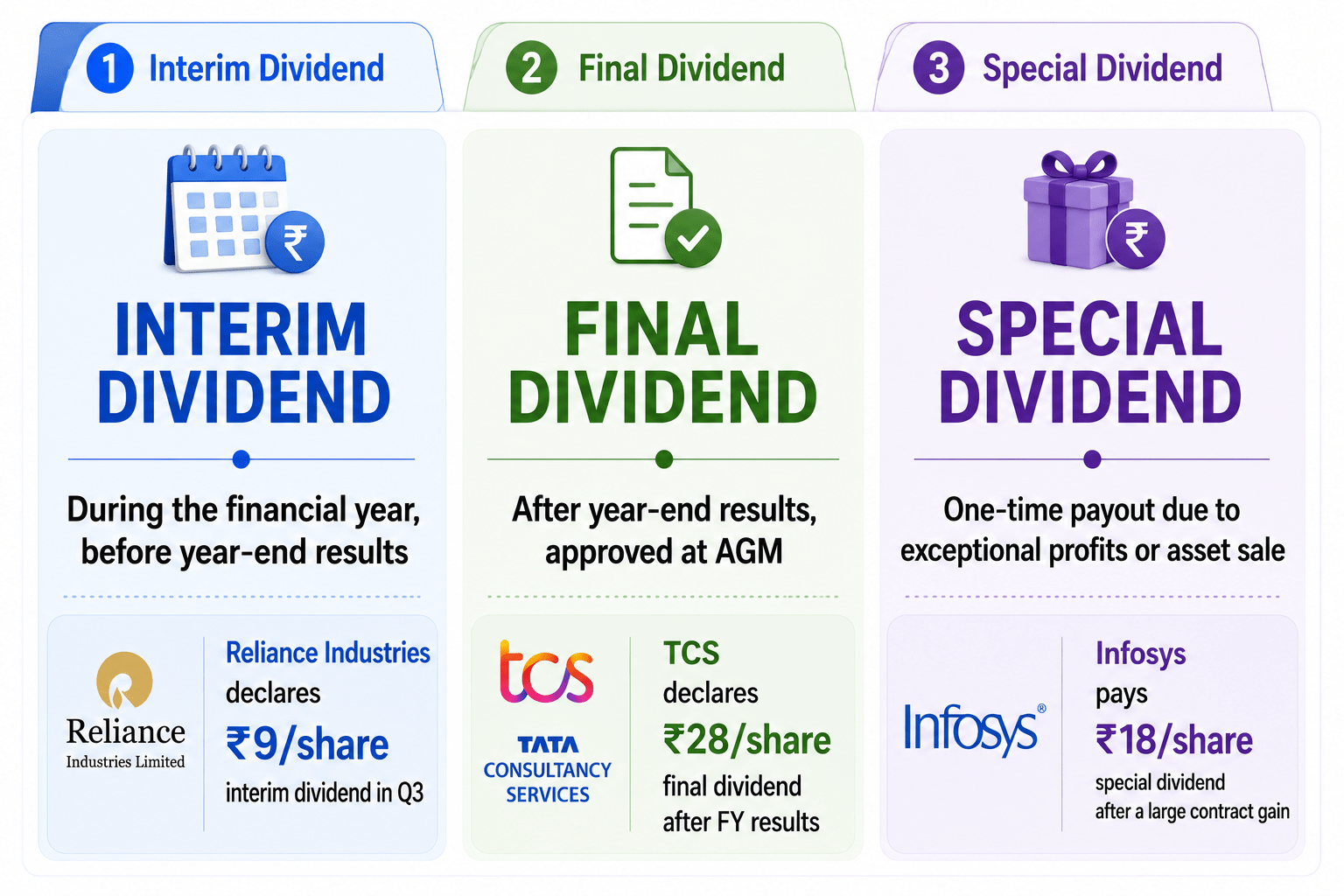
Dividend
A dividend is a company profit distributed to shareholders and credited directly to their bank accounts.
Types of Dividend
Impact on Share Price
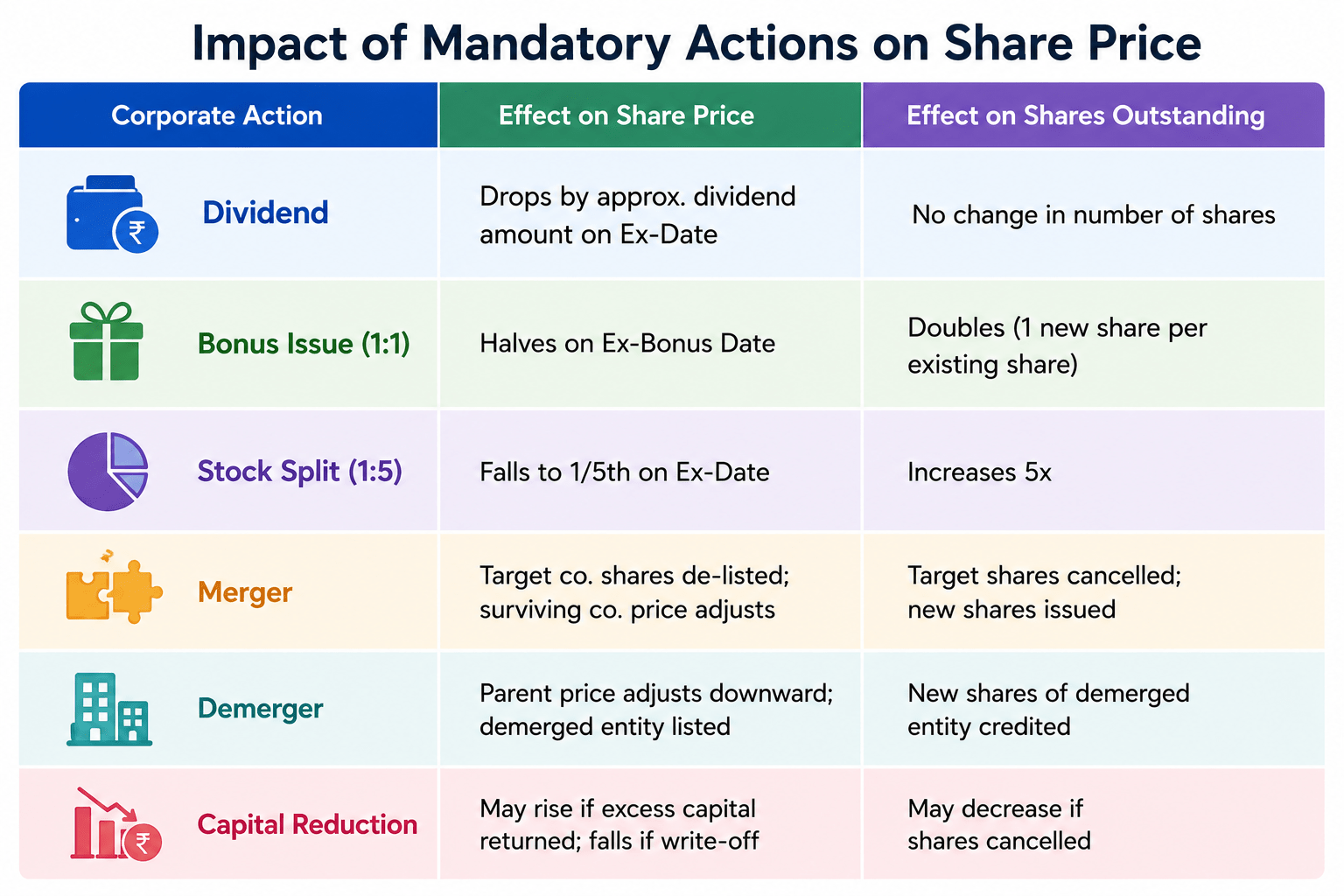
Share prices usually fall by the dividend amount on the Ex-Dividend Date.
This adjustment is called the dividend adjustment.
Investors buying on or after the Ex-Date are not eligible for the dividend.
Existing shareholders receive the dividend in their registered bank accounts.
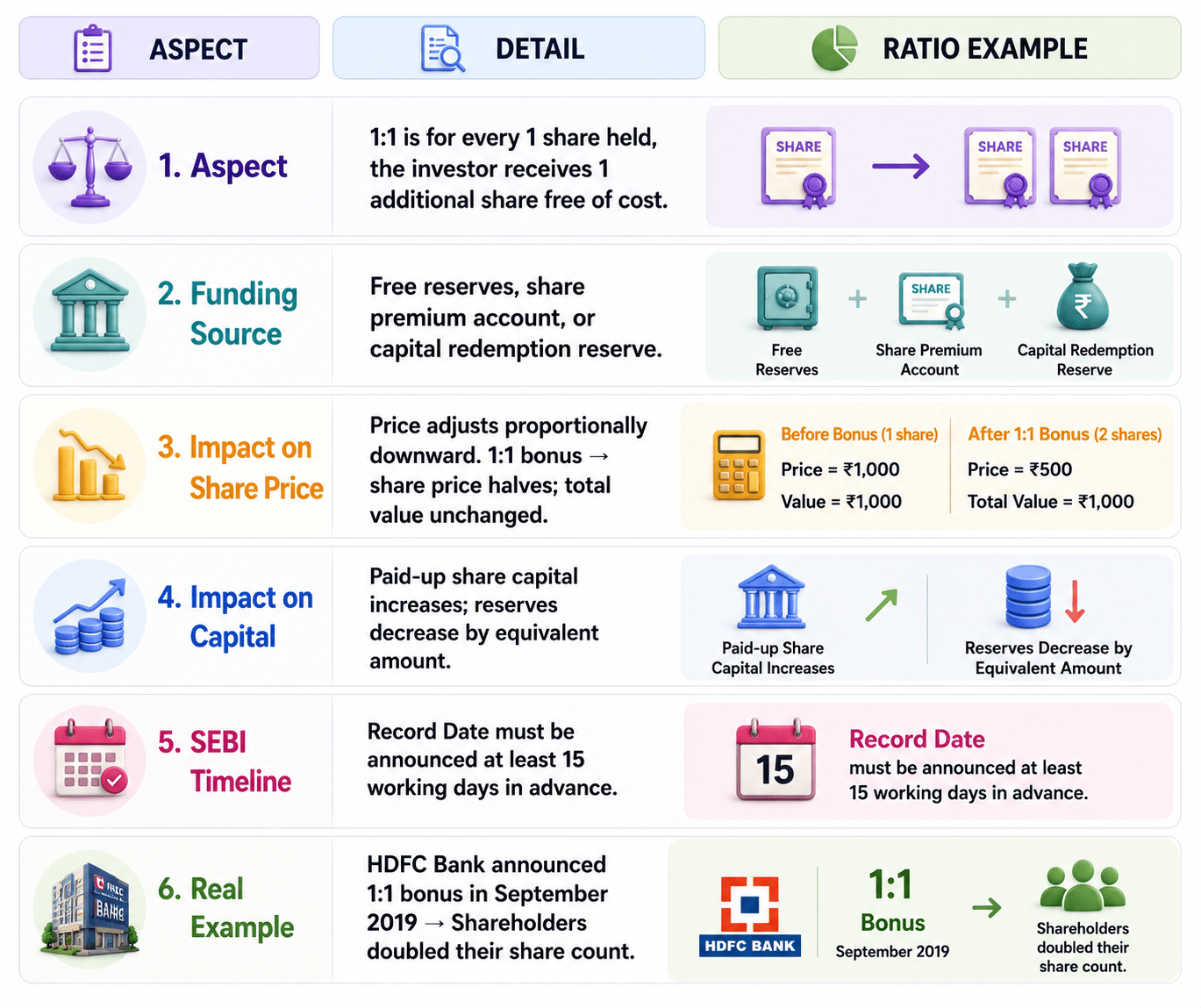
Bonus Issue (Bonus Shares)
A Bonus Issue gives existing shareholders free additional shares from company reserves, increasing share count while adjusting the share price proportionally.
Stock Split (Share Split)
A Stock Split increases share count and lowers share price without changing shareholder wealth.
split ratio
What Happens
Example
1:2 Split
100 shares at ₹500 become
200 shares at ₹250.
₹10 share split into two ₹5 shares
split ratio
What Happens
Example
1:5 Split
Before split:
You have 100 shares priced at ₹3,500 each.
Total value = 100 × ₹3,500 = ₹3,50,000.
After split (1:5 split):
You now have 500 shares priced at ₹700 each.
Total value = 500 × ₹700 = ₹3,50,000.
10 shares at ₹20,000 become
100 shares at ₹2,000 each.
1:10 Split
₹5 share split into five ₹1 shares
₹10 share split into ten ₹1 shares
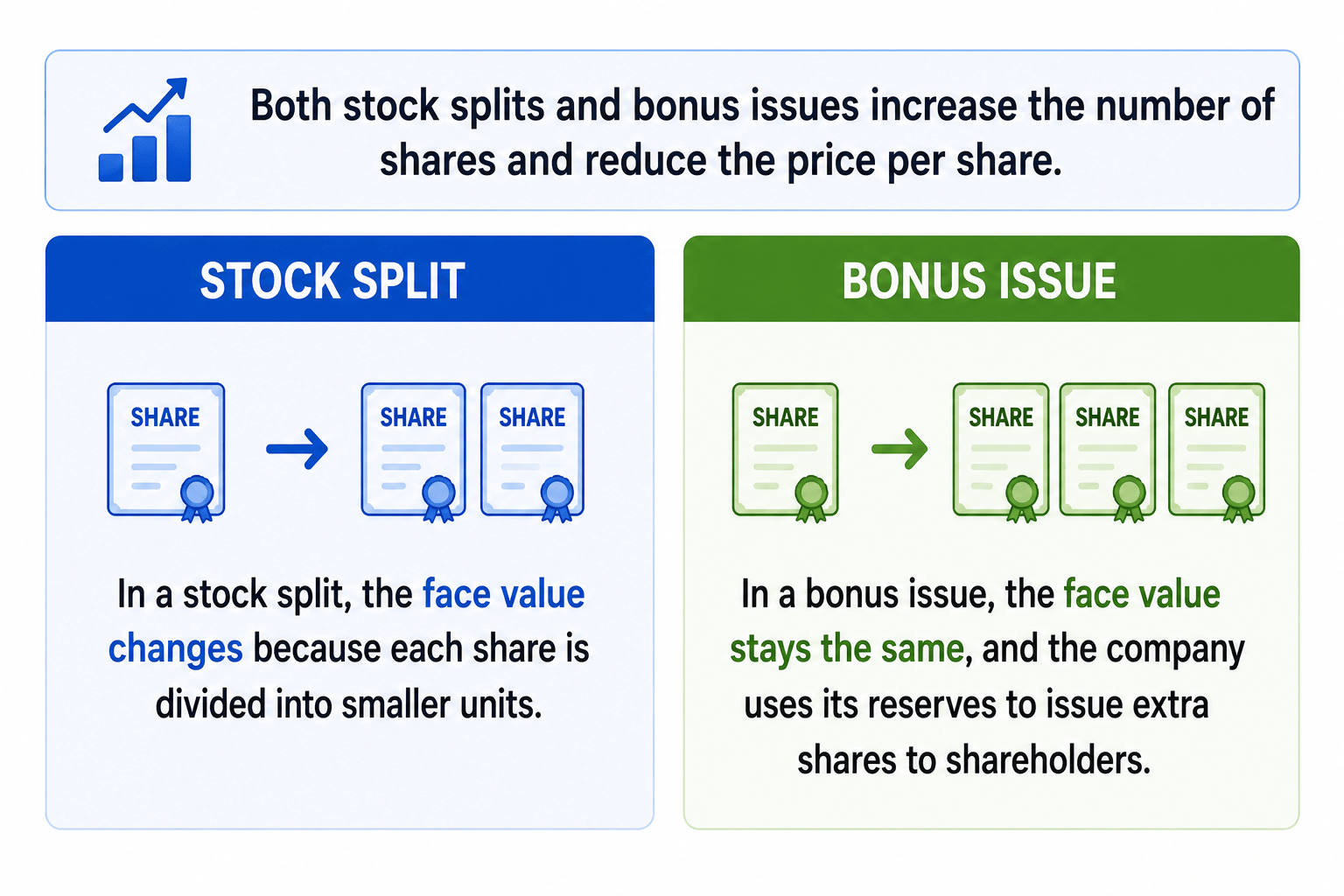
Stock Split vs Bonus Issue
Merger / Amalgamation
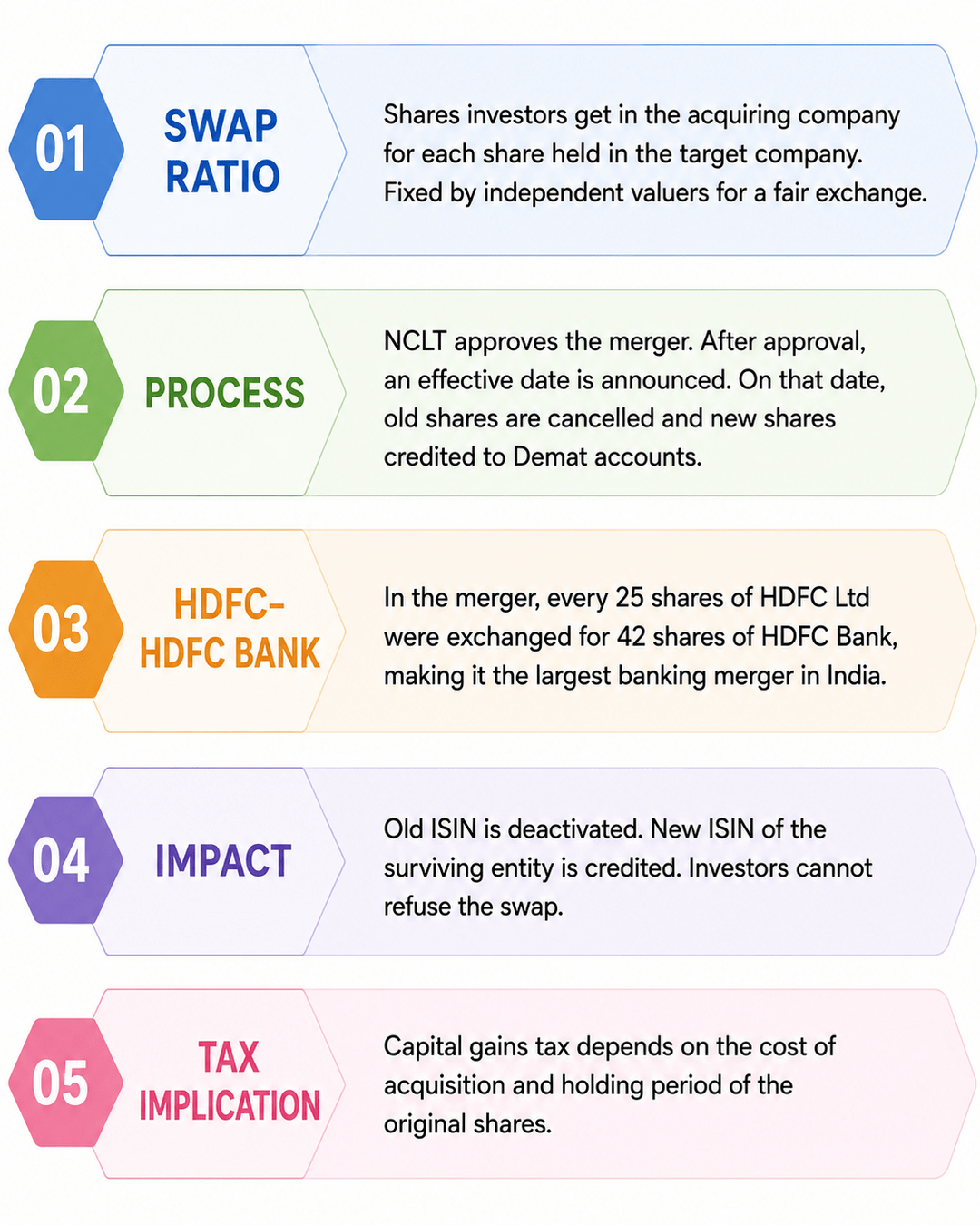
In a merger, shareholders of the target company must exchange their old shares for shares of the acquiring company based on a fixed swap ratio.
Capital Reduction
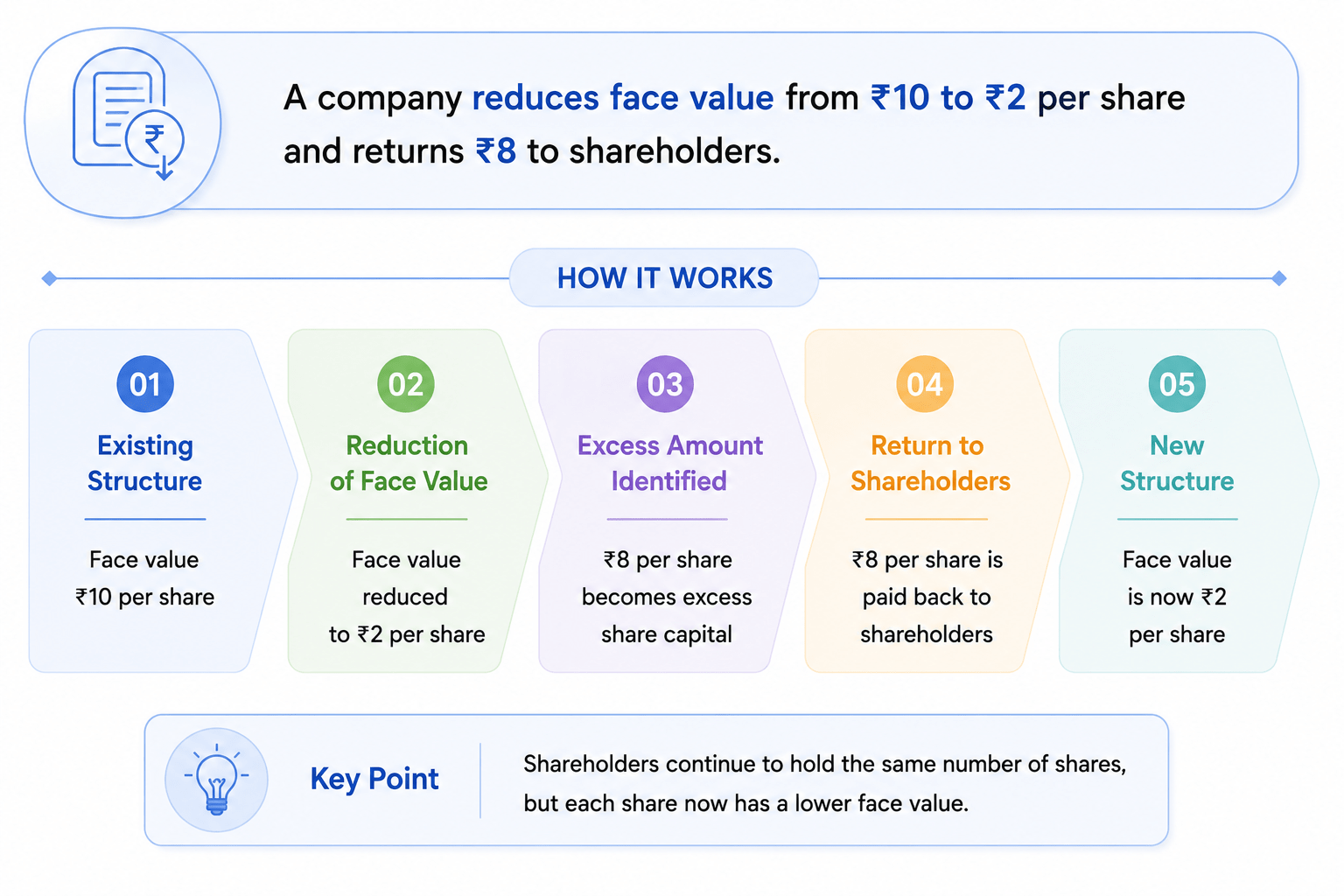
Capital Reduction reduces a company’s paid-up share capital.
It may involve share cancellation, face value reduction, or capital repayment.
It requires approval from National Company Law Tribunal.
It is used to write off losses or restructure the balance sheet.
The action is compulsory for all shareholders once approved.
Stock Consolidation (Reverse Split)
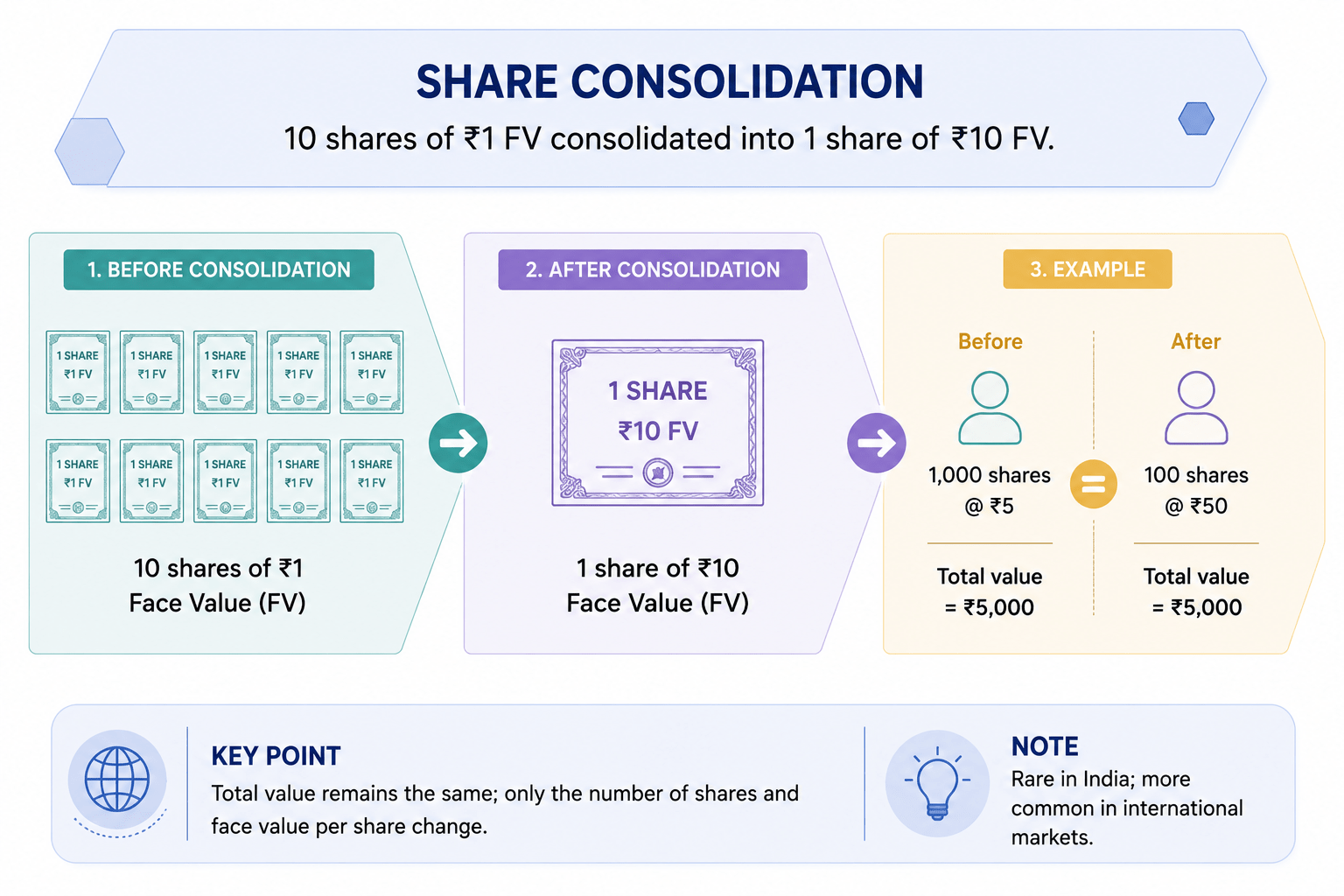
Stock Consolidation merges multiple low-value shares into fewer high-value shares.
It is the reverse of a stock split.
It increases the face value and market price per share.
Total shareholder value remains unchanged immediately after consolidation.
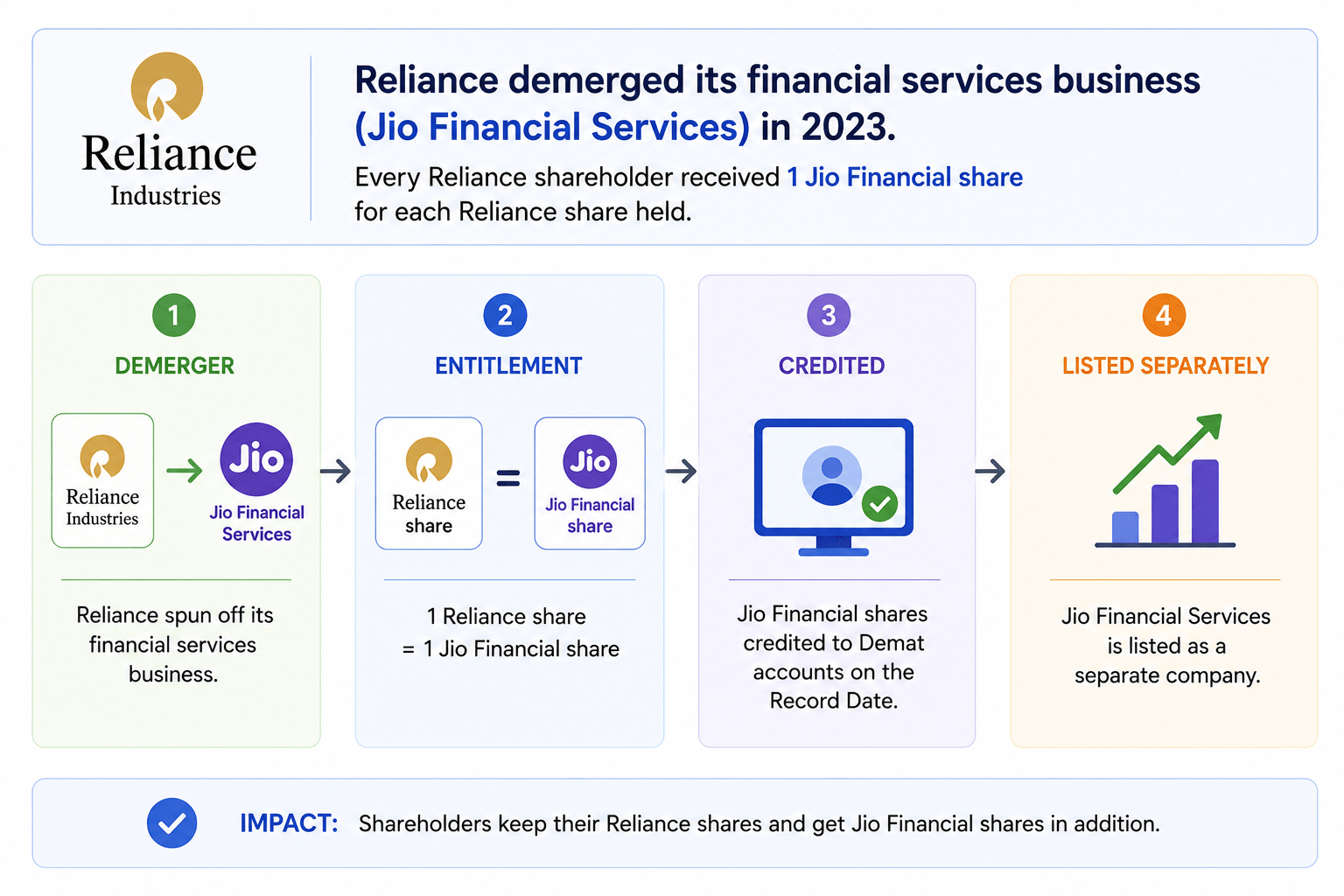
Demerger / Spin-Off
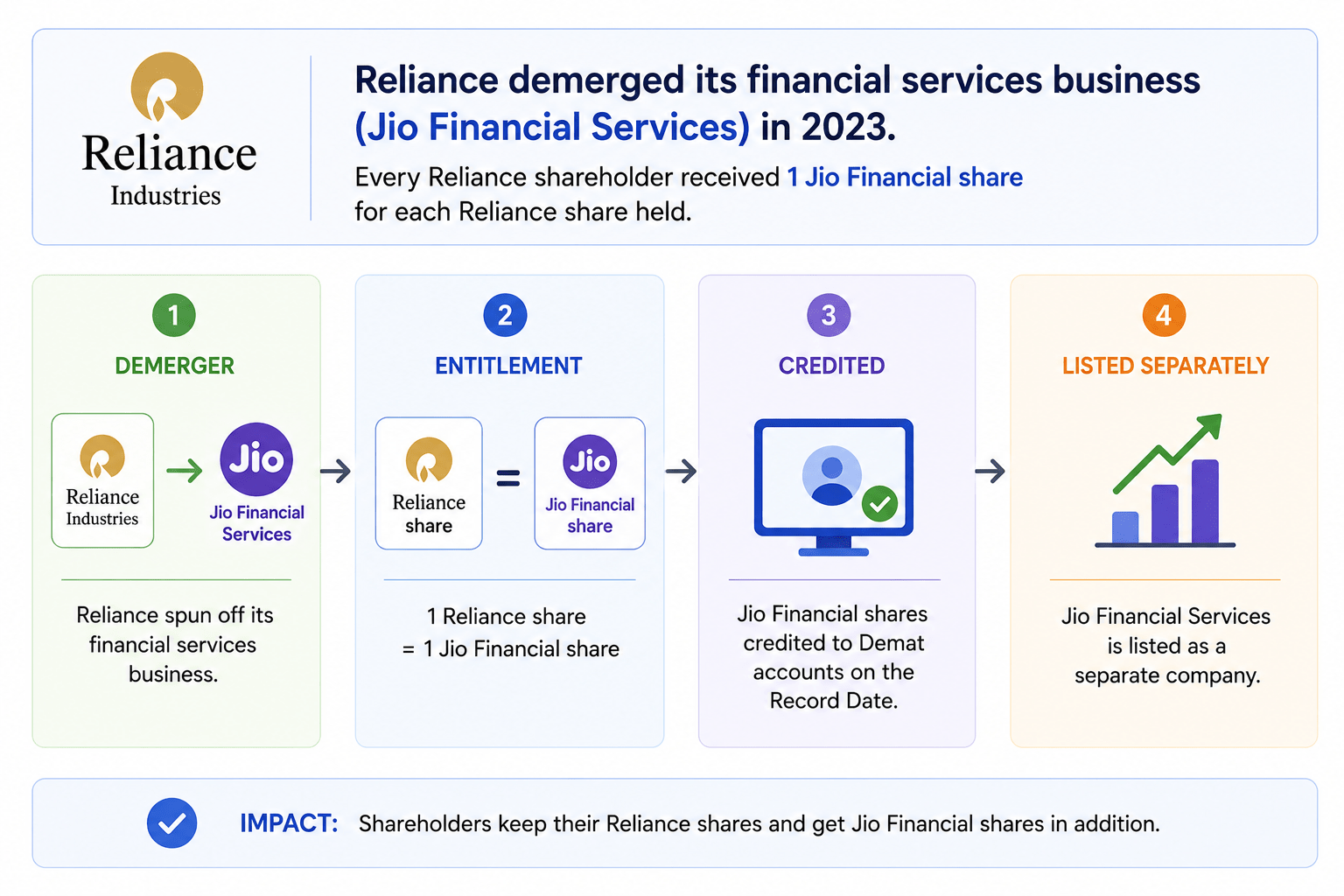
A demerger separates a company division into a new independent entity.
Shareholders receive shares of the new company in a fixed ratio.
The process is compulsory for eligible shareholders.
Demergers help businesses focus on core operations independently.
Role of the Depository in Mandatory Actions
Impact of Mandatory Actions on Share Price
Summary
5
These actions impact share prices.
4
Depositories credit benefits automatically.
3
Includes dividends, splits, and mergers.
2
Record and Ex-Date decide eligibility.
1
Mandatory actions apply automatically.
Quiz
Which corporate action gives existing shareholders the right to buy additional shares at a discounted price?
A. Bonus Issue
B. Rights Issue
C. Stock Split
D. Dividend
Quiz-Answer
Which corporate action gives existing shareholders the right to buy additional shares at a discounted price?
A. Bonus Issue
B. Rights Issue
C. Stock Split
D. Dividend
By Content ITV