Taking Turns
Christopher Makler
Stanford University Department of Economics
Econ 51: Lecture 10
Today's Agenda
Part 1: Discrete Strategies
Part 2: Continuous Strategies
Extensive Form Games
Backward Induction
Strategies in Extensive Form Games
Subgame Perfect Nash Equilibrium
Example: Entry Deterrence
Example: Ultimatum Game
Example: Stackelberg Duopoly
Big Ideas
Credibility: can you credibly threaten some retaliation, or promise
some reward, to get the other player to do something you want?
Finite vs. Infinite Time Horizon: Does the game end?
Subgames: games will have more than one move; we can break them
up and examine subgames which are like games-within-games.
Extensive Form
Nodes:
Branches:
Initial node: where the game begins
Decision nodes: where a player makes a choice; specifies player
Terminal nodes: where the game ends; specifies outcome
Individual actions taken by players; try to use unique names for the same action (e.g. "left") taken at different times in the game
Information sets:
Sets of decision nodes at which the decider and branches are the same, and the decider doesn't know for sure where they are.
A "tree" representation of a game.
Example: Gift-Giving
She chooses to give one of three gifts:
X, Y, or Z.
1
X
Y
Z
Player 1 makes the first move.
Initial node
Player 1's actions at her decision node
(and decision node)
Example: Gift-Giving
Twist: Gift X is unwrapped,
but Gifts Y and Z are wrapped.
(Player 1 knows what they are,
but player 2 does not.)
After each of player 1's moves,
player 2 has the move: she can either accept the gift or reject it.
2
Accept X
Reject X
2
1
X
Y
Z
We represent this by having an information set connecting
player 2's decision nodes
after player 1 chooses Y or Z.
2
2
Player 2's actions
Player 2's decision nodes
Information set
Accept Y
Reject Y
Accept Z
Reject Z
Also: player 2 cannot make her action contingent on Y or Z; her actions must be "accept wrapped" or "reject wrapped"
Accept Wrapped
Reject Wrapped
Accept Wrapped
Reject Wrapped
Example: Gift-Giving
After player 2 accepts or rejects the gift, the game ends (terminal nodes) and payoffs are realized.
1
0
1
0
2
0
2
0
3
0
–1
0
2
2
1
X
Y
Z
,
,
,
,
,
,
Accept X
Reject X
Accept Wrapped
Reject Wrapped
Accept Wrapped
Reject Wrapped
Terminal Nodes
Player 1's payoffs
Player 2's payoffs
In this game, both players get a payoff of
0 if any gift is rejected,
1 if gift X is accepted, and
2 if gift Y is accepted.
If gift Z is accepted, player 1 gets a payoff of 3, but player 2 gets a payoff of –1.
Strategies and Strategy Spaces
A strategy is a complete, contingent plan of action for a player in a game.
This means that every player
must specify what action to take
at every decision node in the game tree!
A strategy space is the set of all strategies available to a player.
Strategies & Strategy Spaces
Player 1 has a single decision:
which gift to give (X, Y, or Z).
1
0
1
0
2
0
2
0
3
0
–1
0
2
2
1
X
Y
Z
,
,
,
,
,
,
Accept X
Reject X
Accept Wrapped
Reject Wrapped
Accept Wrapped
Reject Wrapped
Player 2 might have to make one of two decisions: accept or reject gift X,
and accept or reject a wrapped gift.
Let's abbreviate these as A/R and A'/R'.
A
R
S_1 = \{X,Y,Z\}
S_2 = \{AA', AR', RA', RR'\}
A'
R'
A'
R'
Then player 2's strategy space is
Therefore player 1's strategy space is
Strategy Profiles
A strategy profile \(s = (s_1,s_2)\) is a vector showing which strategy from their strategy space is chosen by each player.
1
0
1
0
2
0
2
0
3
0
–1
0
2
2
1
X
Y
Z
,
,
,
,
,
,
A
R
S_1 = \{X,Y,Z\}
S_2 = \{AA', AR', RA', RR'\}
A'
R'
A'
R'
s_1 = Z
s_2 = AR'
The outcome of this is that gift Z is given and rejected, and both players receive a payoff of 0.
\text{Example: }s = (Z, AR')
Note: the strategy profile specifies which action is taken at every decision node!
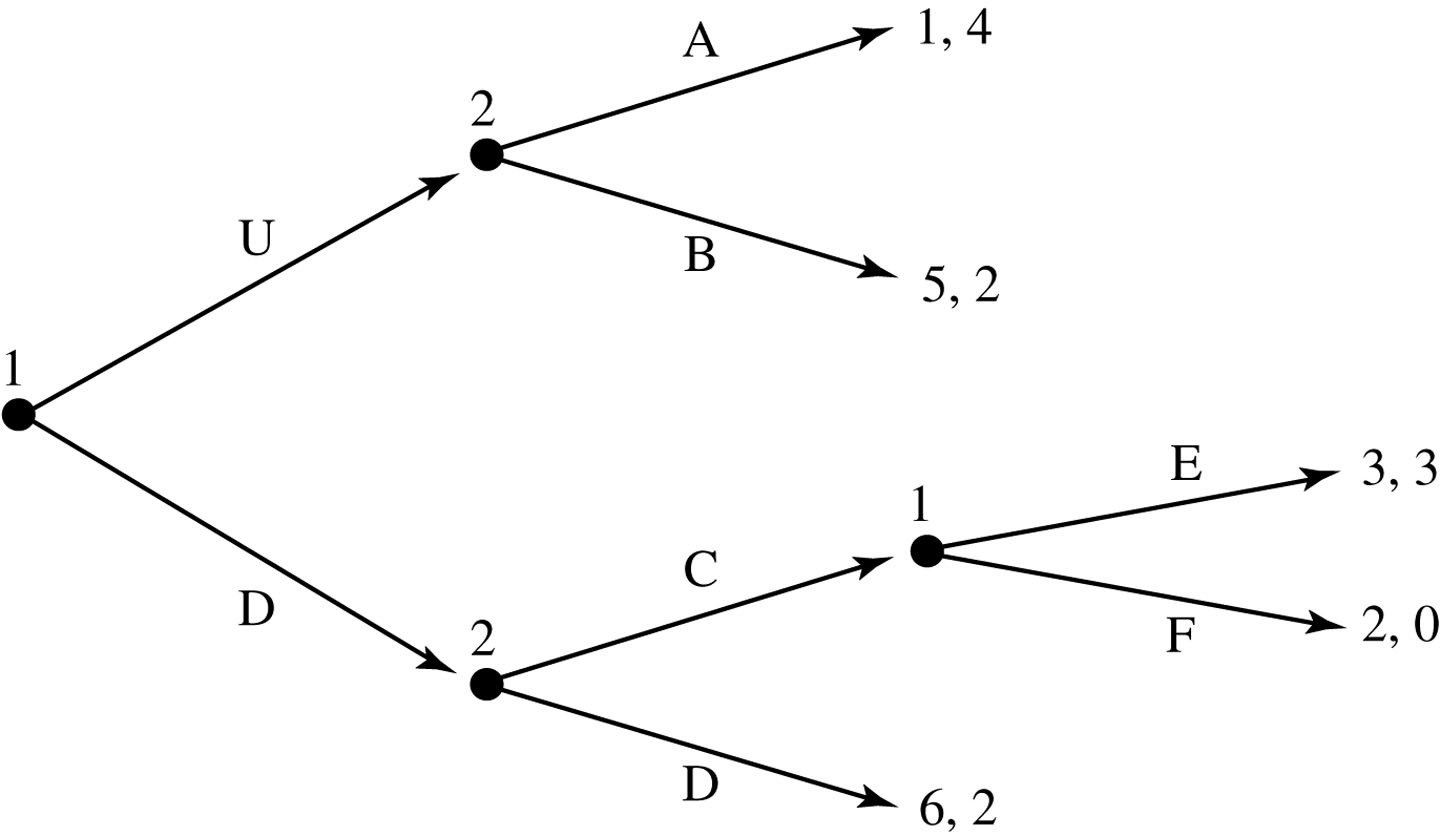
What is player 2's strategy space?
pollev.com/chrismakler

What is player 1's strategy space?
pollev.com/chrismakler
1
0
1
0
2
0
2
0
3
0
–1
0
2
2
1
X
Y
Z
,
,
,
,
,
,
A
R
S_1 = \{X,Y,Z\}
S_2 = \{AA', AR', RA', RR'\}
A'
R'
A'
R'
\(X\)
\(AA'\)
1
2
\(AR'\)
\(RA'\)
\(RR'\)
\(Y\)
\(Z\)
Normal Form Representation
1
0
1
0
2
0
2
0
3
0
–1
0
2
2
1
X
Y
Z
,
,
,
,
,
,
A
R
S_1 = \{X,Y,Z\}
S_2 = \{AA', AR', RA', RR'\}
A'
R'
A'
R'
\(X\)
\(AA'\)
1
2
\(AR'\)
\(RA'\)
\(RR'\)
\(Y\)
\(Z\)
0
0
,
Normal Form Representation
1
0
1
0
2
0
2
0
3
0
–1
0
2
2
1
X
Y
Z
,
,
,
,
,
,
A
R
S_1 = \{X,Y,Z\}
S_2 = \{AA', AR', RA', RR'\}
A'
R'
A'
R'
\(X\)
\(AA'\)
1
2
\(AR'\)
\(RA'\)
\(RR'\)
\(Y\)
\(Z\)
0
0
,
3
–1
,
Normal Form Representation
1
0
1
0
2
0
2
0
3
0
–1
0
2
2
1
X
Y
Z
,
,
,
,
,
,
A
R
S_1 = \{X,Y,Z\}
S_2 = \{AA', AR', RA', RR'\}
A'
R'
A'
R'
\(X\)
\(AA'\)
1
2
\(AR'\)
\(RA'\)
\(RR'\)
\(Y\)
\(Z\)
1
1
,
1
1
,
0
0
,
0
0
,
2
2
,
0
0
,
2
2
,
0
0
,
3
–1
,
0
0
,
3
–1
,
0
0
,
Normal Form Representation
Extensive-Form Representation
of a Simultaneous Game
If 1 and 2 choose at the same time, we can represent this in the same way as if
player 1 chooses first, and player 2 chooses second without observing player 1's choice.
Normal-Form vs. Extensive-Form Representations
The extensive-form representation
of a game specifies:
The normal-form representation
of a game specifies:
The strategies available to each player
The player's payoffs for each combination of strategies
The players in the game
When each player moves
The actions available to each player each time it's their move
The players in the game
The player's payoffs for each combination of actions
Backward Induction
Backward induction is a method of determining the outcome(s) of a game by starting at the end and working backwards.
Finite games: start from terminal nodes
Infinite games: a bit more complicated
Centipede Game
Player 1 chooses to Quit or Play
- If they quit, they get $200
and player 2 gets $0 - If they play, the game continues
Player 2 chooses to Quit or Play
- If they quit, they get $200
and player 2 gets $0 - If they play, the game continues
Player 1 chooses to Take or Share
- If they take, they get $500
and player 2 gets $100 - If they share, both get $300
Subgame-Perfect Nash Equilibrium
Definition: Subgame
A subgame consists of a decision node and all nodes reachable after that node, provided that none of the nodes in the subgame is connected to a node outside the subgame via an information set.
(basically, it's a separable game-within-a-game)
X
Y
A
B
3
2
1
0
2
0
1
3
C
D
1
2
2
Consider the following game.
Player 1 starts.
She chooses X or Y.
Player 2 observes player 1's choice.
If player 1 chose X, player 2 chooses A or B.
If player 1 chose Y, player 2 chooses C or D.
After player 2 makes his choice, the payoffs to each player are realized.
"Play X."
"Play Y."
What is player 1's strategy space?
What is player 2's strategy space?
"Play A after X, and C after Y."
"Play A after X, and D after Y."
"Play B after X, and C after Y."
"Play B after X, and D after Y."
X
Y
A
B
3
2
1
0
2
0
1
3
C
D
1
2
2
X
Y
X
Y
A
B
3
2
1
0
2
0
1
3
C
D
1
2
2
What is player 1's strategy space?
What is player 2's strategy space?
AC
AD
BC
BD
1
2
X
Y
X
Y
A
B
3
2
1
0
2
0
1
3
C
D
1
2
2
AC
AD
BC
BD
We can create the normal-form representation of this game.
3
2
1
0
2
0
1
3
3
2
1
3
2
1
0
0
1
2
X
Y
X
Y
A
B
3
2
1
0
2
0
1
3
C
D
1
2
2
AC
AD
BC
BD
We can create the normal-form representation of this game.
3
2
1
0
2
0
1
3
3
2
1
3
2
1
0
0
What are the Nash equilibria of this normal-form game?
Do any of the Nash equilibria not make sense?
1
2
X
Y
X
Y
A
B
3
2
1
0
2
0
1
3
C
D
1
2
2
AC
AD
BC
BD
3
2
1
0
2
0
1
3
3
2
1
3
2
1
0
0
Think about this: after player 1 makes her move, we are in one of two subgames.
What should player 2 do in each subgame?
1
2
X
Y
X
Y
A
B
3
2
1
0
2
0
1
3
C
D
1
2
2
AC
AD
BC
BD
Think about this: after player 1 makes her move, we are in one of two subgames.
3
2
1
0
2
0
1
3
3
2
1
3
2
1
0
0
What should player 2 do in each subgame?
Anticipating how player 2 will react, therefore, what will player 1 choose?
1
2
X
Y
X
Y
A
B
3
2
1
0
2
0
1
3
C
D
1
2
2
AC
AD
BC
BD
Think about the other Nash equilibrium.
3
2
1
0
2
0
1
3
3
2
1
3
2
1
0
0
This is better for player 2.
It's kind of like player 2 is threatening to play D if player 1 chooses Y.
But this threat is not credible.
Definition: Subgame Perfect Nash Equilibrium
In an extensive-form game of complete and perfect information,
a subgame in consists of a decision node and all subsequent nodes.
A Nash equilibrium is subgame perfect if the players' strategies
constitute a Nash equilibrium in every subgame.
(We call such an equilibrium a Subgame Perfect Nash Equilibrium, or SPNE.)
Informally: a SPNE doesn't involve any non-credible threats or promises.
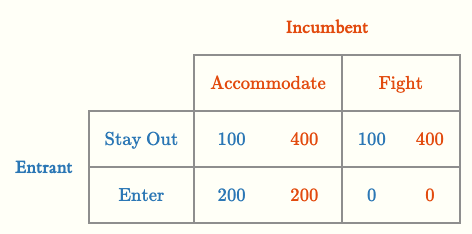
Application: Entry Deterrence
Continuous Strategies
How do we represent a continuous strategy in an extensive-form game?
(For example, the quantity chosen by a firm in a Cournot-like game?)
Quantity Duopoly
- Two firms ("duo" in duopoly)
- Each chooses how much to produce
- Market price depends on
the total amount produced - Each firm faces a residual demand curve
based on the other firm's choice
Players: Two firms, Firm 1 and Firm 2
Payoffs:
Market price is determined by total output produced
Profit to Firm 2:
\pi_2(q_1,q_2) = P(q_1,q_2)q_2 - c_2(q_2)
Profit to Firm 1:
\pi_1(q_1,q_2) = P(q_1,q_2)q_1 - c_1(q_1)
P(q_1,q_2) = 14 - (q_1 + q_2)
c_1(q_1) = 2q_1
c_2(q_2) = 2q_2
\text{Market Demand: }
\text{Firm 1's Costs: }
\text{Firm 2's Costs: }
New twist:
Firm 1 chooses \(q_1\) first;
Firm 2 observes \(q_1\) and chooses \(q_2\)
What are the strategy spaces?
Example: Stackelberg Duopoly
Stackelberg Model
- Firm 1 chooses how much to produce first \(q_1\),
at a cost of $2 per unit - Firm 2 observes firm 1's choice,
and then chooses how much to produce \(q_2\),
also at a cost of $2 per unit - The market price is determined by \(P(q_1,q_2) = 14 - (q_1+q_2)\)
- Profits are realized
- \(\pi_1(q_1,q_2) = (14 - [q_1 + q_2]) \times q_1 - 2q_1\)
- \(\pi_2(q_1,q_2) = (14 - [q_1 + q_2]) \times q_2 - 2q_2\)
What is firm 2's optimal strategy,
having observed \(q_1\)?
P(q_1,q_2) = 14 - (q_1+q_2)
c_2(q_2) = 2q_2
\pi_2(q_2) = P(q_1 + q_2)q_2 - c_2(q_2)
= (14 - q_1 - q_2)q_2 - 2q_2
= 14q_2 - q_1q_2 - q_2^2 - 2q_2
\pi'_2(q_2) = 14-q_1 - 2q_2 - 2 = 0
q_2^*(q_1) = 6-\frac{1}{2}q_1
\text{total revenue}
\text{total cost}
\text{marginal revenue}
\text{marginal cost}
2
P
P(q_2|q_1) = 14-q_1 - q_2
MR(Q) = 14-q_1 - 2q_2
MC(q_2) = 2
6-\frac{1}{2}q_1
14-q_1
q_2
"Firm 2's Residual Demand Curve"
This function is firm 2's strategy.
It specifies what firm 2 will do after every possible move of firm 1.
What is firm 1's best response to firm 2's strategy of \(q_2^*(q_1)\)?
P(q_1,q_2) = 14 - (q_1+q_2)
c_1(q_1) = 2q_1
q_2^*(q_1) = 6-\frac{1}{2}q_1
Firm 2's strategy:
\pi_1(q_1|q_2^*(q_1)) = P(q_1 + q_2^*(q_1))q_1 - c_1(q_1)
= (14 - q_1 - [6 - {1 \over 2}q_1])q_1 - 2q_1
= 14q_1 - q_1^2 - [6q_1 - {1 \over 2}q_1^2] - 2q_1
\pi'_1(q_1|q_2^*(q_1)) = 14 - 2q_1 - (6 - q_1) - 2 = 0
q_1^* = 6
Stackelberg Equilibrium
Firm 2's strategy: whatever \(q_1\) firm 1 produces, produce \(6 -{1 \over 2} q_1\) (or 0)
Firm 1's strategy: produce 6 units of output
Given what the other firm is doing, does either firm
have any incentive to change its strategy?
In equilibrium, firm 2 produces 3 units.
Why don't we just say that its strategy is "produce 3 units of output"?
Consider the following strategy for firm 2:
"You should produce the Cournot quantity of 4.
If you do, I'll also produce 4.
If you don't, I'll produce so much that the price is 2,
so we both sell at marginal cost and nobody makes a profit."
What is firm 1's best response to this strategy?
Summary & Next Steps
- Today we saw that some Nash Equilibria are not subgame perfect.
- Next time, we'll look at a special kind of dynamic game: repeated games.
- We'll show that playing a repeated game enables us to have outcomes
that are not Nash equilibria of the one-shot game - In particular, we'll show that we can sustain cooperation in
Prisoners' Dilemma type games if players have an ongoing relationship
(are playing an infinitely repeated game)
Econ 51 | 10 | Taking Turns
By Chris Makler
Econ 51 | 10 | Taking Turns
Sequential Games of Complete and Perfect Information