Doing history research
Workshop for HIST 30A
(Brown, Spring 2026)
Simon Elichko (they/he)
Social Sciences & Data Librarian
What we'll work on today:
- How to get the most out of research projects
- Navigating scholarly research
- Exploring digital collections for 19th & 20th century European history
Annotated Bibliography, 3/27
Craft an annotated bibliography of six monographs, journal articles, and chapters from edited volumes. At least two sources must be monographs. Each entry should concisely state the main argument, types of evidence provided, and contributions in relationship to the overall theme of the bibliography.
Please include a 250-word introduction to the bibliography that explains the thematic link or subject of the sources and how the bibliography as a whole could be of use to scholars (whether seasoned researchers or first-year undergrads).
Analytical Essay, 5/11
Proposed topic due 4/10
Produce a thesis-driven analytical essay about a theme or event relevant to our class’s subject matter. Essays must be focused on Modern European history, and unless advanced permission is granted, must be about Britain and/or France. You may use your annotated bibliography’s sources, as well as the syllabus’s assignments, for this essay. Other peer-reviewed, scholarly sources are also welcome. Papers should be 3,000-4,000 words and include Chicago-style footnotes and a bibliography. Plan to use at least seven sources. At least four must be sources not discussed in class.
What do you like about doing research projects?
What do you find challenging?
How to get the most out of research projects
Doing research vs.
directionless tab overload

Practices for actively building knowledge while you do research
- Create a synthesis matrix to track particular questions and claims across different articles
- Consider using Zotero, which lets you tag your sources, add notes to them, and format citations
(also: free storage with Swarthmore.edu email)
- Make a simple timeline to visualize key dates
Active Reading: Synthesis Matrix
| Article/ Source #1 | Article/ Source #2 | Article/ Source #3 | |
|---|---|---|---|
|
Question 1: |
|||
|
Question 2: |
|||
|
Theme 1: |
|||
|
Theme 2: |
For tips on how to skim scholarly sources, see Professor Burke's How to Read in College
Make a simple timeline to visualize key dates

To find out more about how the way you organize knowledge shapes your development of expertise, see chapter 2 in How Learning Works (Ambrose et al).
Navigating scholarly research
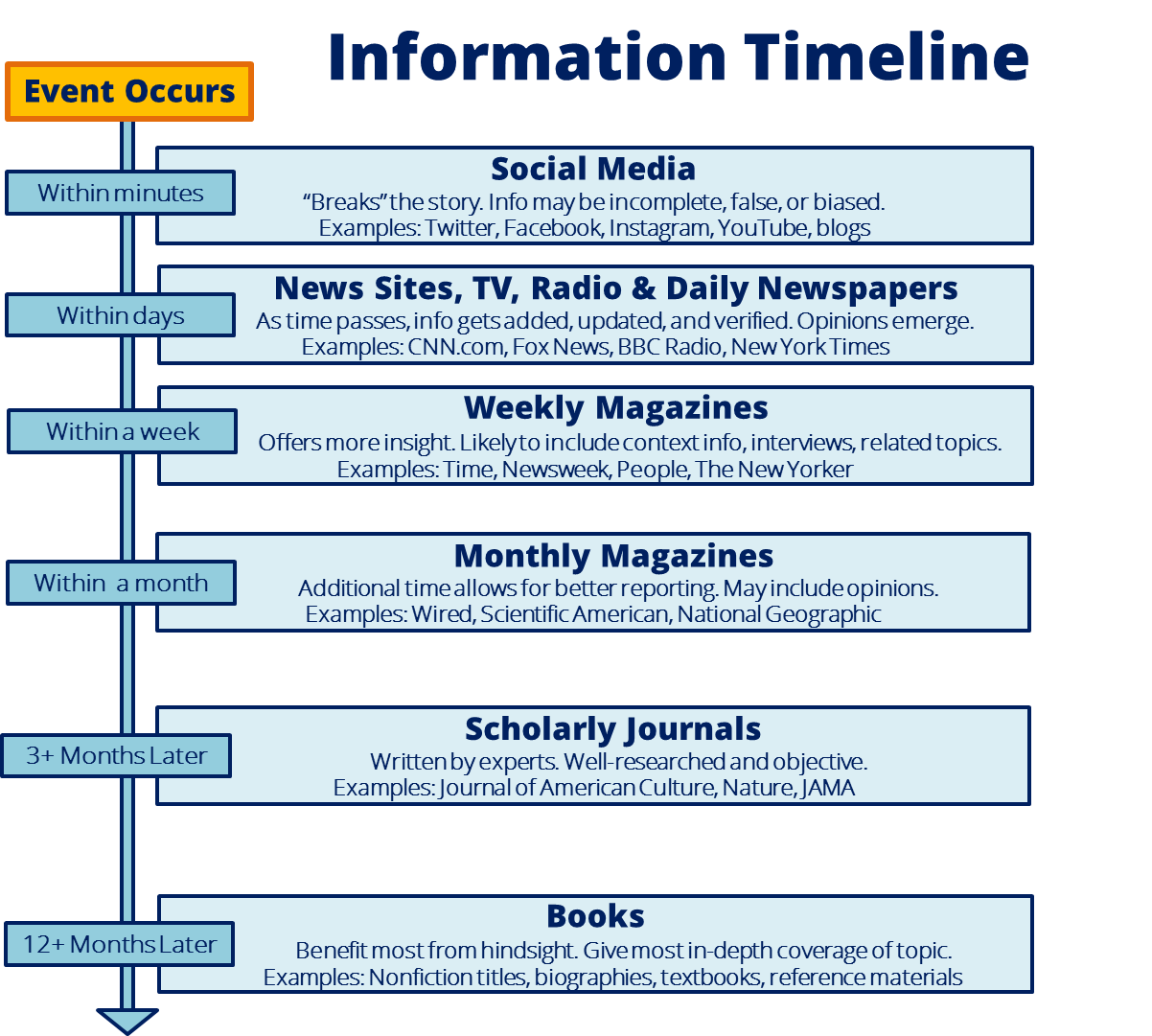
Understanding different types of sources
Information Timeline Graphic by adstarkel. Used under CC BY-NC-SA 2.0
Secondary Sources
Including chapters from edited collections, for example:
Bruce Dorsey, “Changing Representations of Scandalous Murders in the United
States,” in Violence and Visibility in Modern History, ed. Jürgen Martschukat and
Silvan Niedermeier (Palgrave Macmillan, 2013), 57-72.


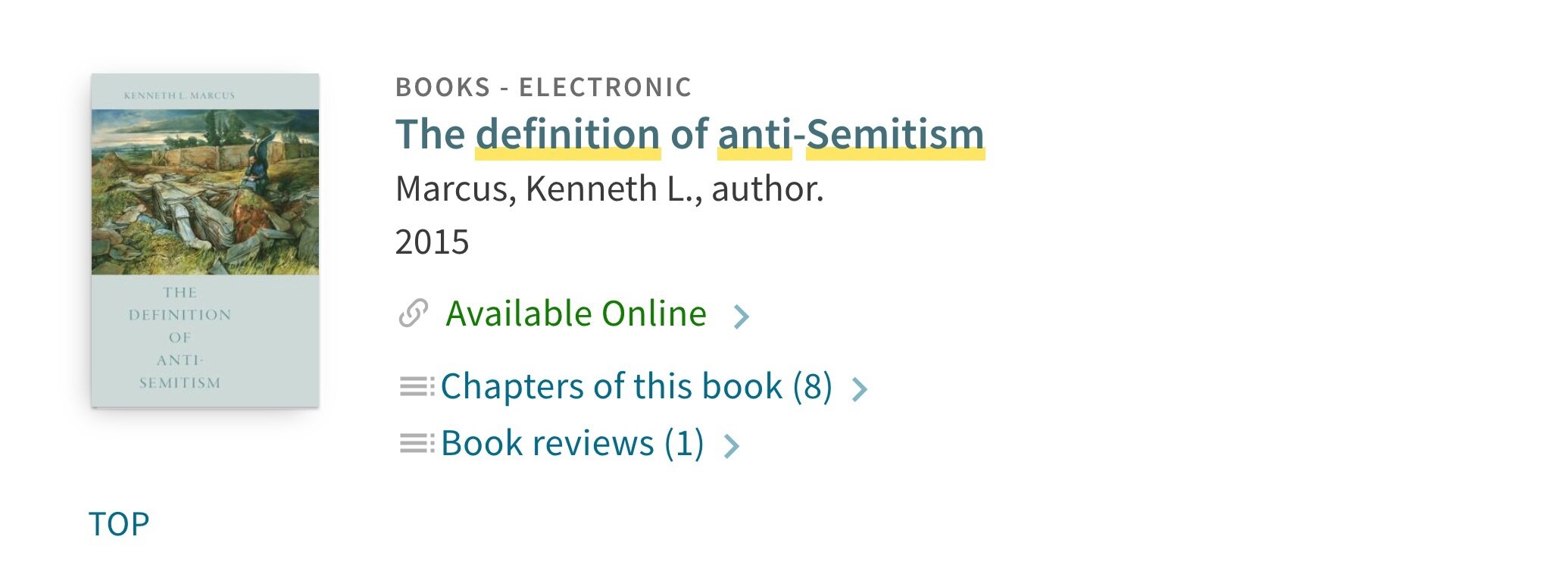
Books
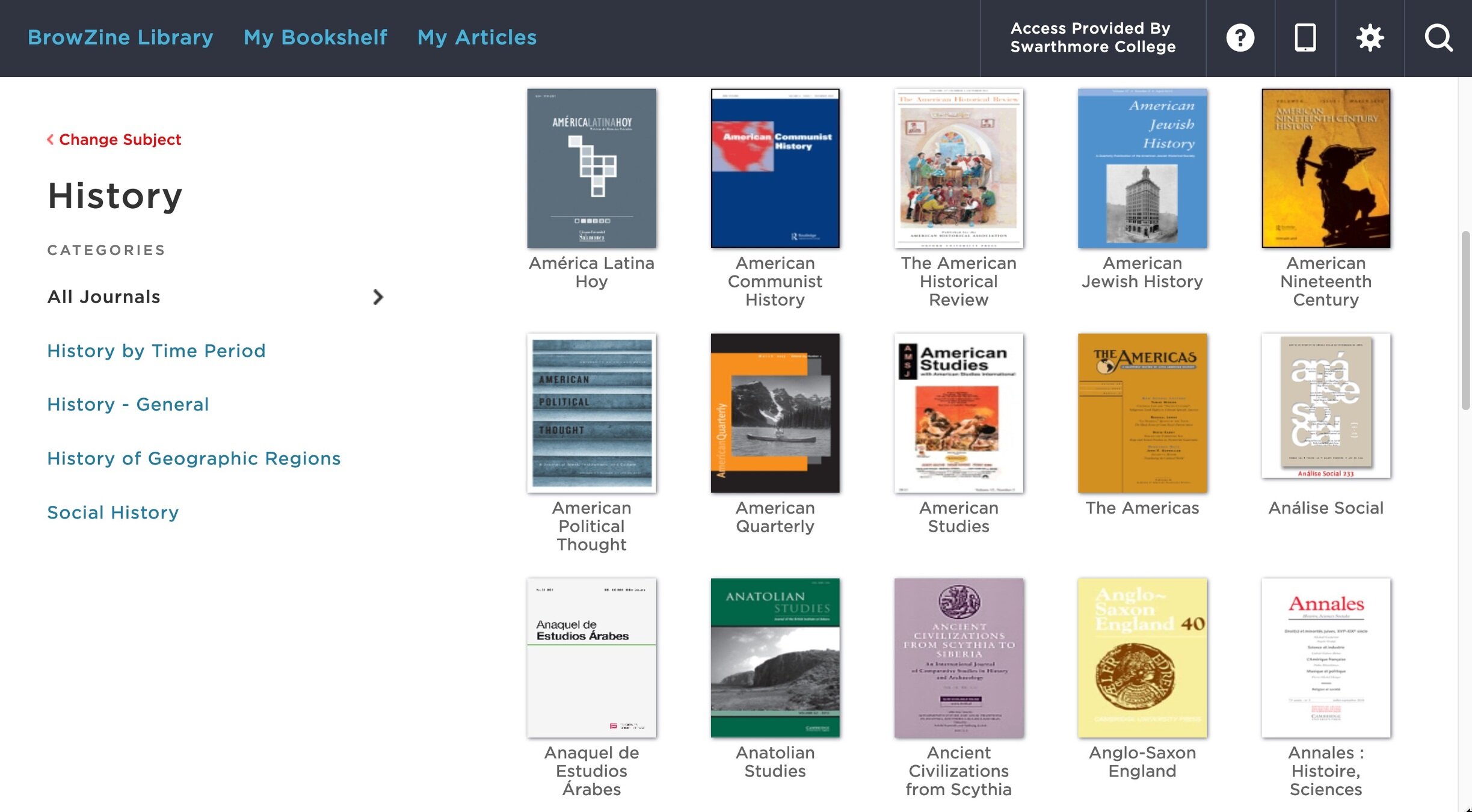
Secondary Sources: Journal Articles
Explore scholarly journals in Browzine and Tripod
Example articles:
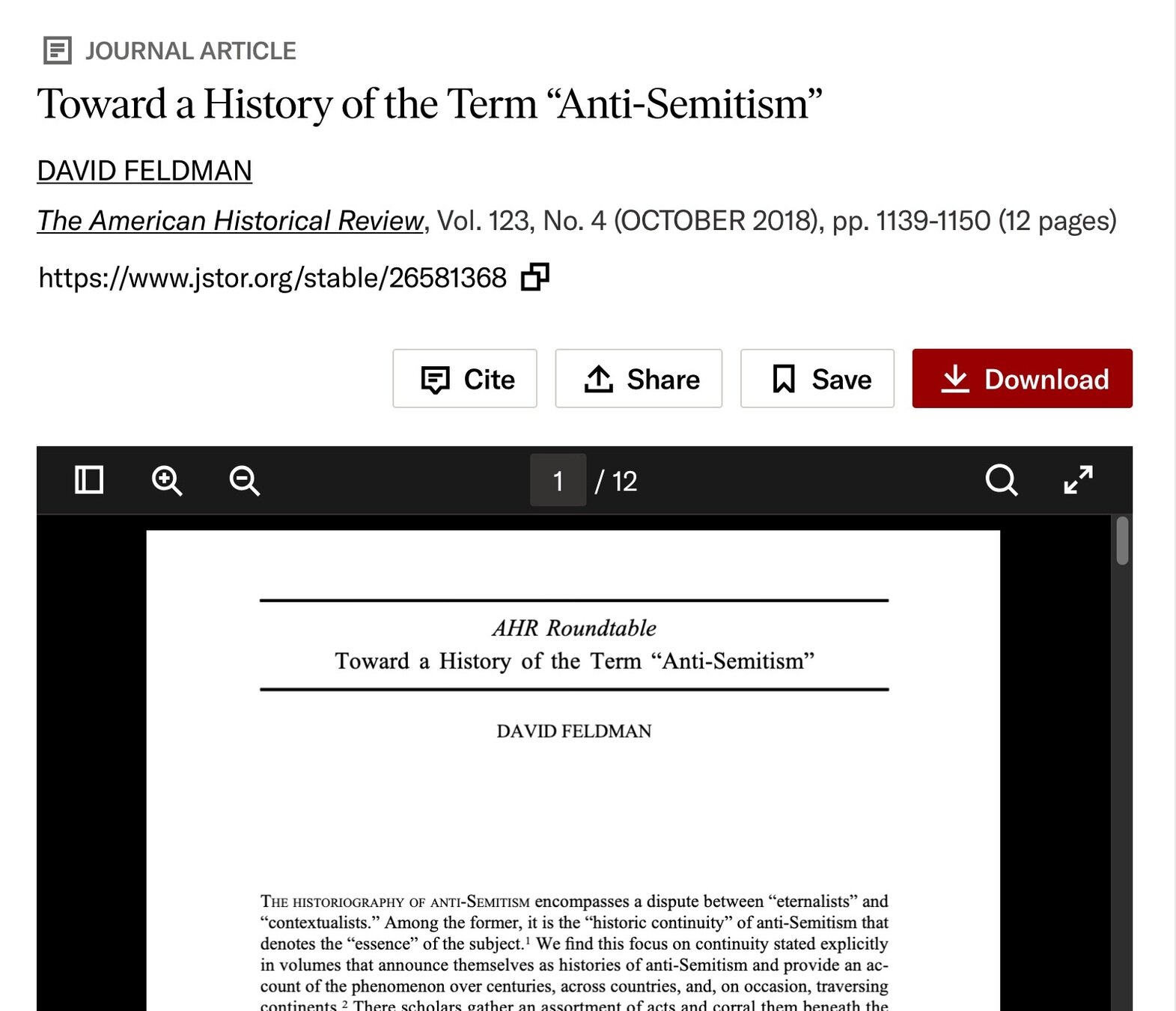
Feldman, David. “Toward a History of the Term ‘Anti-Semitism.’” The American Historical Review 123, Issue 4 (October 2018): 1139-1150.
Schüler-Springorum, Stefanie. “The Dark Side of Modernity? Rethinking Antisemitism and Sexuality.” Bulletin of the German Historical Institute 73 (Spring 2024): 99–122.
Monographs & other scholarly books
Secondary Sources:
Books & Book Chapters

Questions for identifying scholarly research
-
Who wrote it?
- Does the author have training in history? Another field?
- What kind of expertise do they have about the topic of the book?
-
Who published it?
- University presses such as Duke, Princeton, Oxford, Cambridge, Chicago, Penn, Rutgers, Wisconsin
- Non-university presses that often publish scholarly books include Routledge, Berghahn, Rowman and Littlefield, Springer/Palgrave
-
How does this source engage with other research?
- Do you see citations to other scholarship?
- Are there notes and/or references at the end of the book or article?
Choose one of these books
Borrowing & Reading Books

Links here if it's available online
You can borrow physical books from the TriCo libraries, usually for the semester.
If you login to Tripod, you'll see the option: Request Physical Copy.
- You'll pick it up from the library front desk
- Usually arrives in 1 day
- You can request Swat, Bryn Mawr, and Haverford books
How to borrow a Swarthmore book? Bring to the front desk or Request Physical Copy in Tripod.
TriCo
Login to Tripod to request delivery (arrives 1-2 days)
E-Z Borrow
Borrow from academic libraries in PA, NJ (arrives in ~1 week)
Borrow books, journals, microfilm, DVDs, etc. from all over the world. (arrives in 1-3 weeks)
Penn Drexel Temple NYU Rutgers
Swat Haverford Bryn Mawr
Oxford Columbia University of Amsterdam
Harvard Stanford Museum of Natural History
You can access materials from TriCo libraries and beyond
You can also request PDFs of articles & book chapters not owned in the TriCo.
crimin* OR violen* OR delinquen* OR scandal* OR devian*
Finding a book using Tripod Advanced Search
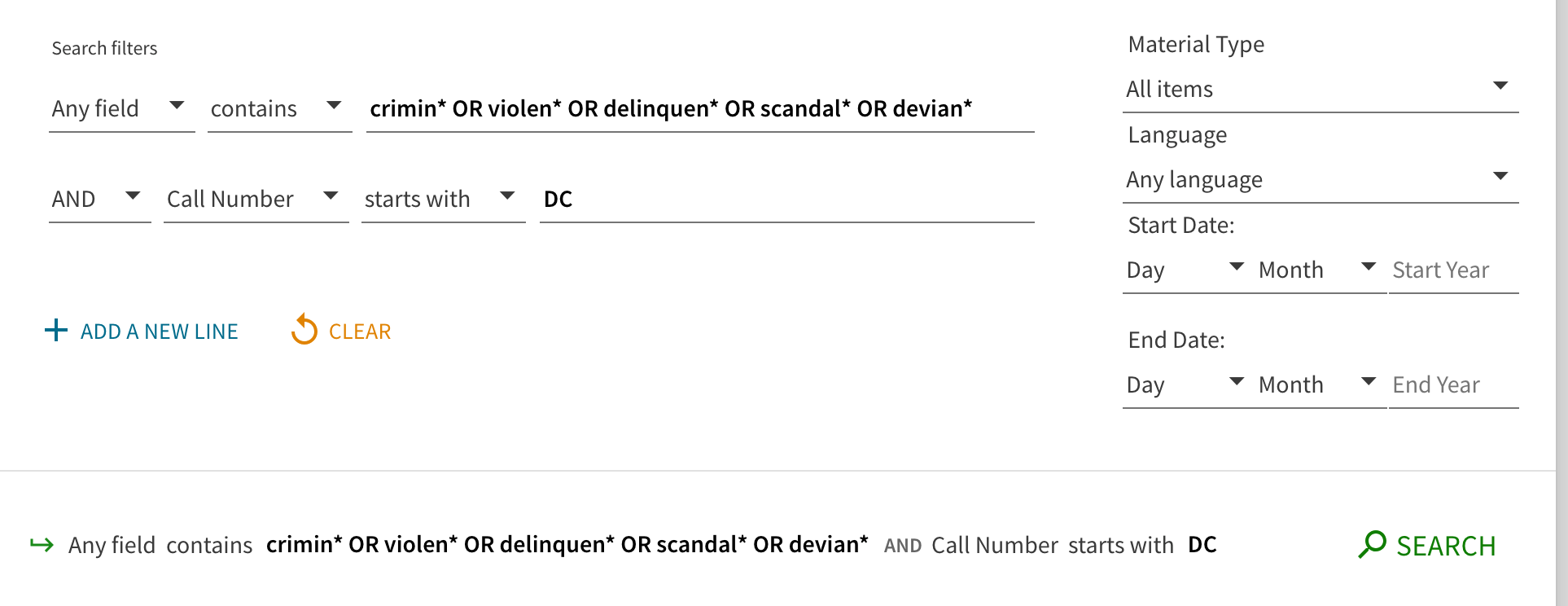
Call Number starts with DC
DA
← France
← Great Britain
Choose one book from the results. It needs to be available in McCabe Library.
Take a photo of the call number in the Tripod record.

source: McMaster University Library
Library Book Basics
Example call number:
HQ1163 .H55 2022
H: Social Sciences
| Call number starts with | Floor in McCabe |
|---|---|
| A-E | Lower Floor |
| F-K | 2nd Floor |
| L-Z | 3rd Floor |
Tutorial: How to find a book in McCabe
Let's go find our books on the shelf, then bring them back here.
Example call number:
HQ1163 .H55 2022
H: Social Sciences
2nd floor
| Call number starts with | Floor in McCabe |
|---|---|
| A-E | Lower Floor |
| F-K | 2nd Floor |
| L-Z | 3rd Floor |
How does your book fit into the rest of the literature?
| 1. Search for the book title in Tripod | Do you find any book reviews? | If so, which journal(s) are they published in? |
| 2. Search for the book title in JSTOR | What kinds of results do you get? | Is it helpful to filter these results? |
| 3. Search for the book title in Google Scholar | On the results page, look for "Cited By __" | How many books and articles cite this book, according to Google Scholar? |
Tip: Especially in JSTOR, it can help to put your book title (part or whole) inside quotation marks, e.g. "How Learning Works"
Making good use of Google Scholar
- ☑ Search within citing sources
- source:history OR source:historical
- source:"history compass"
- source:"cambridge history"
Keep in mind that inclusion in Google Scholar doesn't mean all that much


History Databases
Finding journal articles and book reviews
Useful databases for finding history research
Let you find articles by time period being discussed
Searching a Database:
Historical Abstracts
- Start from Tripod (tripod.swarthmore.edu) or swarthmore.edu/libraries.
- Follow the link to Database Finder.
- Look for Historical Abstracts. Click the yellow S to connect.
Searching a Database: Historical Abstracts
Reasonable search, but it
doesn't work very well:
14 results
Looking at the results, pay attention to the Subjects. These are used to tag articles by topic. Do you notice useful Subjects to search with?
hint: look at result #7
spain
Subject Terms - SU ▽
Subject Terms - SU ▽
strike OR labor
AND
Go to ▼All Filters and set Language to English
Searching a Database: Historical Abstracts
| Wildcard search: add * to end of word |
Quaker* | You'll find: Quaker, Quakers, Quakerism |
| Phrase search: "two words" enclosed in quotes |
"Society of Friends" | You'll find: "Also known as the Religious Society of Friends..." Won't find: "They became friends after meeting in the hall of a secret society on-campus" |
| OR search: put OR in between each word |
Quaker OR friend | You'll find articles including either the word "Quaker" or the word "friend" |
Database Search Tips
Key tip: use filters to refine your results
▼ All Filters : Language • Publication Date • Subjects
Advanced Search : Historical Period
Primary sources: exploring digital collections for 19th and 20th century European history
Primary & Secondary Sources
Your assignments in this class require you to find and engage with scholarly secondary sources.
- Newspaper archives including The Times (London), The Guardian and Observer, and Le Monde
- Search a wide range of sources, then go to specific sub-collections and documents:
A few digital collections for 19th & 20th century European history
Explore secondary sources on your own
- Choose a possible theme or topic
- Search for a relevant journal article or book using one of these resources:
- Historical Abstracts
- Tripod
- JSTOR
- Ask for help as you work - this is the best way to learn.
Background image credit: Paddington Station, Mason C (via Unsplash)
Timeline image credit: House of Austrian History, Kateryna Ivasiva
Research Help & Advice
- Make an appointment with Simon
- Or email them: selichk1@swarthmore.edu
- Quick questions, try the chat button in Tripod (librarians available M-F 1-4pm)
HIST 30A: Scandal
By Swarthmore Reference