Waldo in the Wilderness
Using terrain-based probabilistic search strategies
-
Introduction
-
A review of probabilistic reasoning
-
History of current land search strategy
-
Matt Jacobs' paper
-
Summary and recommendations
How to find people faster and more often
Waldo in the Wilderness: using terrain-based probabilistic search strategies
-
Introduction
-
A review of probabilistic reasoning
-
History of current land search strategy
-
Matt Jacobs' paper
-
Summary and recommendations
Introduction
Discussion of Matt Jacobs' paper
Terrain Based Probability Models for SAR (2015)
How did we get here? A brief history of current land search strategy
A review of "probabilistic thinking"
The paper, its findings, and the "spider web" strategy
Summary: new strategies using Matt's data and probabilistic considerations
Extra credit:
- Recommendations for operational periods
- Applications for tracking
Waldo in the Wilderness: using terrain-based probabilistic search strategies
-
Introduction
-
A review of probabilistic reasoning
-
History of current land search strategy
-
Matt Jacobs' paper
-
Summary and recommendations
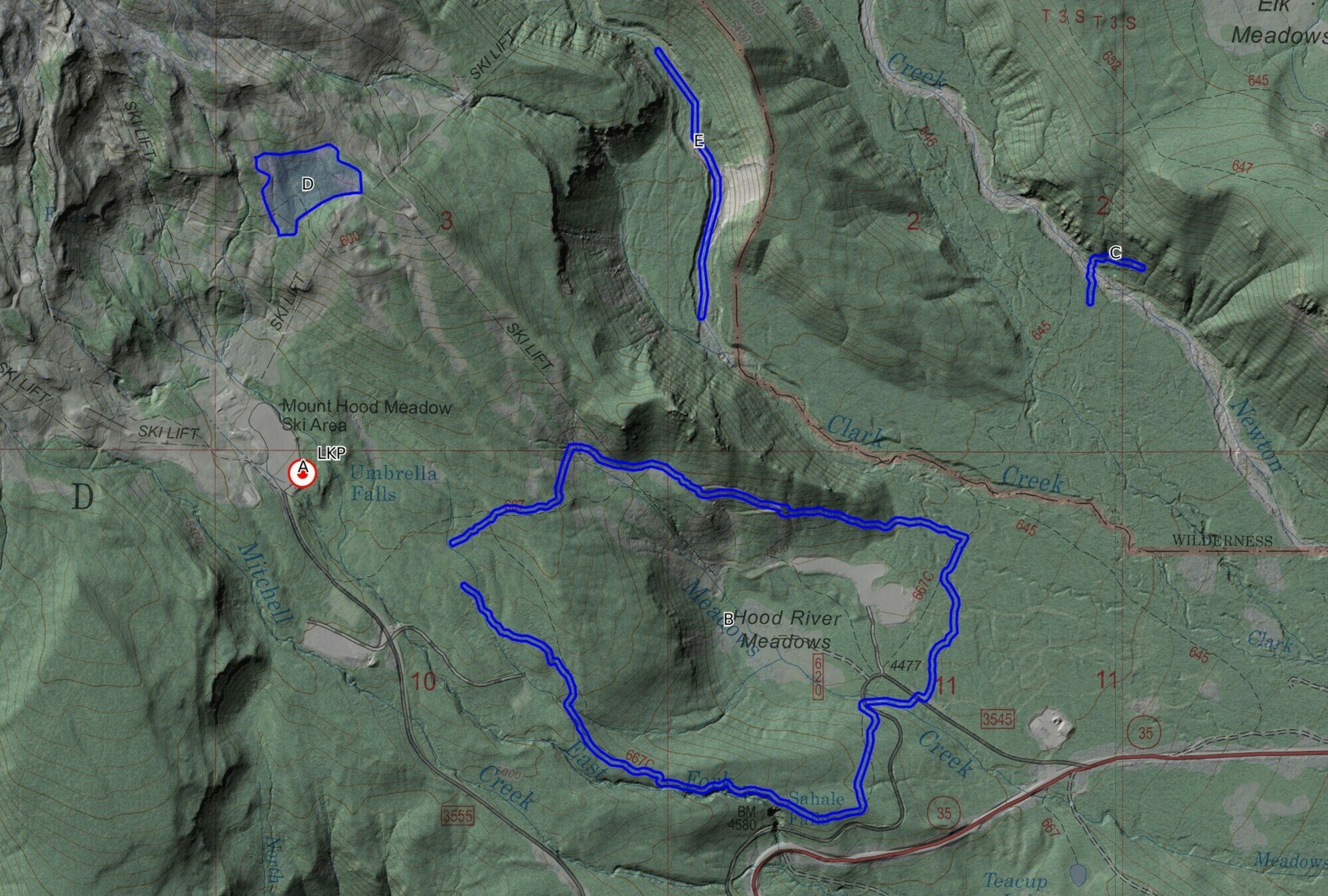
A Scenario
OP 4
A: LKP
B: Popular trail
C: Trail/creek junction
D: Heard "help"?
E: K9 scent alert
-
Introduction
-
A review of probabilistic reasoning
-
History of current land search strategy
-
Matt Jacobs' paper
-
Summary and recommendations
Introduction
About me, briefly
- SAR volunteer for a California team 2016 to 2021
- SAR Type 1, Hasty team, IC roles (esp. Plans section)
- CalOES Direction & Control, 2017
- FEMA NIMS ICS-300, "Managing the Expanding Incident", via CalFire, 2020
- NASAR MLPI, 2021
- Tracker, tracking instructor, tracking team leader
- Software developer, Linux sysadmin, etc.
- Math, science, data, and GIS geek
Waldo in the Wilderness: using terrain-based probabilistic search strategies
-
Introduction
-
A review of probabilistic reasoning
-
History of current land search strategy
-
Matt Jacobs' paper
-
Summary and recommendations
Introduction

Waldo in the Wilderness: using terrain-based probabilistic search strategies
-
Introduction
-
A review of probabilistic reasoning
-
History of current land search strategy
-
Matt Jacobs' paper
-
Summary and recommendations
A review of probabilistic reasoning
Where are my keys?
Common behavior:
- Check pockets, table by door, dresser, night stand, desk (common places)
- Check sofa, recliner, bathroom, laundry (less likely, but plausible places)
- Check refrigerator, cupboards, and microwave (why?)
- Check pockets again, table by door again, dresser again, night stand again, desk again
- Check sofa again, recliner again, bathroom again, laundry again
They haven't been found, they must be in one of these places, I just need to check them again, more carefully this time.
Waldo in the Wilderness: using terrain-based probabilistic search strategies
-
Introduction
-
A review of probabilistic reasoning
-
History of current land search strategy
-
Matt Jacobs' paper
-
Summary and recommendations
A review of probabilistic reasoning
Where are my keys?
They're in the car.
Outside your search area.
Waldo in the Wilderness: using terrain-based probabilistic search strategies
-
Introduction
-
A review of probabilistic reasoning
-
History of current land search strategy
-
Matt Jacobs' paper
-
Summary and recommendations
A review of probabilistic reasoning
Let's call this Proximity Bias: intense search activity where we expect to find what we're looking for.
- Maybe a special case of the Base Rate Bias ?
Bias: "...any deviation from correct reasoning about probabilities or Bayesian updating..."
Handbook of Behavioral Economics, Daniel J. Benjamin
Waldo in the Wilderness: using terrain-based probabilistic search strategies
-
Introduction
-
A review of probabilistic reasoning
-
History of current land search strategy
-
Matt Jacobs' paper
-
Summary and recommendations
A review of probabilistic reasoning
Gather
evidence
Evaluate
Guess
Test
Scientific method!
Probabilistic reasoning uses data from past efforts to make more accurate predictions
Waldo in the Wilderness: using terrain-based probabilistic search strategies
-
Introduction
-
A review of probabilistic reasoning
-
History of current land search strategy
-
Matt Jacobs' paper
-
Summary and recommendations
A review of probabilistic reasoning
People intuitively understand these ideas
- but, there are lots of possible biases and errors in reasoning ("bugs" in our "human software")
- and doing this properly requires a lot of work
- collecting data
- analyzing the data
- making predictions based on the data
So it is hard to follow in practice.
Be suspicious of hunches, past experience, "must be here", and misleading evidence.
Waldo in the Wilderness: using terrain-based probabilistic search strategies
-
Introduction
-
A review of probabilistic reasoning
-
History of current land search strategy
-
Matt Jacobs' paper
-
Summary and recommendations
A review of probabilistic reasoning
Probabilistic reasoning is used a lot in search and rescue:
- Probability-of-Detection (POD)
- Probability-of-Area (POA)
- Mattson consensus method
But
There's a lot of pseudo-science and sparse data here.
Matt Jacobs' paper suggests some new methods:
- a little more data
- and a better analysis of that data
Waldo in the Wilderness: using terrain-based probabilistic search strategies
-
Introduction
-
A review of probabilistic reasoning
-
History of current land search strategy
-
Matt Jacobs' paper
-
Summary and recommendations
How did we get here?
A quick history of current land search strategy
Waldo in the Wilderness: using terrain-based probabilistic search strategies
-
Introduction
-
A review of probabilistic reasoning
-
History of current land search strategy
-
Matt Jacobs' paper
-
Summary and recommendations
History of land search strategy
- Probably influenced by maritime search strategies in the 1960s or 1970s, Managing the Search Function
- Establishing Search Priorities by Robert Mattson 1976 - 1979
- Analysis of Lost Person Behavior, Syrotuck et al, 1976
- Lost Person Behavior, Robert J. Koester, 2008
- ISRID
- Local variations
- ...?
Waldo in the Wilderness: using terrain-based probabilistic search strategies
-
Introduction
-
A review of probabilistic reasoning
-
History of current land search strategy
-
Matt Jacobs' paper
-
Summary and recommendations
History of land search strategy
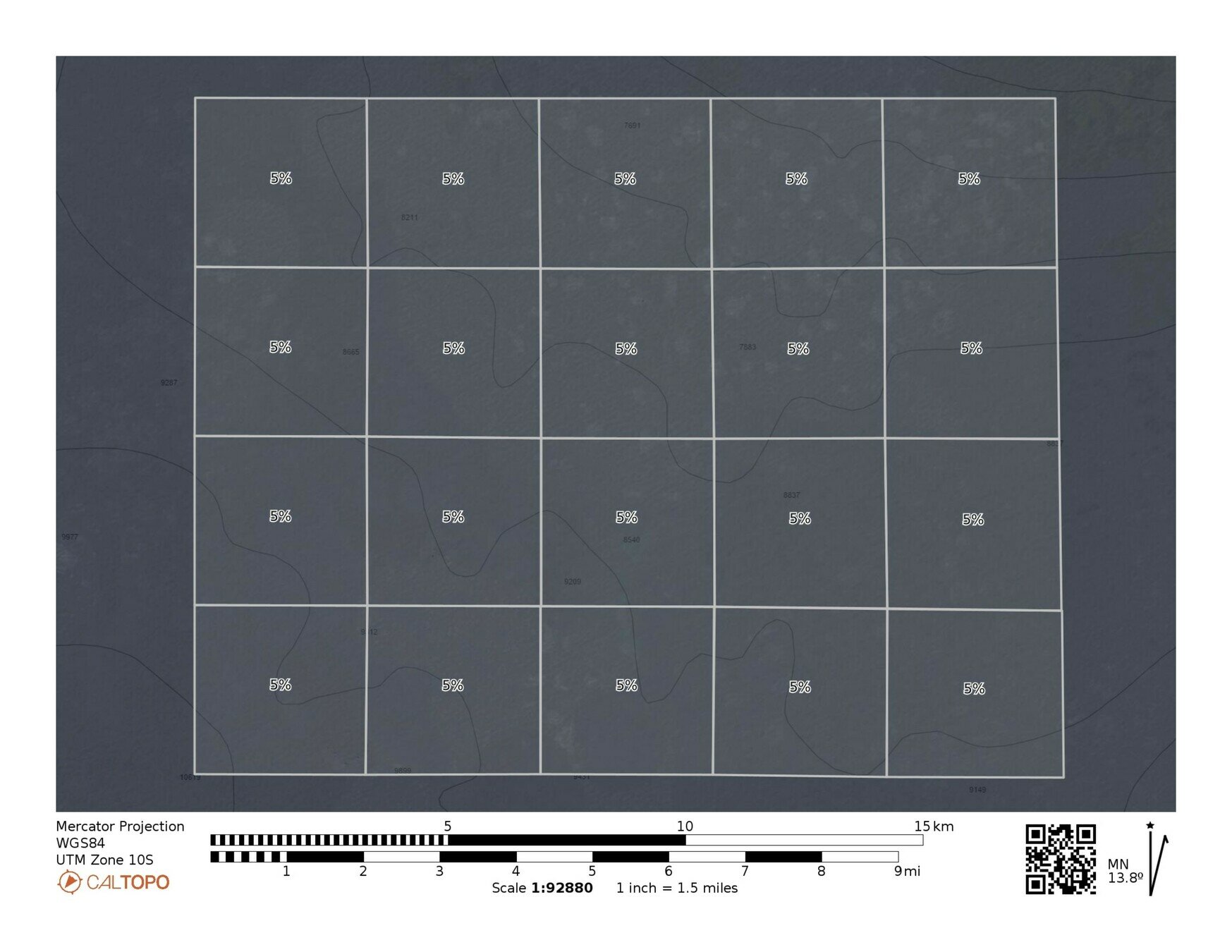
This is a smooth or continuous uniform
probability distribution.
Each segment in this area of the ocean has an equal probability of detection and any point in this area is as likely as any other point.
Waldo in the Wilderness: using terrain-based probabilistic search strategies
-
Introduction
-
A review of probabilistic reasoning
-
History of current land search strategy
-
Matt Jacobs' paper
-
Summary and recommendations
History of land search strategy
Marine search has changed a lot in the last 50 years:
- Advanced modeling software
- Lots of data on currents and flows
- Experimentation
- Funding
- And new tactics
Waldo in the Wilderness: using terrain-based probabilistic search strategies
-
Introduction
-
A review of probabilistic reasoning
-
History of current land search strategy
-
Matt Jacobs' paper
-
Summary and recommendations
History of land search strategy
Waldo in the Wilderness: using terrain-based probabilistic search strategies
-
Introduction
-
A review of probabilistic reasoning
-
History of current land search strategy
-
Matt Jacobs' paper
-
Summary and recommendations
History of land search strategy
Advancements in land SAR search strategy:
- Lost Person Behavior
- Range rings still have a smooth probability distribution within each range ring (equal POA at same distance from PLS/LKP in any direction mostly regardless of terrain)
- Lost Person Behavior includes notes emphasizing terrain features for some subject categories
- ...but area / grid searches are still the common approach
- 95% range ring is often treated as ROW because it's very big
Waldo in the Wilderness: using terrain-based probabilistic search strategies
-
Introduction
-
A review of probabilistic reasoning
-
History of current land search strategy
-
Matt Jacobs' paper
-
Summary and recommendations
History of land search strategy
Scenario:
- Missing trail jogger, mid-30s, avid hiker
- Got bad directions to a trailhead and is on the wrong trail
- Last seen 0700, reported missing 12 hours later, vehicle located LS+26h, OP 1 begins LS+28h
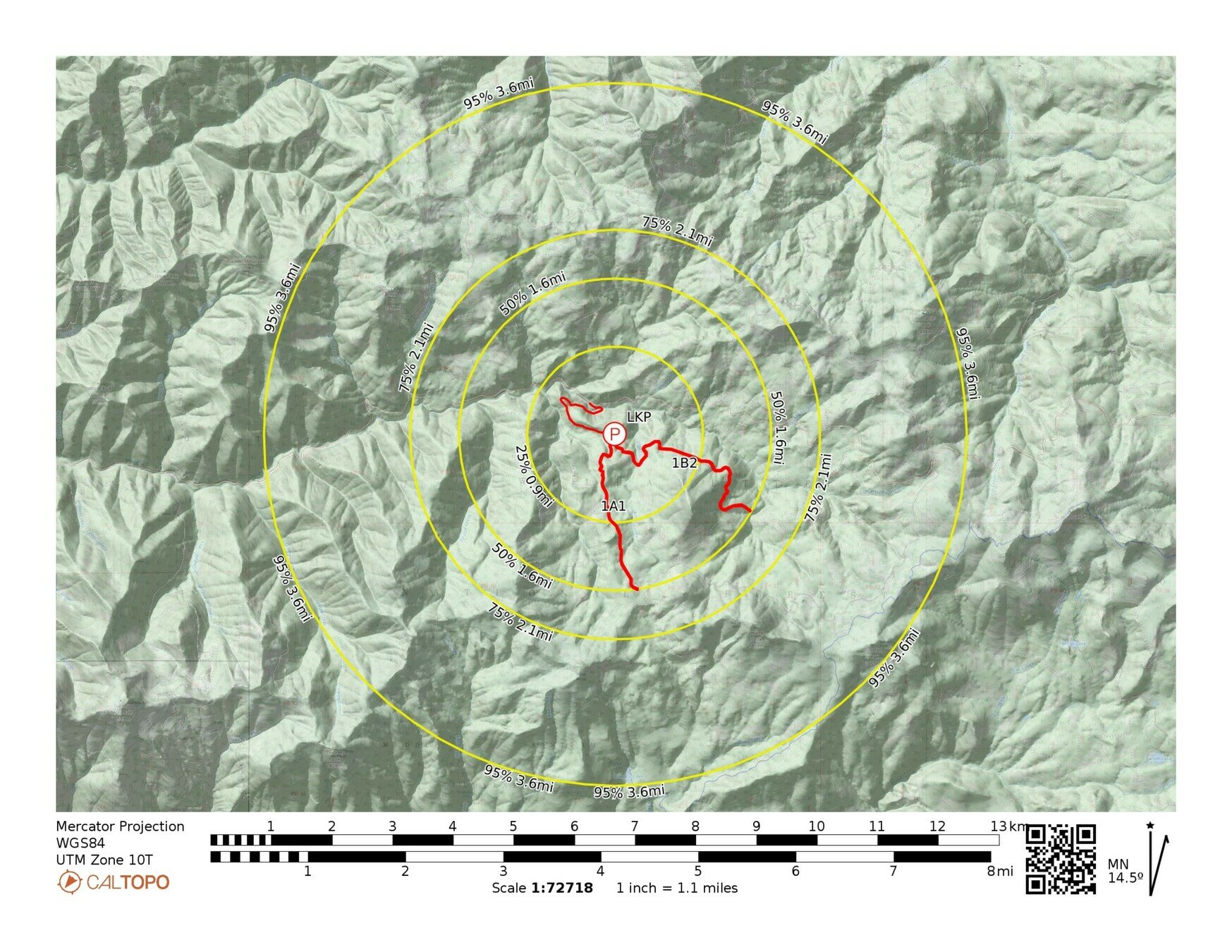
- LPB 95% distance from IPP is 3.6 crow miles
- That means 40 square miles of rugged, difficult, mixed terrain
- Assuming 60-acre assignments, that's ~425 area assignments
- ...or a minimum of 7,650 human hours of search time (not including overhead, transpo, IWI...)
- Any volunteers?
Waldo in the Wilderness: using terrain-based probabilistic search strategies
-
Introduction
-
A review of probabilistic reasoning
-
History of current land search strategy
-
Matt Jacobs' paper
-
Summary and recommendations
History of land search strategy
Waldo in the Wilderness: using terrain-based probabilistic search strategies
-
Introduction
-
A review of probabilistic reasoning
-
History of current land search strategy
-
Matt Jacobs' paper
-
Summary and recommendations
History of land search strategy
Oh, by the way: N = 30 for "Runner" category in LPB
Waldo in the Wilderness: using terrain-based probabilistic search strategies
-
Introduction
-
A review of probabilistic reasoning
-
History of current land search strategy
-
Matt Jacobs' paper
-
Summary and recommendations
History of land search strategy
Is there another way?
Waldo in the Wilderness: using terrain-based probabilistic search strategies
-
Introduction
-
A review of probabilistic reasoning
-
History of current land search strategy
-
Matt Jacobs' paper
-
Summary and recommendations
Terrain-based probability models
Examined 1,455 find locations:
- Independent of LKP/PLS/IPP (just the subject's location when found)
- Focused on hunters, hikers, and gatherers (larger sample sizes)
- 75% were in Oregon, remainder were in New York and Arizona
- Compared locations of finds to the distance to the nearest linear feature
- Efforts were made to apply statistical methods to reduce factors of random chance
- 622 incidents of subjects on foot were examined in closer detail
-
Caution: Some categories had a low number of samples
- Further research with more data is required
- But this is a useful analytical update
Waldo in the Wilderness: using terrain-based probabilistic search strategies
-
Introduction
-
A review of probabilistic reasoning
-
History of current land search strategy
-
Matt Jacobs' paper
-
Summary and recommendations
Terrain-based probability models
Findings:
- Uninjured subjects are significantly more likely to be found on or very near a road than injured ones
- Injured and uninjured persons are approximately equally likely to be found on or near a trail
- They are both 12 times more likely to be found within a few meters of a trail
- Find probability decreases as you move farther away from the trail
- Uninjured subjects are 2.5 times more likely to be found near a stream
- Injured subjects are 5 times more likely
- Locations within 80 meters of the intersection of a trail and a stream are much more probable
- Lower elevations are statistically more likely for injured subjects especially
- High points and low points are more likely for all subjects
- LPB track offsets may not be useful due to data collection methods
- 60% to 80% of subjects were found on or near selected linear features
- but those features comprise 45% of the search area
Waldo in the Wilderness: using terrain-based probabilistic search strategies
-
Introduction
-
A review of probabilistic reasoning
-
History of current land search strategy
-
Matt Jacobs' paper
-
Summary and recommendations
Terrain-based probability models
Terrain is not a smooth (uniform) probability distribution
Waldo in the Wilderness: using terrain-based probabilistic search strategies
-
Introduction
-
A review of probabilistic reasoning
-
History of current land search strategy
-
Matt Jacobs' paper
-
Summary and recommendations
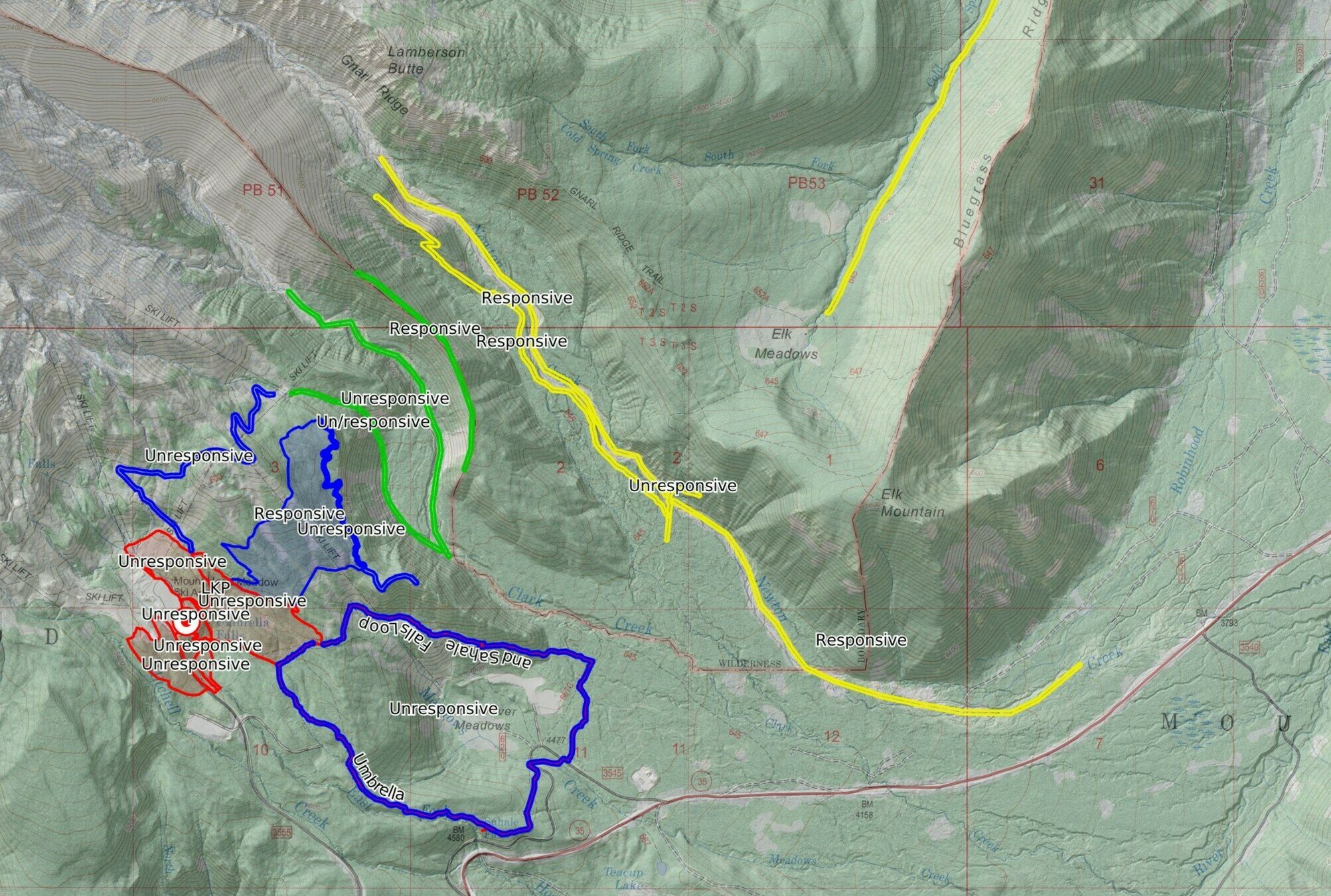
Summary and Recommendations
Jacobs' "Spider Web"
Waldo in the Wilderness: using terrain-based probabilistic search strategies
Core
- Area searches for an unresponsive subject
Inner Web
- Area searches for a responsive subject
- Linear features and high terrain for an unresponsive subject
Outer Web
- Natural linear features and high terrain for a responsive subject
- Low terrain for an unresponsive subject
Stringers
- Roads, trails, and low terrain for a responsive subject
- Stream / trail intersections for an unresponsive subject
-
Introduction
-
A review of probabilistic reasoning
-
History of current land search strategy
-
Matt Jacobs' paper
-
Summary and recommendations
Summary and Recommendations
Jacobs' "Spider Web"
Waldo in the Wilderness: using terrain-based probabilistic search strategies
-
Introduction
-
A review of probabilistic reasoning
-
History of current land search strategy
-
Matt Jacobs' paper
-
Summary and recommendations
Summary and Recommendations
Other Considerations:
- Time missing
- Operational Period (and volume of search activity)
- Assume previously-searched areas are lower probability
- Frequency of visitor activity to nearby features
- Probability Inversion: over time, less likely solutions become more likely
Waldo in the Wilderness: using terrain-based probabilistic search strategies
-
Introduction
-
A review of probabilistic reasoning
-
History of current land search strategy
-
Matt Jacobs' paper
-
Summary and recommendations
Summary and Recommendations
For trackers:
-
OP 1
- Focus on PLS/LKP
- nearby track traps
- cut roads and trails within day's search area
-
OP 2
- Re-assess PLS/LKP
- cut roads, trails, and water features outside previous day's search area
-
OP 3+
- Focus efforts on examining as many track traps as possible outside of areas of previous search efforts
- especially any intersections of trails and water features
- Focus efforts on examining as many track traps as possible outside of areas of previous search efforts
Waldo in the Wilderness: using terrain-based probabilistic search strategies
-
Introduction
-
A review of probabilistic reasoning
-
History of current land search strategy
-
Matt Jacobs' paper
-
Summary and recommendations
References and reading material
Errors in probabilistic reasoning and judgment biases, ScienceDirect.
https://www.sciencedirect.com/science/article/abs/pii/S2352239918300228
Base Rate Fallacy Overview & Examples
https://statisticsbyjim.com/probability/base-rate-fallacy/
Mattson
http://www.sarmath.com/consensus-category/mattson
The Pseudoscience of Land Search Probability Theories, Hugh Dougher
http://www.saraz.org/documents/ThePseudoscienceofLandSearchTheoriesv06-12r.pdf
(http://www.saraz.org/SARAZNew/documents.html is worth a visit)
Why This Zig-Zag Coast Guard Search Pattern is Actually Genius, Destin Sandlin
https://www.youtube.com/watch?v=aoXJfuPaFF8
Terrain Based Probability Models for SAR, Matt Jacobs, 2015
https://mra.org/wp-content/uploads/2016/05/TerrainProbabilityModelsReport.pdf
Video: MRA Webinar Series: Terrain Based Probability in SAR
https://www.youtube.com/watch?v=SXx8Xae_2hs&list=PLqoc5NvB_Xu7TnCahOu1N9q4sDe9EggiN
Waldo in the Wilderness: using terrain-based probabilistic search strategies
Jacobs' Web
By robsheldon