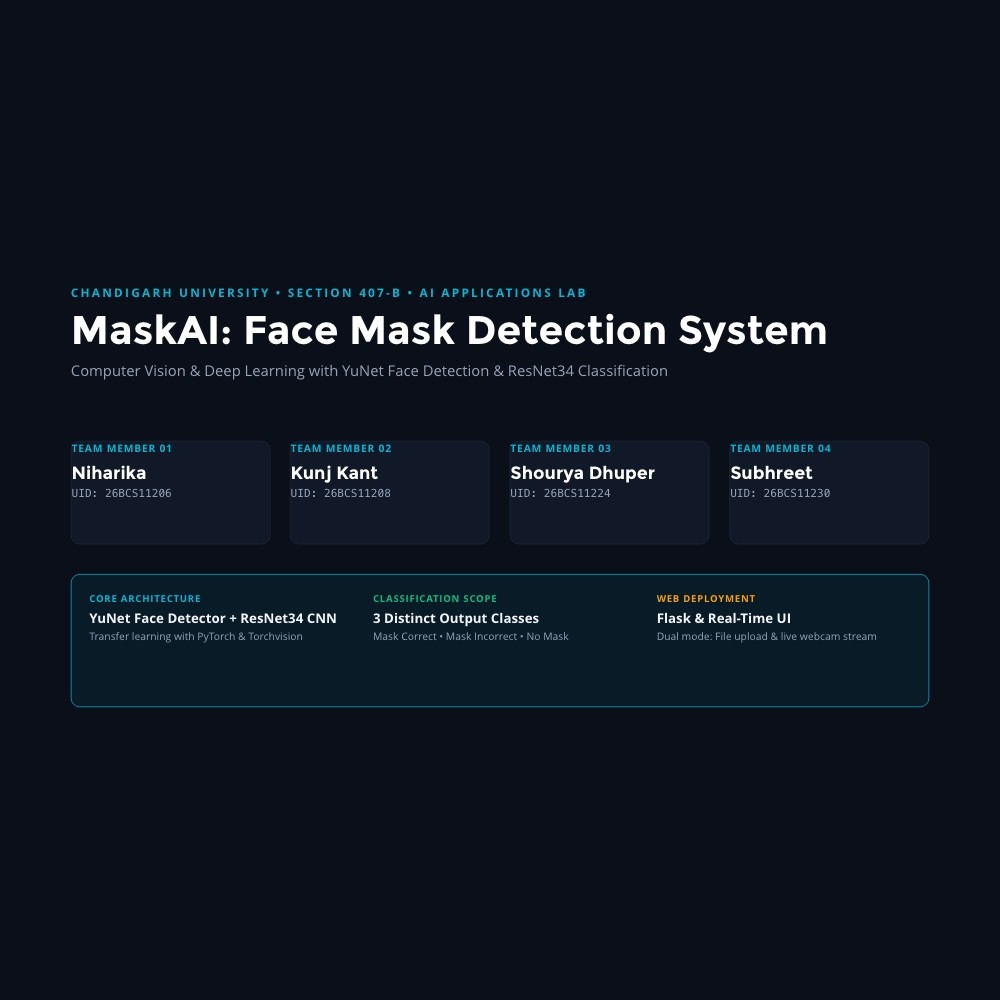
Chandigarh University • Section 407-B • AI Applications Lab
MaskAI: Face Mask Detection System
Computer Vision & Deep Learning with YuNet Face Detection & ResNet34 Classification
Team Member 01
Niharika
UID: 26BCS11206
Team Member 02
Kunj Kant
UID: 26BCS11208
Team Member 03
Shourya Dhuper
UID: 26BCS11224
Team Member 04
Subhreet
UID: 26BCS11230
Core Architecture
YuNet Face Detector + ResNet34 CNN
Transfer learning with PyTorch & Torchvision
Classification Scope
3 Distinct Output Classes
Mask Correct • Mask Incorrect • No Mask
Web Deployment
Flask & Real-Time UI
Dual mode: File upload & live webcam stream
02 • Executive Summary
Project Motivation & Background
The Challenge
Why Automated Mask Monitoring?
Post-pandemic safety, healthcare protocols, and industrial cleanrooms mandate compliant facial coverings. Manual inspections are error-prone, labor-intensive, and non-scalable in crowded public domains.
Critical Nuance:
A binary (Mask / No-Mask) model fails when a mask is worn below the nose or chin. MaskAI enforces strict 3-tier classification.
The MaskAI Solution
Integrated Deep Learning Vision
MaskAI combines lightweight face localization (YuNet) with a deep feature extraction backbone (ResNet34) wrapped in a Flask web application.
Modular Pipeline
Decoupled detection and classification ensures high throughput and adaptability.
Multi-Face Processing
Simultaneous bounding box cropping and batch classification per frame.
03 • Classification Scope
Problem Formulation: 3-Class Categorization
01
Mask Worn Correctly
Mask completely covers both the nose and the mouth, fitting securely against sides of the face with no gaps.
Diagnostic Rule
Nasal ridge and oral cavity obscured by approved protective fabric.
02
Mask Worn Incorrectly
Mask present on the subject's face but pulled under the nose, pulled down to the chin, or loosely hanging off one ear.
Diagnostic Rule
Mask detected on facial bbox, but key landmarks (nose/mouth) remain exposed.
03
No Mask Detected
Face completely exposed with zero protective barrier covering the mouth, nose, or lower facial region.
Diagnostic Rule
Full facial landmarks visible with zero occluding mask contours detected.
04 • Project Goals
Core Objectives & Milestones
OBJECTIVE 01
Real-Time Face Detection
Implement OpenCV with the YuNet detector to localize faces and extract precise bounding coordinates at high FPS.
OBJECTIVE 02
ResNet34 Deep Classification
Leverage a 34-layer residual CNN via PyTorch and Torchvision, replacing the output head to distinguish the 3 mask categories.
OBJECTIVE 03
Transfer Learning Integration
Harness pre-trained feature weights to maximize generalization, combat overfitting, and accelerate gradient convergence.
OBJECTIVE 04
Full-Stack Web Interface
Build an intuitive Flask server supporting image upload, live webcam streaming, and dynamic rendering of confidence scores and analytics.
05 • System Pipeline
End-to-End System Architecture
PHASE 1
Input Acquisition
Webcam video stream or image file uploaded via browser UI.
PHASE 2
YuNet Face Detection
OpenCV DNN scans frame to detect faces and compute bounding boxes.
PHASE 3
Face Cropping & Prep
ROI extraction, PIL conversion, and Torchvision tensor transforms.
PHASE 4
ResNet34 Inference
Feedforward pass through 34 residual layers to generate class logits.
PHASE 5
Flask UI Display
JSON serialization of label, confidence %, and annotated visual display.
Client Layer (Frontend)
- HTML5 & CSS3 layout with dynamic result cards
- JavaScript Canvas for frame grabbing & webcam API
- Asynchronous Fetch requests sending base64/multipart data
Application Layer (Flask Backend)
- HTTP endpoints receiving image buffers
- OpenCV / NumPy array decoding and preprocessing
- Orchestration between detection and deep learning model
AI Inference Engine
- YuNet lightweight ONNX/OpenCV detector
- Torchvision transforms for standard normalization
- ResNet34 forward pass yielding Softmax class probabilities
06 • Technical Stack
Technologies, Frameworks & Libraries
| Technology | Primary Purpose in MaskAI | Domain |
|---|---|---|
| Python | Primary programming language powering model pipelines & server | Core Language |
| PyTorch | Deep learning model building, transfer learning weights & tensor computation | Deep Learning |
| Torchvision | ResNet34 pretrained architecture access & image transformation pipelines | Vision Models |
| OpenCV & YuNet | Fast facial landmarking, ROI extraction & bounding box coordinate math | Computer Vision |
| Flask | Lightweight Python WSGI backend web framework routing API requests | Backend Web |
| NumPy & Pillow | High-speed multi-dimensional array operations & image format conversions | Data Handling |
| HTML / CSS / JS | Responsive client-side interface, video webcam capture & dynamic results | Frontend UI |
07 • Detection Module
Stage 1: Face Detection via OpenCV & YuNet
Why YuNet for Face Detection?
YuNet is an ultra-fast, lightweight CNN face detector optimized natively for the OpenCV DNN module (cv::FaceDetectorYN). It is specifically built for real-time edge processing.
Ultra-Lightweight Footprint
Model size under a few megabytes; runs at high frame rates on standard CPU hardware without GPU requirement.
Multi-Scale & Landmark Extraction
Outputs 5 facial landmarks (eyes, nose tip, mouth corners) along with bounding box [x, y, w, h] and detection score.
YuNet Responsibilities in MaskAI
- Stream Ingestion: Ingests frames decoded from image uploads or live webcam.
- Face Localization: Detects single or multiple faces simultaneously in each scene.
- Coordinate Extraction: Calculates exact facial bounding boxes [x, y, w, h] and confidence scores.
- Sub-Image Cropping: Slices the face regions of interest (ROI) from the original high-res frame.
- Handoff to Classifier: Passes cropped face patches directly into the ResNet34 pipeline.
VIVA CLARIFICATION NOTE
YuNet performs face detection only; it does NOT classify masks. Mask classification is strictly handled by ResNet34.
08 • Data Preprocessing
Stage 2: Preprocessing & Torchvision Transforms
Data Preparation Pipeline
1. Color Space Conversion (BGR → RGB)
OpenCV reads images in BGR format; converted to RGB via cv2.cvtColor for PyTorch compatibility.
2. Spatial Resizing (transforms.Resize)
Face crops vary in dimension. Standardized to 224×224 pixels, the native input dimension of ResNet34.
3. Tensor Conversion (transforms.ToTensor)
Converts PIL/NumPy arrays [0, 255] to PyTorch float tensors [0.0, 1.0] with shape [C, H, W].
4. Normalization (transforms.Normalize)
Standardized with ImageNet stats: mean=[0.485, 0.456, 0.406] and std=[0.229, 0.224, 0.225].
PyTorch Pipeline Implementation
# Torchvision Transforms
transform = transforms.Compose([
transforms.Resize((224, 224)),
transforms.ToTensor(),
transforms.Normalize(
mean=[0.485, 0.456, 0.406],
std=[0.229, 0.224, 0.225]
)
])
input_tensor = transform(cropped_face).unsqueeze(0)
transform = transforms.Compose([
transforms.Resize((224, 224)),
transforms.ToTensor(),
transforms.Normalize(
mean=[0.485, 0.456, 0.406],
std=[0.229, 0.224, 0.225]
)
])
input_tensor = transform(cropped_face).unsqueeze(0)
Key Invariant
Consistent normalization between pretrained weights and runtime inputs is mandatory for accurate inference.
09 • Deep Learning Backbone
Stage 3: ResNet34 Model Architecture
Architecture Specifications
Base Network
ResNet-34 (Residual Network)
Total Convolutional Layers
34 Weighted Layers
Building Block
BasicBlock (2x 3x3 Convs + Shortcut)
Feature Pooling
Adaptive Average Pooling (1x1)
Output Features (in_features)
512 Dimensional Vector
Custom Linear Head
nn.Linear(512, 3)
The Power of Residual Connections
Mathematical formulation:
F(x) + x
Instead of learning an underlying mapping H(x), residual blocks fit a residual mapping F(x) = H(x) - x.
- Solves Vanishing Gradients: Shortcut skip-connections allow backpropagated error gradients to flow unimpeded directly to earlier layers.
- Prevents Degradation: Identity shortcuts guarantee that deeper networks perform at least as well as shallower counterparts.
- Fine Feature Discrimination: Captures facial texture nuances essential for detecting loose or misplaced masks.
10 • Transfer Learning
Transfer Learning & Classifier Adaptation
Pretrained Feature Transfer
Rather than training 34 convolutional layers from scratch with random initialization (which leads to severe overfitting on small datasets), MaskAI utilizes pretrained weights from ImageNet-1K.
Low-Level Features (Layers 1-16)
Gradients, edges, fabric textures, skin contours, and geometric shapes transferred directly.
High-Level Features (Layers 17-34)
Complex semantic face patterns adapted to discriminate between covered vs. bare mouth and nose areas.
PyTorch Output Head Replacement
import torchvision.models as models
import torch.nn as nn
# Load pre-trained ResNet34 weights
model = models.resnet34(weights="DEFAULT")
# Replace default 1000-class fc layer
num_features = model.fc.in_features # 512
model.fc = nn.Linear(num_features, 3)
# Output: 3 class logits (with/without/incorrect)
import torch.nn as nn
# Load pre-trained ResNet34 weights
model = models.resnet34(weights="DEFAULT")
# Replace default 1000-class fc layer
num_features = model.fc.in_features # 512
model.fc = nn.Linear(num_features, 3)
# Output: 3 class logits (with/without/incorrect)
Critical Viva Point
MaskAI uses a fine-tuned ResNet34 with transfer learning, NOT an experimental scratch CNN or randomly initialized weights.
11 • Server Architecture
Backend Web Server: Flask Integration
Flask Operational Role
WSGI Microframework
Minimal overhead, synchronous and asynchronous request processing directly coupled to PyTorch runtime.
Buffer Ingestion & Decoding
Decodes multipart/form-data images and webcam base64 streams directly into NumPy arrays via OpenCV.
JSON Response Serialization
Packages detection coordinates, predicted labels, confidence percentages, and timestamps to client.
Flask API Endpoints
GET
/
Renders the responsive HTML5 interface with webcam feed controls.
POST
/predict_image
Accepts uploaded static image files, runs full detection, returns JSON.
POST
/predict_frame
Consumes real-time video snapshots from browser JS client loop.
12 • User Interface
Frontend Features & User Experience
UI Capabilities & Workflow
- Image Drag-and-Drop: Intuitive file picker supporting JPEG, PNG, and WebP formats.
- Webcam Streaming: Direct browser access using HTML5 MediaDevices API (navigator.mediaDevices.getUserMedia).
- Dynamic Bounding Canvas: Client-side HTML5 canvas paints real-time bounding boxes around detected subjects.
- Multi-Subject Detection: Automatically handles multiple faces within the same frame with distinct tags.
MaskAI – Face Mask Detection System
By Nirbhai Singh
MaskAI – Face Mask Detection System
MaskAI - Face Mask Detection System presentation for Chandigarh University AI Applications Lab (Section 407-B)
- 24