
















Content ITV
This is Itvedant Content department
Learning Outcome
4
Rewrite weak prompts into strong prompts.
3
Distinguish weak and strong prompts.
2
Identify the five key components of a good prompt.
1
Understand what prompts are and why they affect AI responses.
Before learning about Prompting,
let's quickly recall:
We know how the request gets sent, but what actually determines whether that response is useful or not?
Let's understand the one skill that shapes everything,
Prompting.
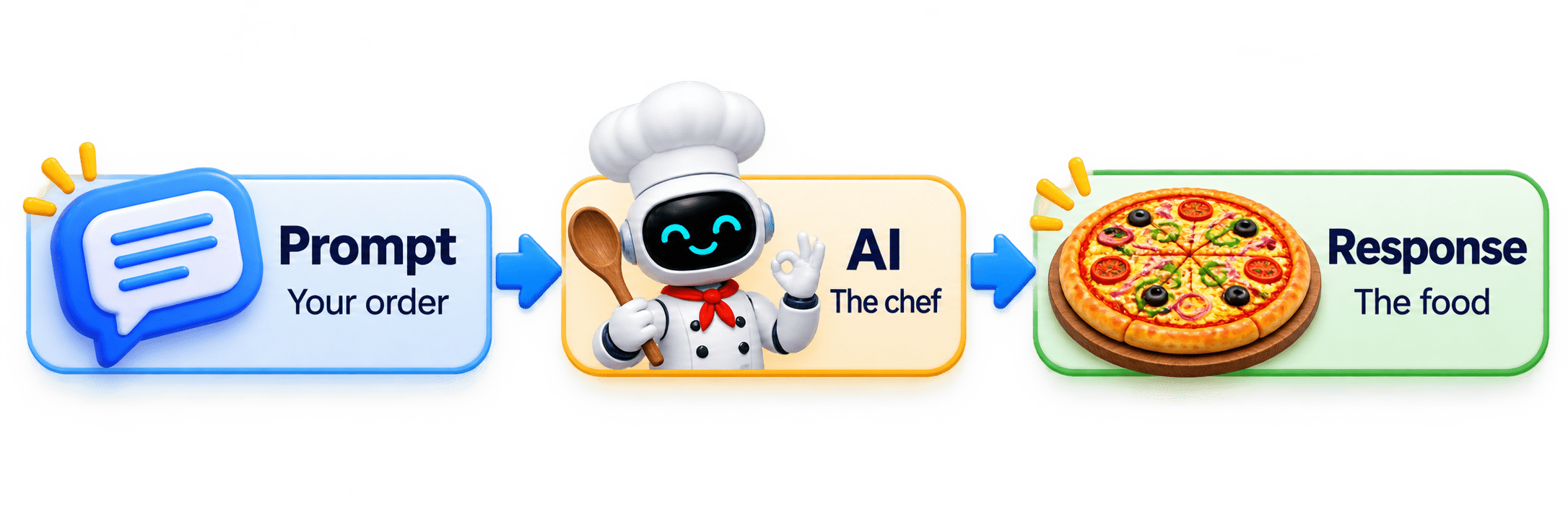
You already know how a request travels to an LLM API and comes back as a structured response, with fields like
messages, temperature, and max tokens.
The GPS Analogy
Imagine you open Google Maps and type
"Take me somewhere."
The app has no idea what to do, where exactly do you want to go?
Now suppose you type
"Navigate from Delhi Railway Station to India Gate."
Google Maps immediately provides
precise, turn by turn directions.
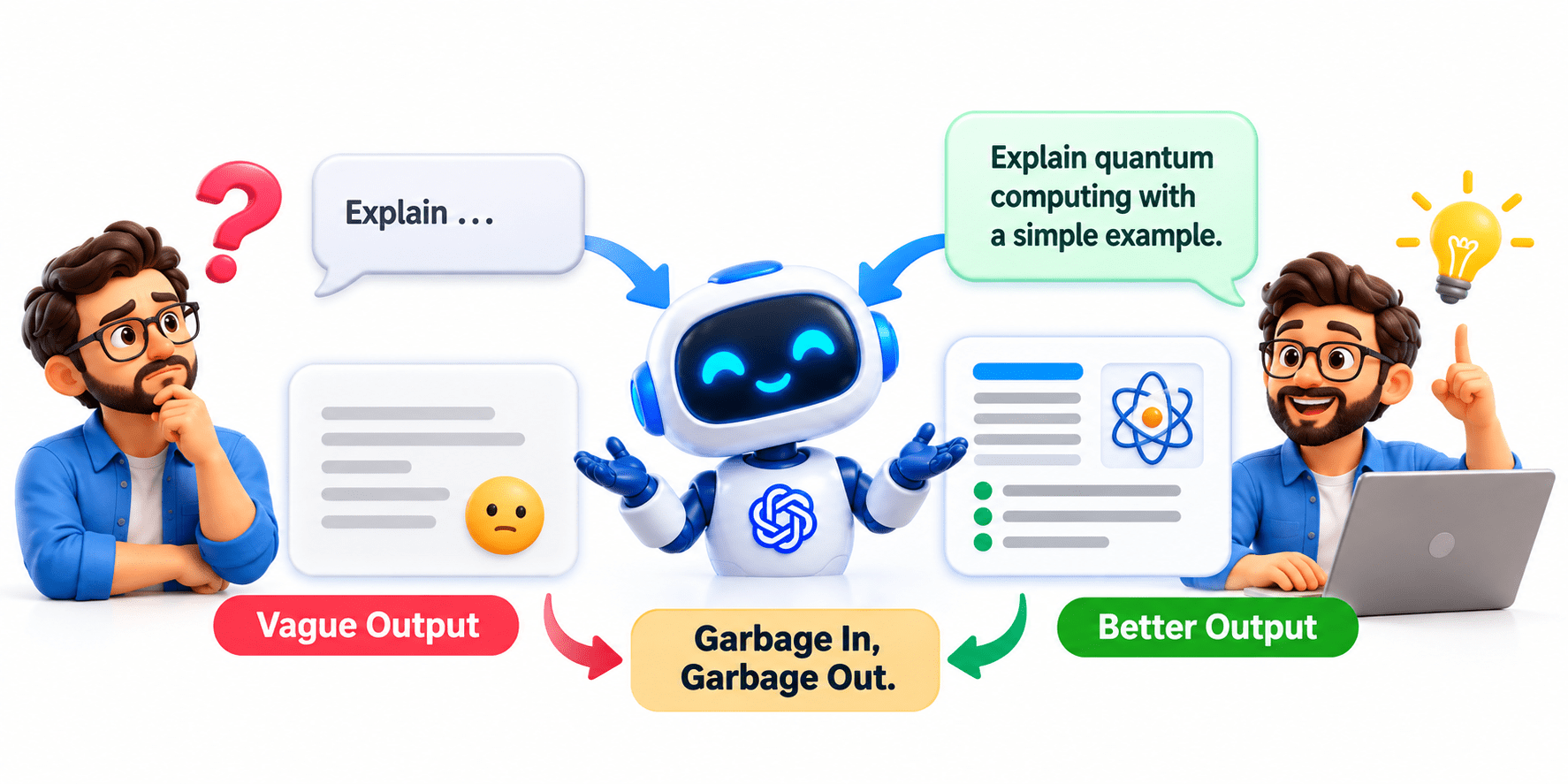
A vague prompt leads to a vague output.
The difference is the Quality of the Instruction.
A clear prompt leads to a better output.
AI works exactly the same way
This is captured in a well known principle,
Garbage In, Garbage Out.
Transition to Technical Concept
Think About It
Previously, we imagined a GPS app that needs a precise destination to give useful directions, not a vague request.
If you type "Tell me about Python," what exactly do you mean, the programming language, the snake, Python for
Data Science, or Python interview questions?
Expected Answer: It's ambiguous, the AI has no way of knowing which meaning you intend without more detail.
Exactly! That's exactly the GPS problem.
So what actually is a prompt, and what makes one clear enough to work well?
What is a Prompt?
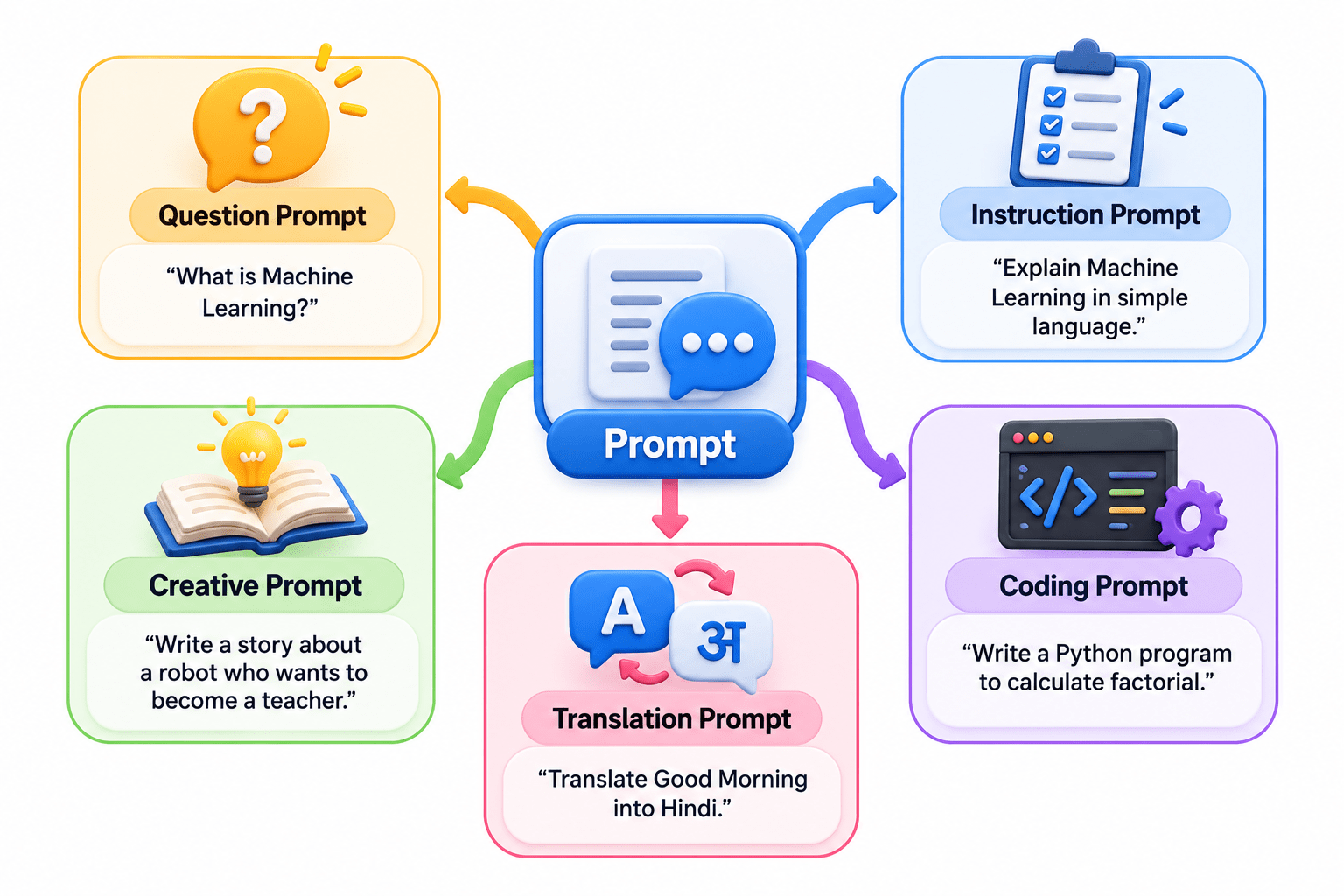
A prompt is any instruction, question, or input that you provide to an AI system, it is how you communicate with AI, your words are the only thing the AI has to work with.
response = model.invoke("Explain Machine Learning in simple language")Why Are Prompts Important?
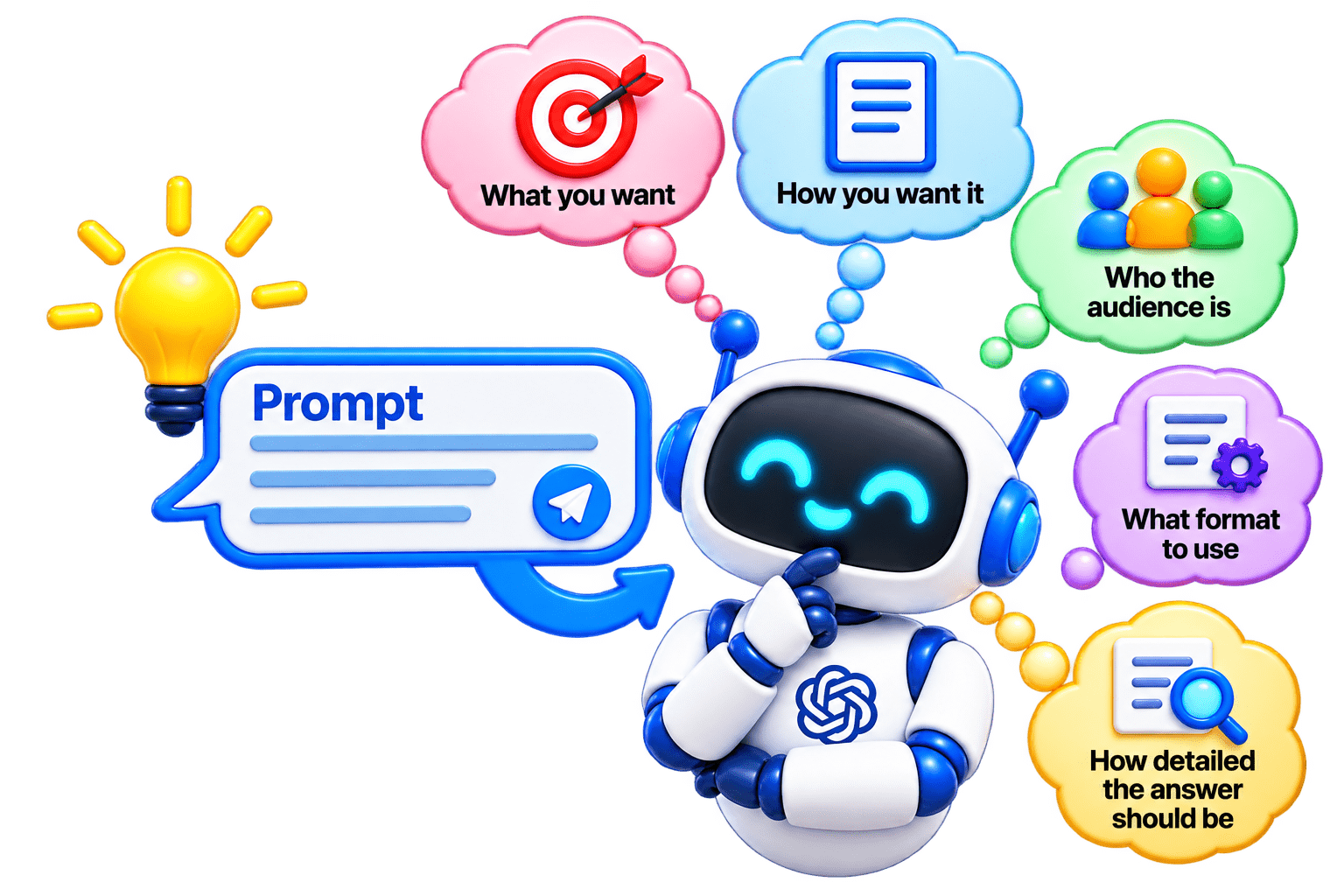
AI models do not read your mind, they only know what you tell them. A good prompt helps the AI understand what you want, how you want it, who the audience is, what format to use, and how detailed the answer should be.
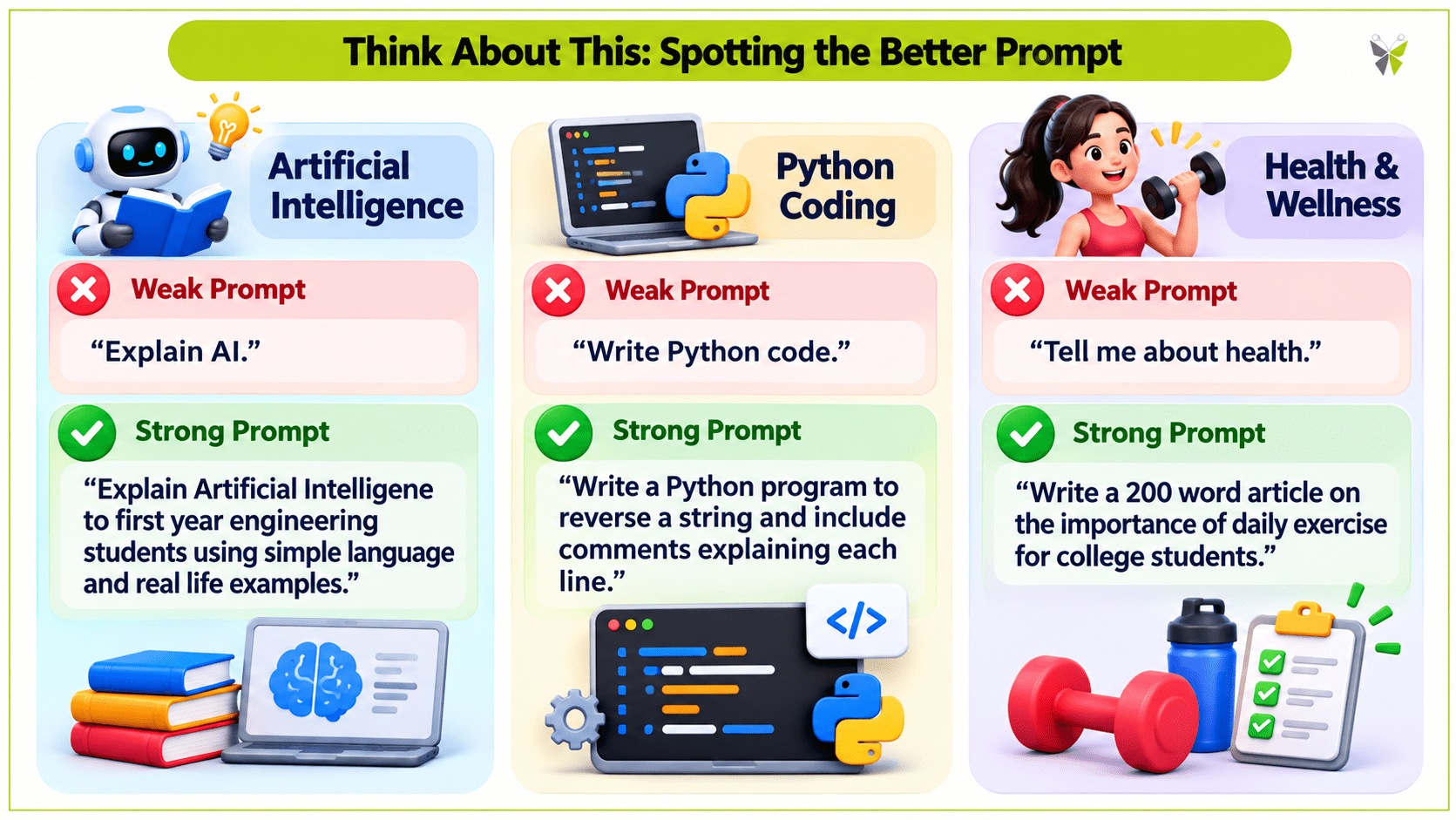
Weak Prompt:
"Tell me about AI." The response may be too broad, too technical, or completely off target.
Strong Prompt:
"Explain Artificial Intelligence in simple language for first year engineering students using realworld examples."
"Now the AI knows the topic, the audience, the style, and the requirement.
Components of a Good Prompt (Part 1)
Tell the AI what action to perform, Explain, Summarise, Translate, Compare, Write, Create, Analyse.
"Summarise this article."
Provide background information so AI understands your situation.
"I am preparing for a university exam on Deep Learning."
Specify who the content is for, AI adjusts its tone and complexity accordingly.
"Explain Neural Networks to Class 10 students."
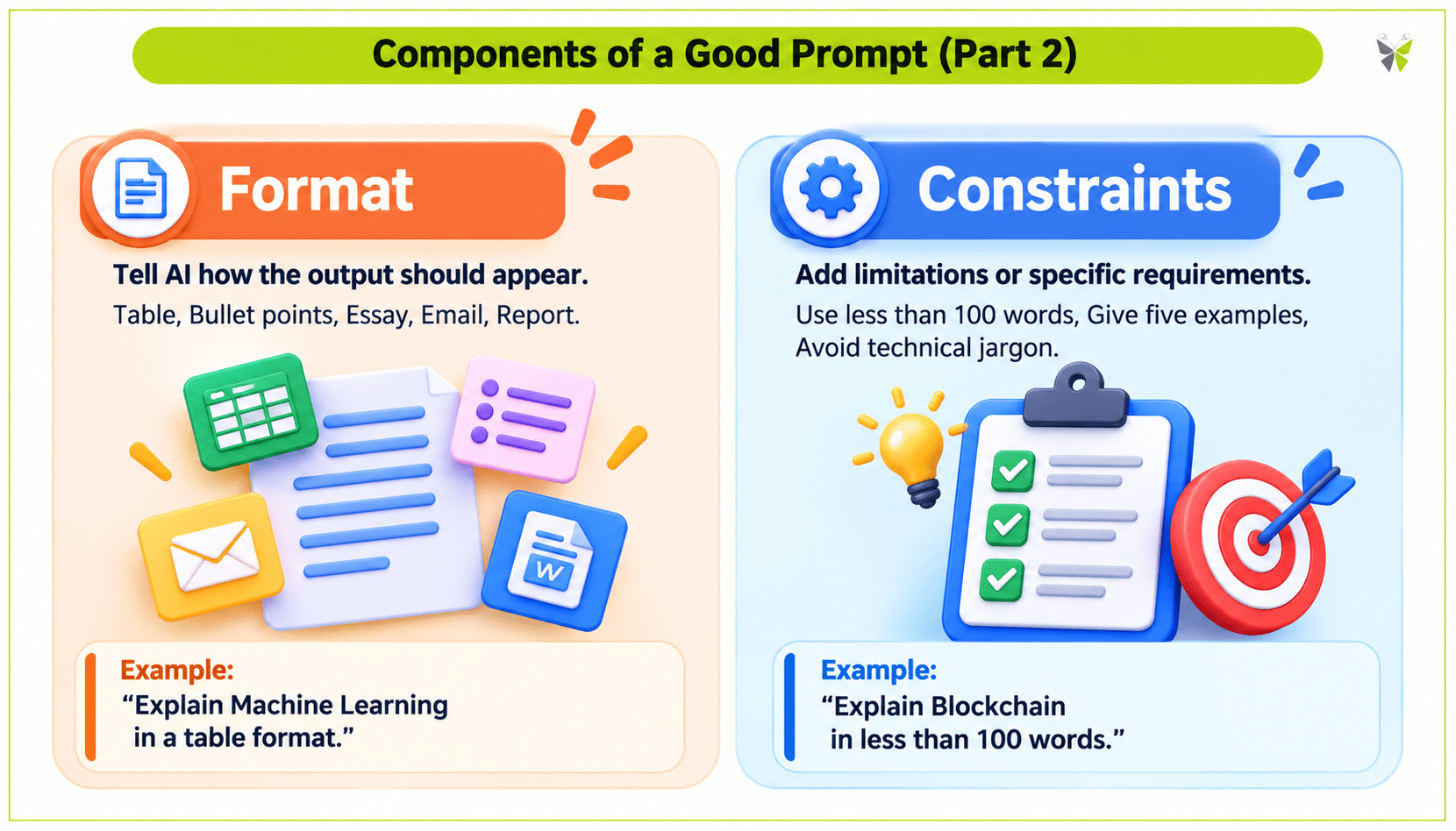
Components of a Good Prompt (Part 2)
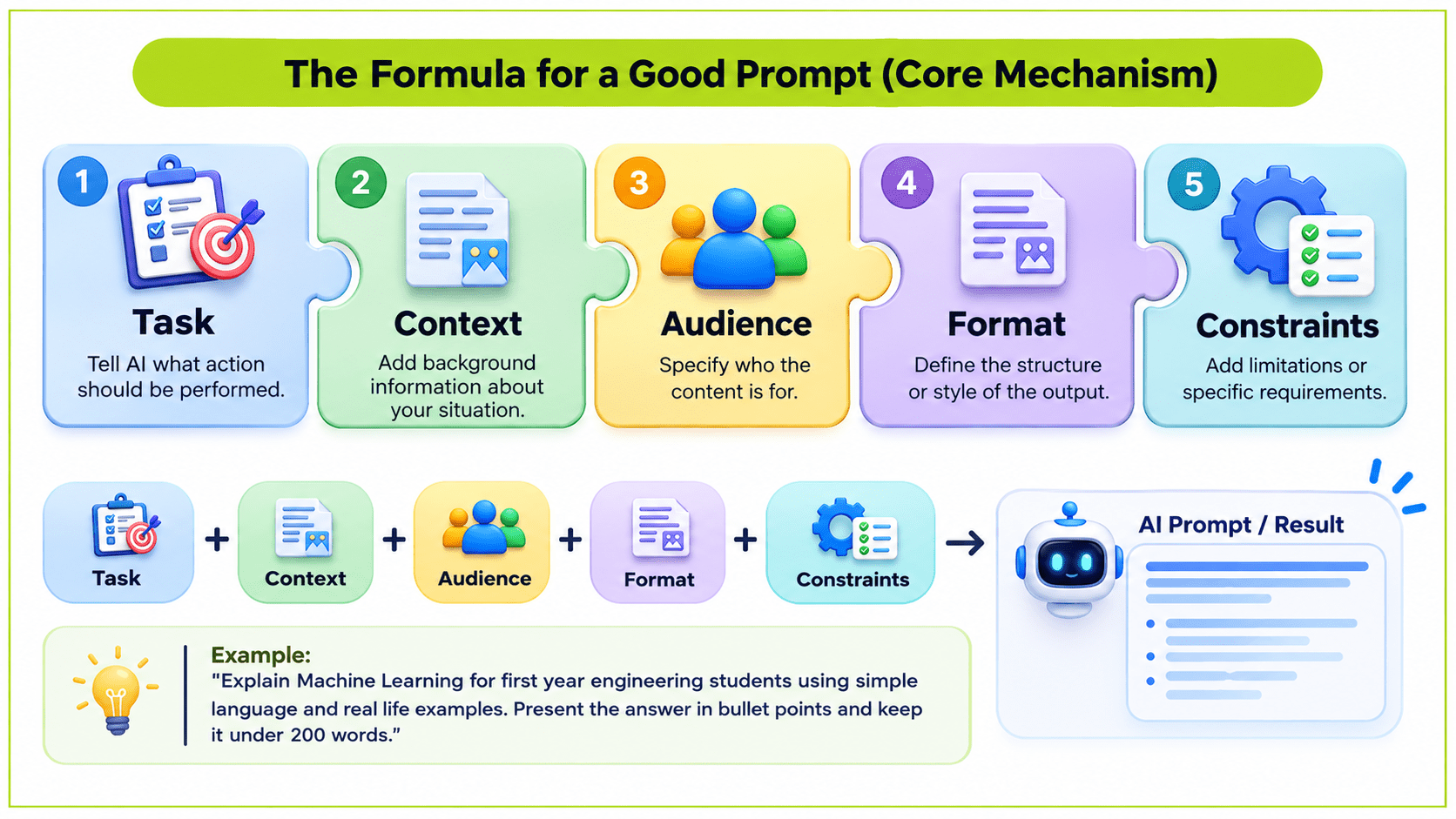
The Formula for a Good Prompt (Core Mechanism)
"Explain Machine Learning for first year
engineering students using simple language and real life examples. Present the answer in bullet points and keep it under 200 words." This is significantly stronger than simply saying "Explain Machine Learning."
Add Context, background information about your situation.
Specify the Audience, who the content is for.
Define the Format, how the output should appear.
Add Constraints, limitations or specific requirements.
Start with the Task,
what action should the AI perform.
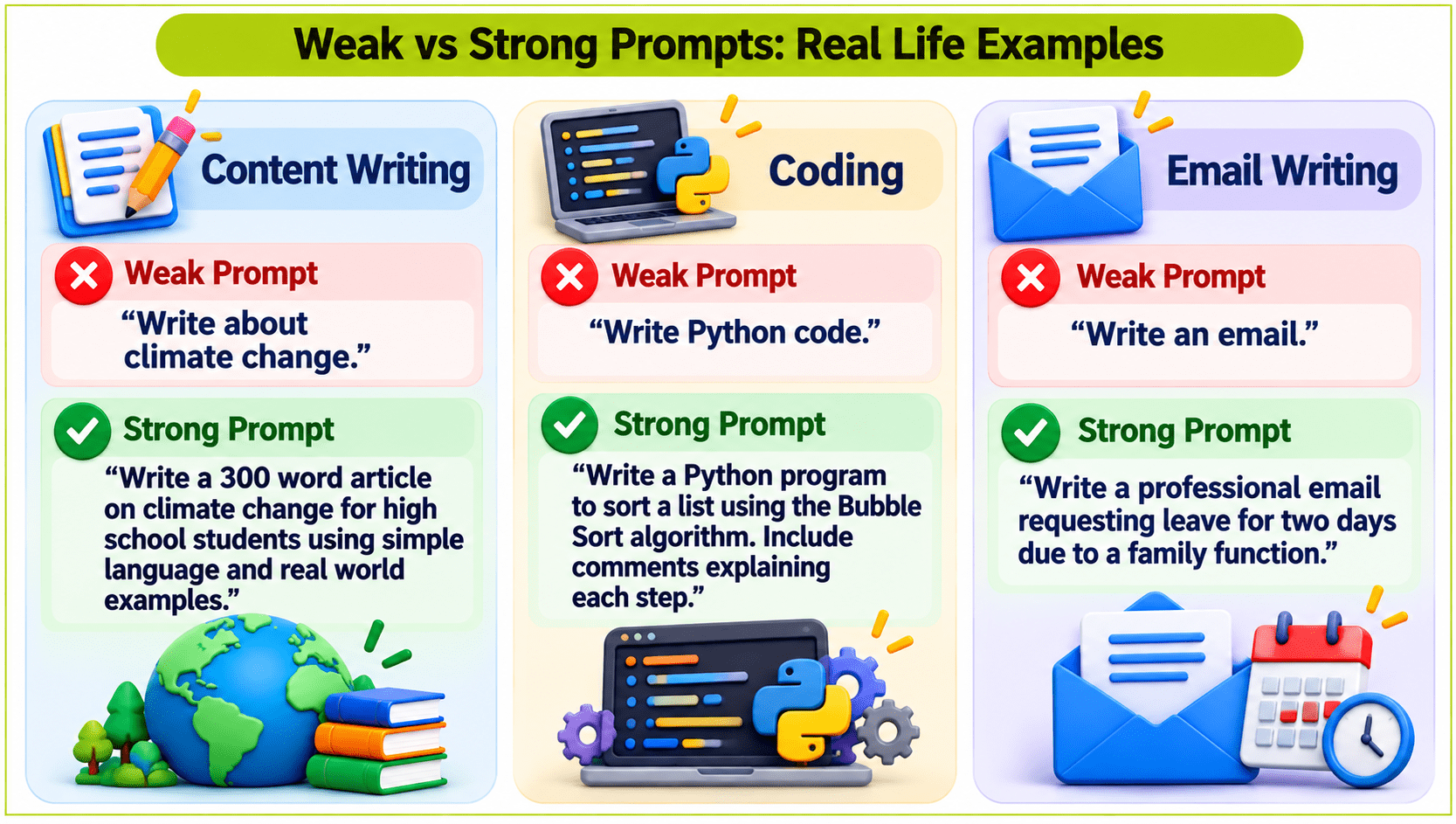
Weak vs Strong Prompts: Real Life Examples
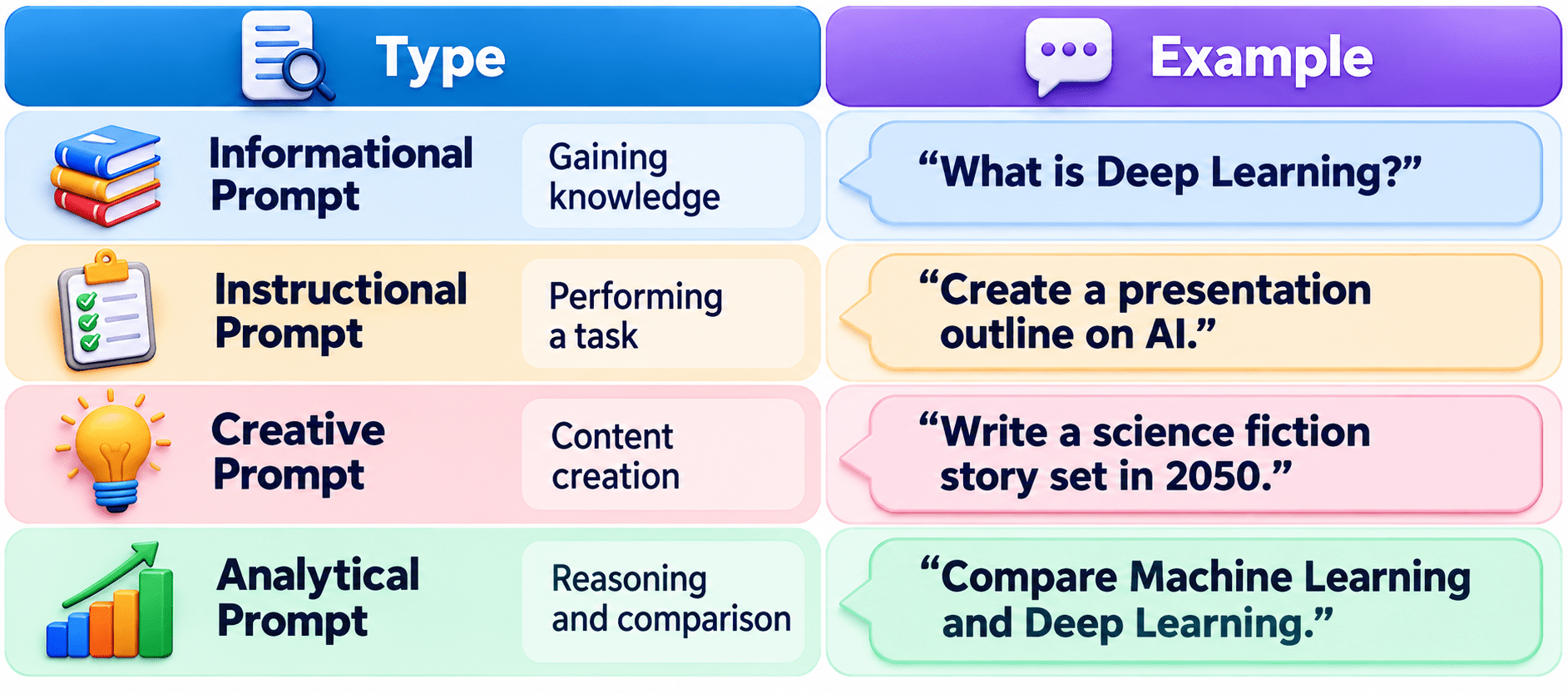
Types of Prompts (Comparison)
Think About This: Spotting the Better Prompt
An Easy Way to Remember
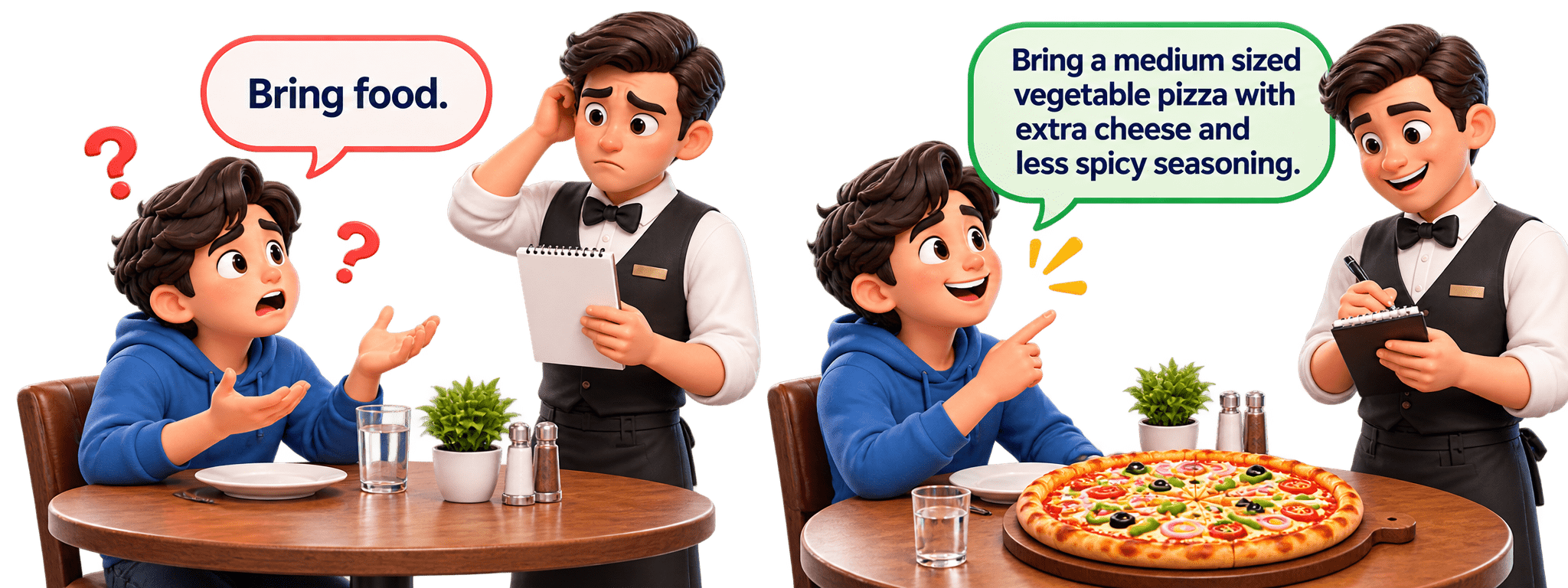
Think of ordering food at a restaurant.
Poor Order:
"Bring food." The waiter has no idea what you want.
Good Order:
"Bring a medium sized vegetable pizza with extra cheese and less spicy seasoning." Now the waiter knows exactly what to prepare.
Better instructions always produce better results.
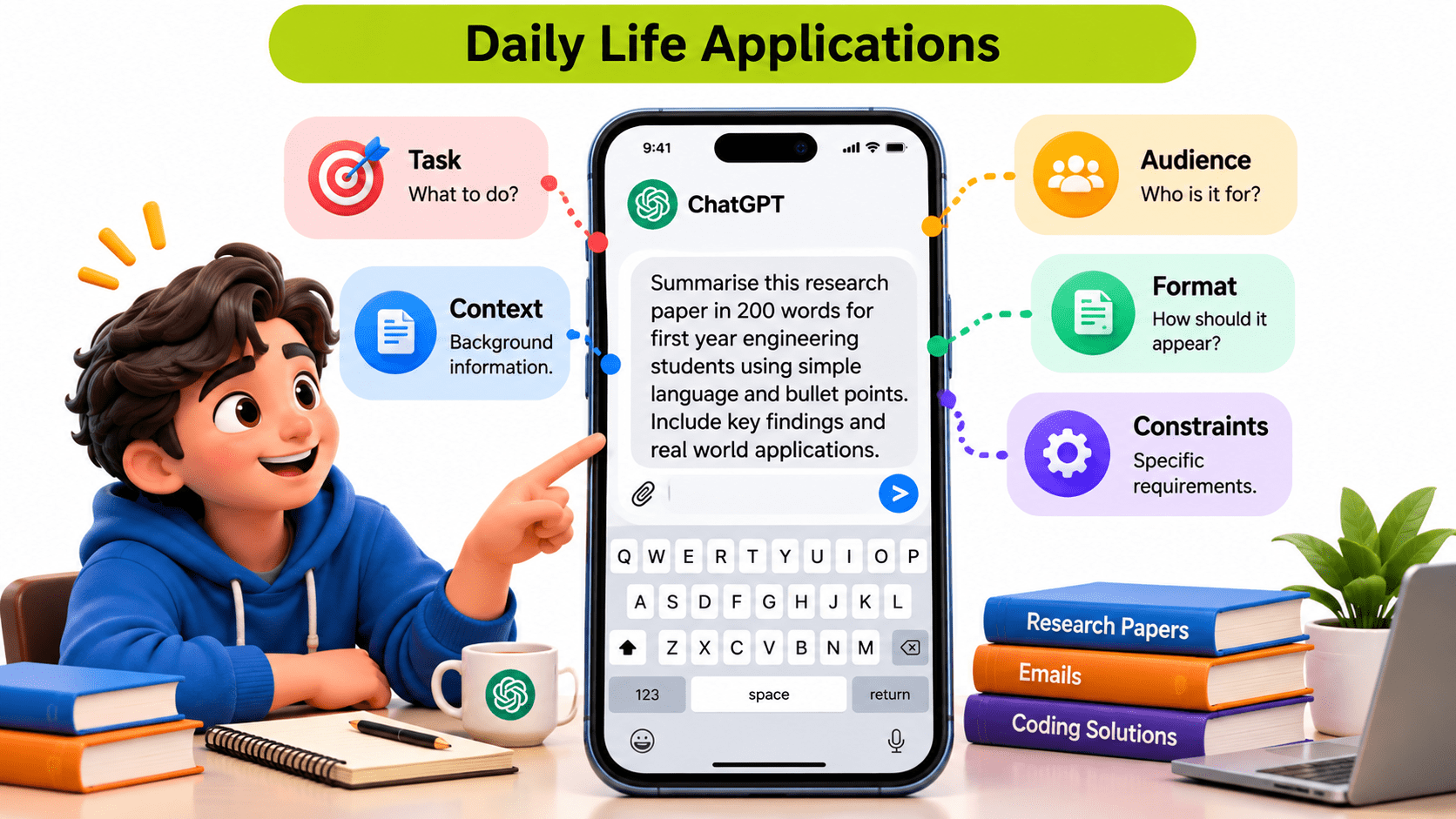
Daily Life Applications
Asking an AI tool to summarise a research paper with a clear length and format requested, rather than just
"summarise this."
Requesting a professional email with the audience and purpose specified, rather than just "write an email."
Asking for a coding solution with the exact task and requirement stated, rather than just "write code."
Summary
4
Prompting: A key communication skill for AI.
3
Strong prompts: Clear, focused, useful responses
2
5 Elements: Task, Context, Audience, Format, Constraints.
1
Prompt: Instruction or question for AI.
Quiz
Which prompt components are included in: “Explain AI to first-year engineering students using simple language and real-world examples”?
A. Only Task
B. Task, Audience, and Constraints
C. Task and Audience only
D. Format only
Quiz-Answer
Which prompt components are included in: “Explain AI to first-year engineering students using simple language and real-world examples”?
A. Only Task
B. Task, Audience, and Constraints
C. Task and Audience only
D. Format only
By Content ITV