C++陣列
變數
int i;
string s;- 不同type有不同大小、分配記憶體
- 用來儲存東西
輸入一串數字,然後將這串數字倒著輸出去?
ex: 1 2 3 -> 3 2 1
陣列
int a[5];
int a[5] = {1, 2, 3, 5, 6};
int a[] = {3, 4, 5};
陣列
陣列宣告
陣列
陣列使用
cout << a[0] <<"\n";
cout << a[1] <<"\n";
cout << a[2] <<"\n";
a[0] = 6;
陣列
int a[5] = {3, 6, 4, 5, 1};
for(int i = 0; i < 5; i++)
	cout << a[i] <<" ";
陣列:一次allocate 5個連續空間
a[0] = 7;//a[index] = value;| idx | 0 | 1 | 2 | 3 | 4 |
|---|---|---|---|---|---|
| val | 3 | 6 | 4 | 5 | 1 |
Remark: index從0到n - 1, n 為allocate的個數
Different type
#include <iostream>
#include <string>
using namespace std;
int main()
{
	string s[3];
    for(int i = 0; i < 3; i++)
    	cin >> s[i];
    for(int i = 2; i > -1; i--)
    	cout << s[i] << "\n";
    return 0;
}
如果變數沒有初始值,那初始值可能是任意值
#include <iostream>
using namespace std;
int main()
{
    int a[10];
    for(int i = 0; i < 10; i++)
        cout << a[i] <<"\n";
	return 0;
}
想要讓陣列的所有初始值為 0 ?
#include <iostream>
using namespace std;
int main()
{
    int a[5] = {0, 0, 0, 0, 0};
    for(int i = 0; i < 5; i++)
        cout << a[i] << "\n";
    int b[5] = {};
    for(int i = 0; i < 5; i++)
    	cout << b[i] << "\n";
	return 0;
}
2D array
//syntax int a[Row][COL]
int main(){
 	int arr[2][3] = {
       {9, 8, 7},
       {6, 5, 4}
    };
    return 0;
}| [0][0]: 9 | [0][1]: 8 | [0][2]: 7 |
|---|---|---|
| [1][0]: 6 | [1][1]: 5 | [1][2]: 4 |
前面負責控制row,後面負責控制column
練習:zerojudge a015. 矩陣的翻轉(有很多組)
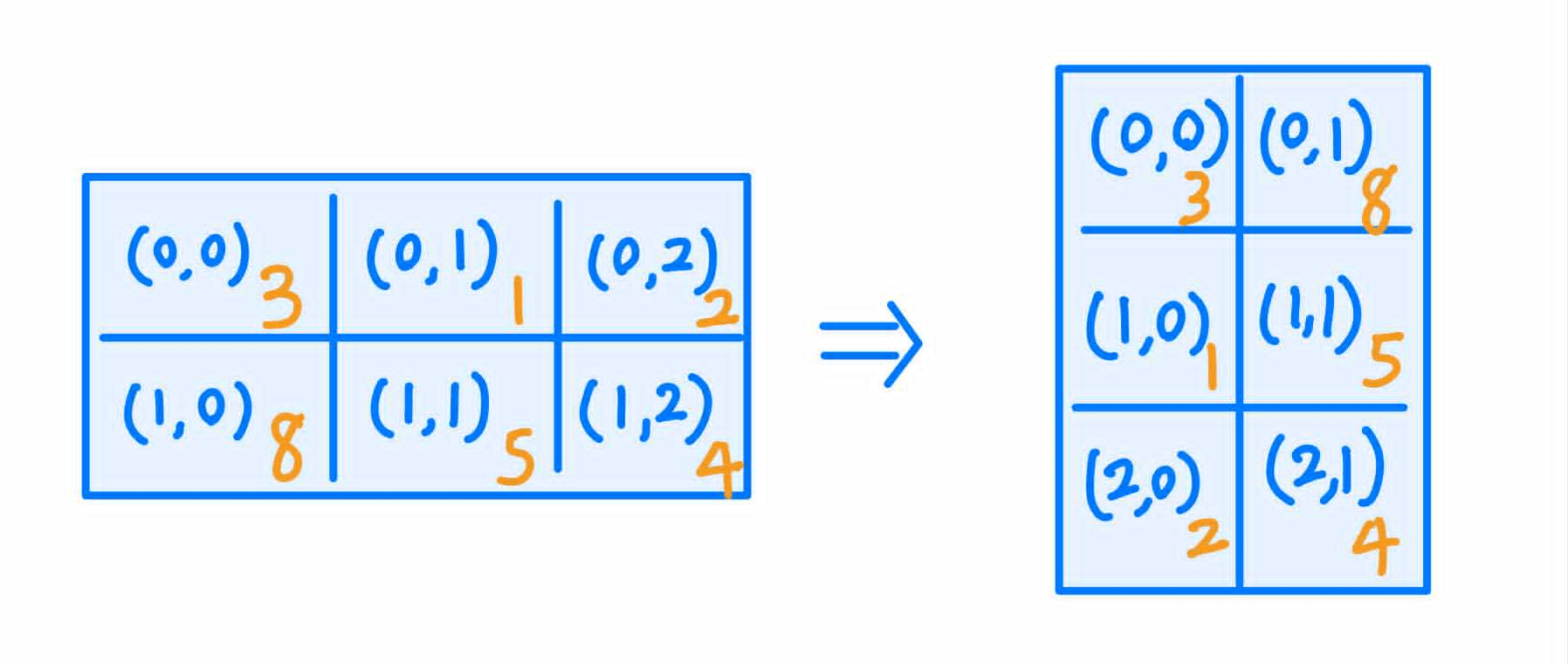
練習:zerojudge d481. 矩陣乘法
Remark
- array在宣告時大小已經固定
- 訪問到超過的index會出錯
- 通常int的陣列可以開到1e6~1e7
- 1e6代表10的六次方
- 可以用陣列來做狀態記錄
- a[2] = 0, a[3] = 1
進位制
常見進位制
- 二進位
- 十進位
- 十六進位
當數字達到一定數量(基數base)時,就向前一位進一
3小時26分鐘又10秒總共有幾秒?
3 \times 60^2 + 26 \times 60 + 10 \times 1 = 12370
10進位
- 每一位數最少是0 最多能到9
- 超過9的話需要進位
個位數代表: 1
十位數代表:10個1也就是10
百位數代表:10個10也就是100
千位數代表:10個100也就是1000
(1234)_{10} = 1 \times 1000 + 2 \times 100 + 3 \times 10 + 4 \times 1\\
(1234)_{10} = 1 \times 10^3 + 2 \times 10^2 + 3 \times 10^1 + 4 \times 10^0\\
60進位
- 每一單位數字最少是0 最多能到59
- 超過59的話需要進位
1秒代表: 1
1分鐘:60個1秒也就是60秒
1小時:60分鐘也就是60*60秒
8進位
- 每一位數最少是0 最多能到7
- 超過7的話需要進位
右一位數代表: 1
右二代表:8個1也就是8
右三位數代表:8個8也就是64
右四位數代表:8個64也就是512
(1234)_{8} = 1 \times 8^3 + 2 \times 8^2 + 3 \times 8^1 + 4 \times 8^0\\
16進位
- 每一位數最少是0 最多能到15
- 超過15的話需要進位
每一位只能用一個字來代替
A: 10 D:13
B: 11 E:14
C: 12 F:15
(13D)_{16} = 1 \times 16^2 + 3 \times 16 + D \times 1
= (317)_{10}
請問
(33)_{8} = ( ? )_{10}
49會出現在8進位嗎,該如何表示
2進位
- 每一位數最少是0 最多能到 1
- 超過1的話需要進位
| 1 | 1 |
|---|---|
| 2 | 10 |
| 3 | 11 |
| 4 | 100 |
| 5 | 101 |
| 6 | 110 |
| 7 | 111 |
\begin{align*}
(10110)_{2} = &1 \times 2^4 + 0 \times 2^3 + 1 \times 2^2 + 1 \times 2 + 0 \times 1 \\
= &(22)_{10}
\end{align*}
n進位轉10進位
\begin{align*}
(abcde)_{n} &= a \times n^4 + b \times n^3 + c \times n^2 + d\times n + e \times 1\\
&=(?)_{10}
\end{align*}
問題: 要把10進位轉成16進位,用長除法 ?
(439)_{10} = ( ? )_{16}
1\times 256 + B \times 16 + 7 \times 1 = (1B7)_{16}
| n⁴ | n³ | n² | n | 1 |
|---|---|---|---|---|
| a | b | c | d | e |
\begin{align*}
&439\ /\ 16\ =\ 27\ ...\ 7\\
&27\ /\ 16\ =\ 1\ ...\ 11\ (11對應到B)\\
&1\ /\ 16\ =\ 0\ ...\ 1
\end{align*}
10進位轉n進位
\begin{align*}
&(((0 * 16) + 1) * 16 + 11) * 16 + 7\\
&=1 * 16^2 + 11 * 16 + 7
\end{align*}
10進位轉n進位
\begin{align*}
(1012)_{10} &= 1 \times 8^3 + 7 \times 8^2 + 6 \times 8^1 + 4 \times 1 \\
126 &= 1 \times 8^2 + 7 \times 8^1 + 6 \times 1 \implies 4 \\
15 &= 1 \times 8^1 + 7 \times 1 \implies 6 \\
1 &= 1\times 1 \implies 7 \\
&\implies 1 \\
(1764)_{8}
\end{align*}
總結
進位制 基底可使用的符號
| 二進位 | 2 | 0, 1 |
| 八進位 | 8 | 0 ~ 7 |
| 十進位 | 10 | 0 ~ 9 |
| 十六進位 | 16 | 0 ~ 9, A~F(A=10...F=15) |
- 10進位轉n進位,用長除法,且要倒轉
- n進位轉10進位公式