Swaps & NDF


Currency swaps


Learning Outcome
5
Evaluate their benefits for global funding.
4
Learn how swaps manage currency risk.
3
Calculate interest payments.
2
Understand principal exchange and re-exchange.
1
Explain Currency Swaps.
What is Currency Swap?
A Currency Swap is an OTC derivative contract.
They pay interest on the exchanged amounts.
Two parties exchange principal in different currencies.
The principal is re-exchanged at maturity using the original exchange rate.

Simple Analogy


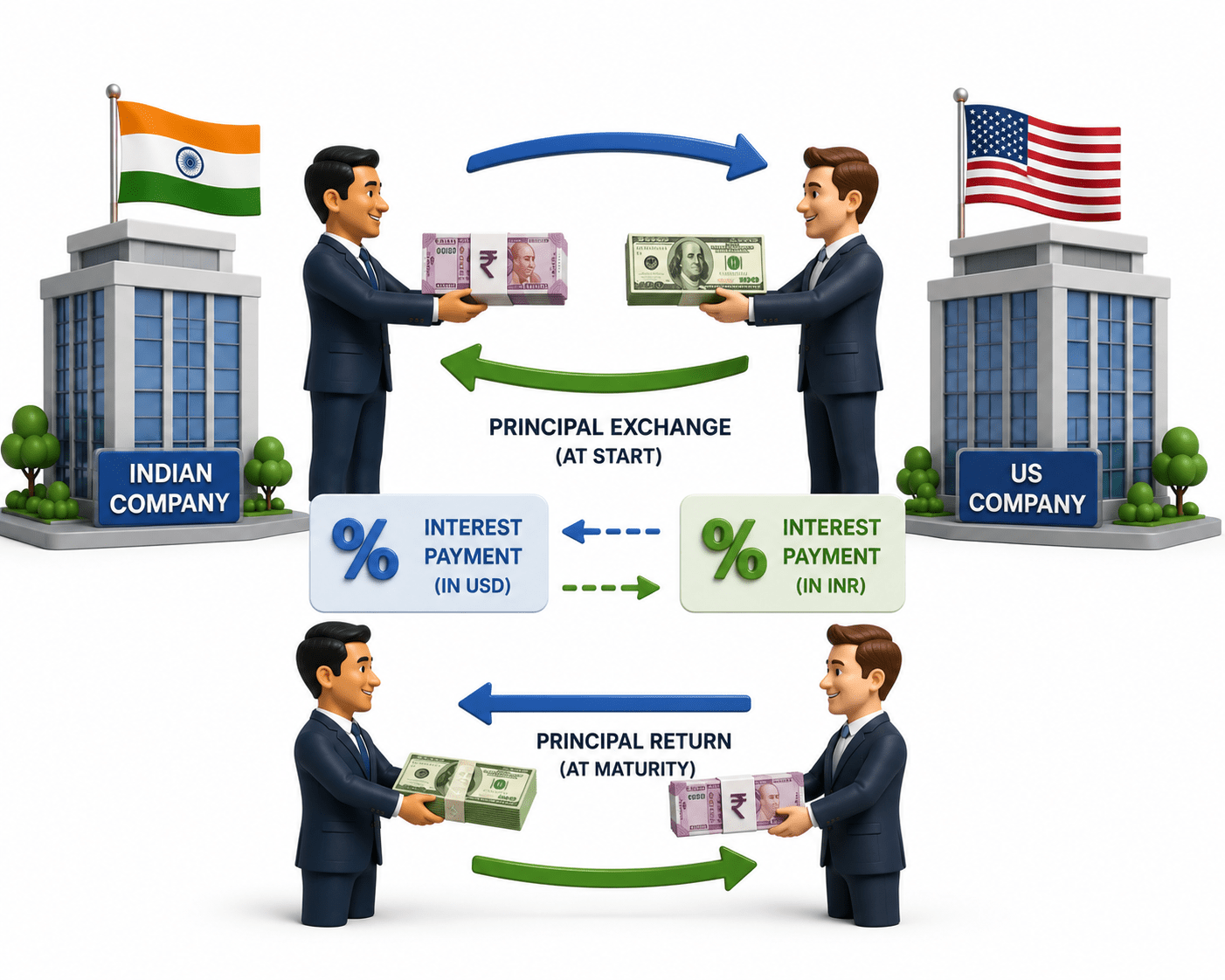
Imagine an Indian company and a U.S. company — both need money in each other’s currency.
The Indian company gets USD, the U.S. company gets INR, and both pay interest on the borrowed currency.
After a fixed time, they return the same amount they originally exchanged.
The principal is re-exchanged at the original exchange rate, protecting both parties from currency fluctuations.
Purpose of Currency Swaps
Provides access to foreign currency for business or investment needs.


Helps hedge against exchange rate fluctuations and currency depreciation.
Enables cheaper borrowing by using comparative advantage between markets.

Aligns assets and liabilities in the same currency for balance sheet stability.

Ensures compliance with local regulations while accessing global funds.

Principal Exchange Process
A currency swap has two principal exchanges — one at the start and one at the end.
Day 1 — Initial Exchange

Party A gives currency X to Party B. Party B gives currency Y to Party A. Both use an agreed spot rate.
Infosys gives USD 10 Mn to US Bank. US Bank gives INR 83 Cr to Infosys. (Rate: 1 USD = ₹83)

During the Swap (Periodic)
Each party pays interest on the amount it received in the foreign currency.
Infosys pays 5% per year on USD 10 Mn. US Bank pays 7% per year on INR 83 Cr.

Maturity — Final Exchange
Both parties return the original principal at the same rate used on Day 1. No forex risk on principal.
Infosys returns USD 10 Mn. US Bank returns INR 83 Cr. Same rate: 1 USD = ₹83.
Interest Payments
After exchanging currencies, both parties pay interest on the borrowed amount in the respective currency at regular intervals.
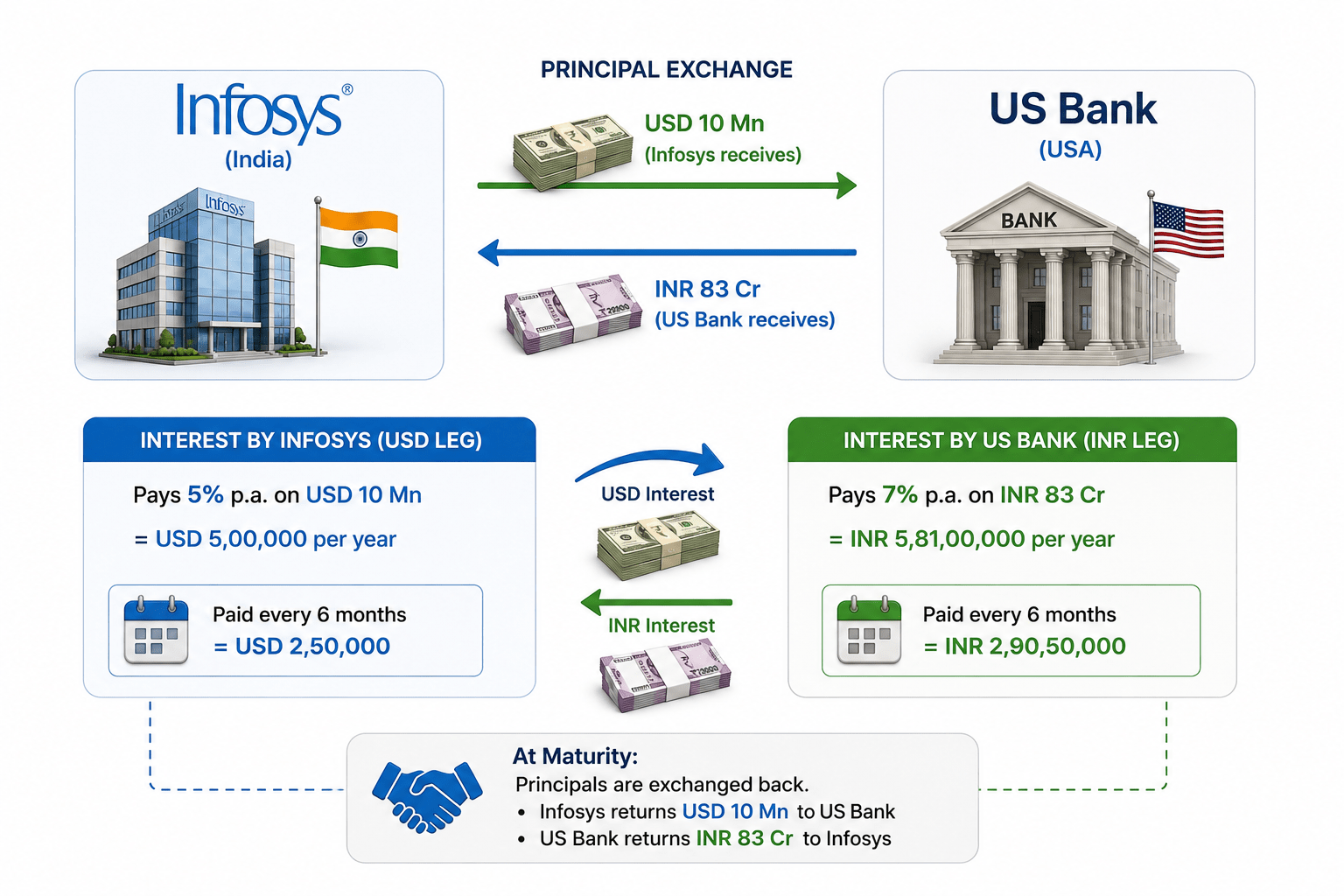
Interest by US bank (INR leg)
Pays 7% p.a. on INR 83 Cr
= INR 5,81,00,000 per year

Paid every 6 months
= INR 2,90,50,000
Interest by Infosys (USD leg)
Pays 5% p.a. on USD 10 Mn
= USD 5,00,000 per year
Paid every 6 months = USD 2,50,000
Full Example Transaction (Practical Walk-Through)
Let us walk through a complete end-to-end example using two real-world style entities: Infosys (Indian IT company) needing USD, and a US pharmaceutical company needing INR.
Scenario Setup
1. Infosys wants to borrow USD 10 million for 5 years (to pay US employees & vendors).
2. US Pharma Co. wants to borrow INR 83 crore for 5 years (to fund India operations).
3. Agreed exchange rate: 1 USD = ₹83
4. Infosys pays: 5% per annum on USD (fixed)
5. US Pharma Co. pays: 7% per annum on INR (fixed)
Interest payment frequency: Annual
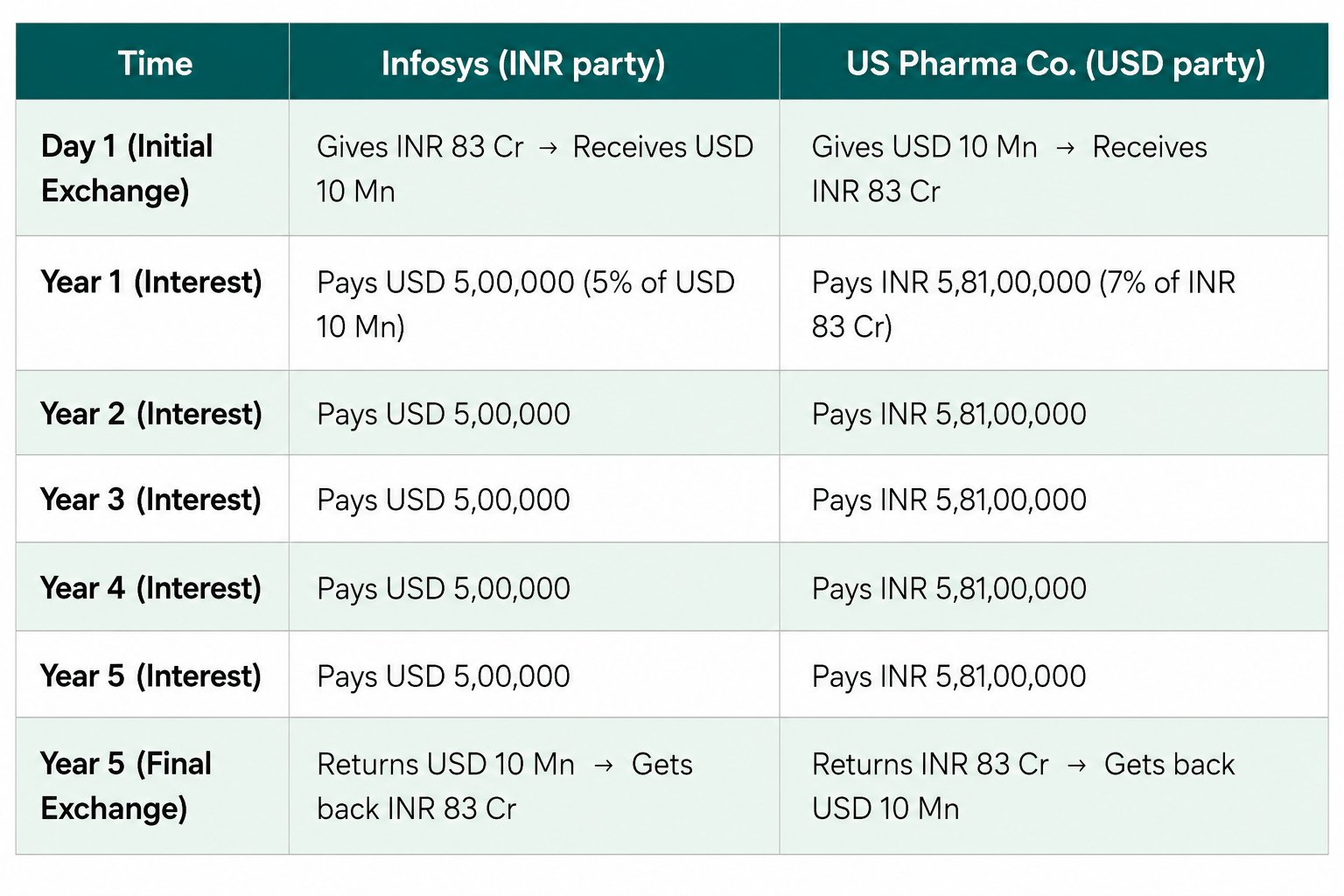
Total Interest Cost for Infosys over 5 Years
5 years × USD 5,00,000/year = USD 25,00,000 (2.5 million dollars)
Total Interest Cost for US Pharma Co. over 5 Years
5 years × INR 5,81,00,000/year = INR 29,05,00,000 (~₹29 crore)
Summary
5
Fixed exchange rates provide stability.
4
Swaps reduce funding and FX risk.
3
Interest is paid in each currency.
2
Principal is exchanged at the start and end.
1
Currency swaps exchange principal and interest.
Quiz
What is the primary purpose of a Currency Swap?
A. Increasing stock prices
B. Hedging foreign exchange risk
C. Avoiding interest payments
D. Speculating on commodity prices

Quiz-Answer
What is the primary purpose of a Currency Swap?
A. Increasing stock prices
B. Hedging foreign exchange risk
C. Avoiding interest payments
D. Speculating on commodity prices