FinCheck Variables, Data Types & Operators Implementation

Business Scenario
After successfully understanding Java Program Structure and Console Output inside the FinCheck Project, your manager now assigns you responsibility for handling Transaction-Related Testing Data using Java Variables and Operators.
During testing activities, QA Testers frequently work with :-
Customer Names
Account Numbers

Transaction Amounts
Transaction Status Values
Recently, new QA Team Members were unable to understand how Application Data is stored and processed inside Java Programs.
Because of this, testers were making mistakes while validating Balances and Transaction
Outputs.
Before starting testing activities, your manager clearly says :-
“If a QA Tester cannot understand how Data is stored and calculated inside Java Programs, Validation Logic becomes difficult to understand. “”
Your responsibility is to understand :-
How Variables Store Testing Data
How Different Data Types Work
How Operators Perform Calculations
How Transaction Balances are Updated
How Java Programs Process Validation Values
Pre-Lab Preparation
- Declare variables
- Use data types (int, double, String)
- Perform calculations
- Store transaction values
Task 1: Understand Variables in Java
Understand & Create Variables
a
What is Variable?
Variable is a storage container used to store data inside Java programs.
QA testers use variables to store :-
-
customer names
-
account numbers
-
transaction amounts
-
balances
-
validation results
How Variables Work
-
Tester creates variable.
-
Value gets stored inside memory.
-
Program uses stored value during execution.
-
Stored value displays inside console output.
Real Life Example
Tester stores :-
-
customer name = Rahul
-
account number = 101001
-
transaction amount = 5000
inside Java variables.
Syntax
VARIABLE DECLARATION AND ASSIGN SYNTAX
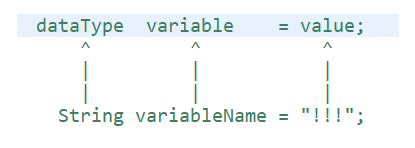
Activity
-
Create Java class
-
Create variables inside main method
-
Store customer information
-
Print stored values
Task 2: Understand Java Data Types
Understand & create Data Types
a
What is Data Type?
Data type defines what kind of value a variable can store inside Java program.
Different testing data requires different data types.
Types of Java Data Types
-
Primitive Data Types
Primitive data types store simple values directly inside memory.
Types of primitive Data Types
-
boolean
Stores true or false values.
-
char
Stores single character value.
-
float
Stores decimal values with smaller precision.
-
double
Stores decimal values with larger precision.
- byte
Stores very small whole numbers.
- short
Stores small numeric values.
- int
Stores whole numbers.
- long
Stores very large whole numbers.
-
Non primitive Data Types
Non-primitive data types store multiple values or complex information.
Types of non-primitive Data Types
-
String
Stores text values.
-
Array
Stores multiple values inside single variable.
-
Class
Used to create objects and program structure.
Real Life Example
Tester stores :-
-
customer name using String
-
transaction amount using int
-
balance using double
Syntax
-
Refer variable declaration syntax
Activity
-
Create variables using multiple data types
-
Store transaction values
-
Print stored output
Task 3: Understand Java Operators
Understand Operators
a
What are Operators?
Operators are symbols used to perform calculations and operations inside Java programs.
QA testers use operators during :-
-
balance calculations
-
transaction validations
-
amount verification
-
testing logic execution
Types of Operators
-
Arithmetic Operator
Arithmetic operators are used to perform mathematical calculations inside Java programs.
Types of Arithmetic Operators
-
Addition Operator (+)
-
Subtraction Operator (-)
-
Multiplication Operator (*)
-
Division Operator (/)
-
Modulus Operator (%)
-
Comparison Operators
Comparison operators are used to compare two values.
These operators return result as :- true or false
Types of Comparison Operators
-
Equal To Operator (==)
- Not Equal To Operator (!=)
-
Greater Than Operator (>)
-
Less Than Operator (<)
-
Greater Than Equal To (>=)
-
Less Than Equal To (<=)
-
Logical Operators
Logical operators are used to combine multiple conditions.
Types of Logical Operators
2. OR Operator (||)
At least one condition must be true otherwise if all conditions are false then end result will be false
1. AND Operator (&&)
Both Condition must be true then end result will be true otherwise always it will be false
-
NOT Operator (!)
Reverses the result
-
Real Life Example
Customer balance = 10000
Withdrawal amount = 2000
Updated balance = 8000
Activity
-
Create balance variable
-
Create withdrawal amount variable
-
Perform subtraction operation
-
Display updated balance
Task 4: Perform Transaction Calculations
Understand Transaction Calculations
a
What is Transaction Calculation?
Transaction calculation means updating balance after debit or credit transaction.
Banking applications perform calculations whenever transaction occurs.
Types of Transaction Calculations
-
Debit Calculation
Amount gets deducted from balance.
-
Credit Calculation
Amount gets added to balance.
How Transaction Calculation Works
-
System reads current balance.
-
Transaction amount gets processed.
-
Updated balance gets calculated.
-
Output displays inside console.
Real Life Example
Current balance = 15000
Debit amount = 5000
Remaining balance = 10000
Activity
Debit Transaction
-
Create balance variable
-
Create debit amount variable
-
Create remaining balance variable
-
Perform subtraction calculation
-
Store calculation value into remaining balance variable
-
Display remaining balance
Activity
Credit Transaction
-
Create balance variable
-
Create credit amount variable
-
Create update balance variable
-
Perform addition calculation
-
Store calculation value into update balance variable
-
Display updated balance
Good Job!!
In this lab, you learned Java Variables, Data Types, and Operators used for transaction calculations and validations.
You also practiced Storing Transaction Data, performing Calculations, and Verifying Console Output.
By completing this lab, you now understand how QA Testers Handle Data and Validate Transaction Outputs using Java.
Checkpoint

Next-Lab Preparation
Git Push
git push origin branchName- Use if-else conditions
- Validate transaction rules
- Handle valid/invalid scenarios
- Print results