Topic Name


Subtopic Name


Learning Outcome(Slide2)
6
Basics of branding and messaging
5
Target audience and segmentation
4
Different marketing channels
3
Creating value for customers
2
Understanding customer needs
1
What marketing means ?
Choose cool, soft colors instead of vibrant colors
Max 6 Points for Summary & Min 4
Topic Name-Recall(Slide3)
Hook/Story/Analogy(Slide 4)
In the last chapter, we learned how to work with strings like beginners exploring a new tool...

We even discovered how to join strings together, repeat them, and search within them.
We learned how to create strings,
How to peek inside them using indexing and slicing,
And how to modify their appearance using different methods.

It felt like we had learned how to handle and control strings...

But then something interesting happened ...
We realized that just handling strings is not enough.
What if we want to present information in a better way?
What if we want to check if a string meets specific rules?
What if we want to search patterns, not just words?


That’s where things get more powerful ...

Now, we step into the next level —
where strings are not just handled, but designed, validated, and analyzed intelligently.
String Formatting → Making output more dynamic
Boolean Methods → Validating string content
Regular Expressions → Pattern-based searching
String Module → Advanced tools and constants
In this chapter, we will explore
In Python, string formatting allows variables and expressions to be inserted into strings in a readable and organized way.
Understanding String Formatting
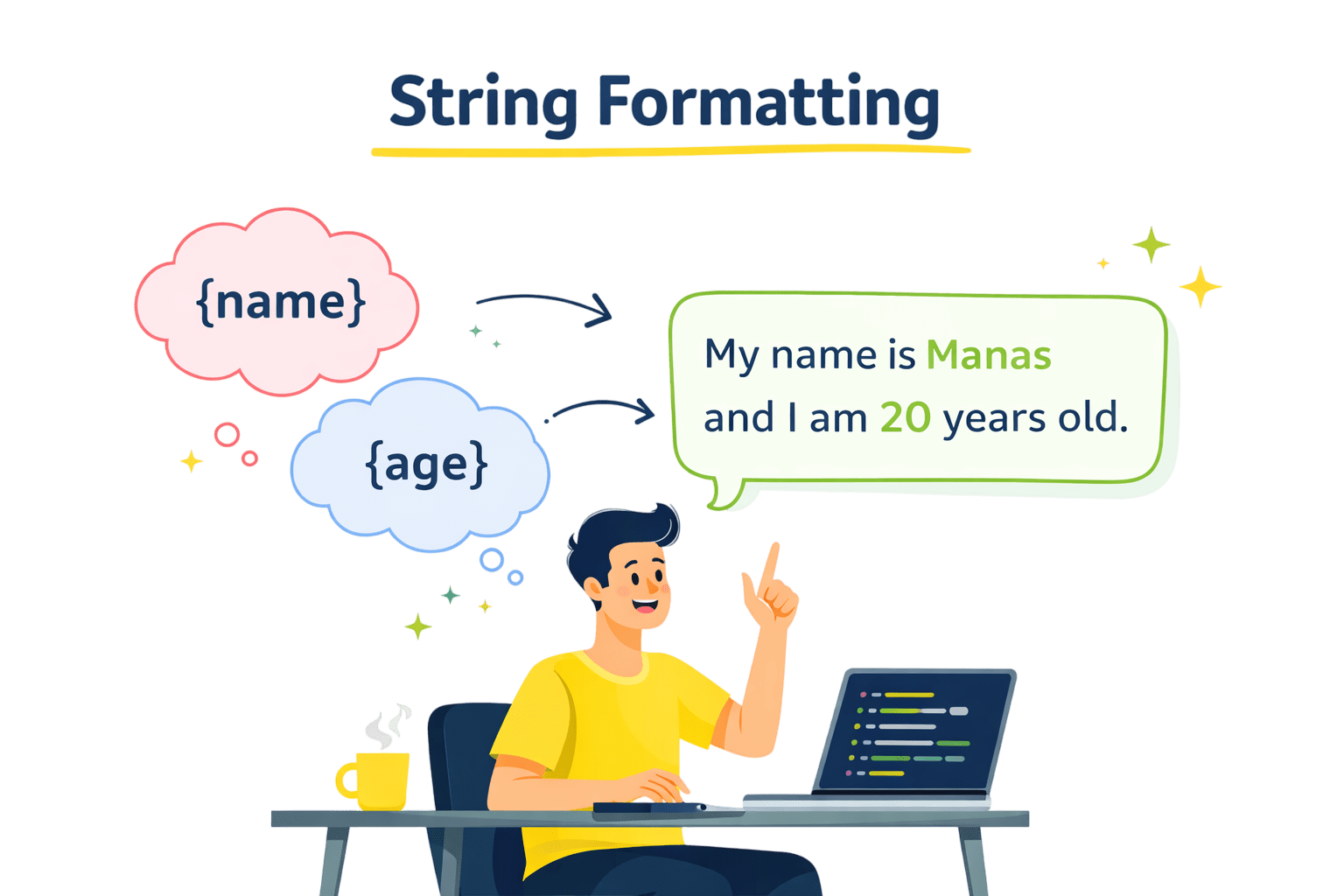

Ways to Format Strings in Python
str.format()
Uses {} placeholders
Values passed in format()
Supports positional/keyword arguments
f-strings
Introduced in Python 3.6
More readable and faster
Directly use variables inside {}
Understanding String Formatting
name = "Manas"
age = 20

# Using str.format()
print("My name is {} and I am {} years old".format(name, age))

# Using f-strings
print(f"My name is {name} and I am {age} years old")
My name is Manas and I am 20 years old
My name is Manas and I am 20 years old
Boolean String Methods
In Python, "boolean string methods" are built-in methods of the str class that perform tests on a string and return either True or False.

Common Methods
text.isupper() → True if all uppercase
text.islower() → True if all lowercase
text.isidentifier() → Valid variable name
text.isalpha() → True if only alphabets
text.isnumeric() → True if all numeric
text.isdigit()→ True if only digits
text.isdigit()→ True if only digits
Boolean String Methods
text1 = "PYTHON"
text2 = "python"
text3 = "12345"
text4 = "var_1"

print(text1.isupper())
print(text2.islower())
print(text3.isdigit())
print(text4.isidentifier())
True
True
True
True
=== Code Execution Successful ===
Note: These are some commonly used boolean string methods— many more are available to explore.

Regular Expressions
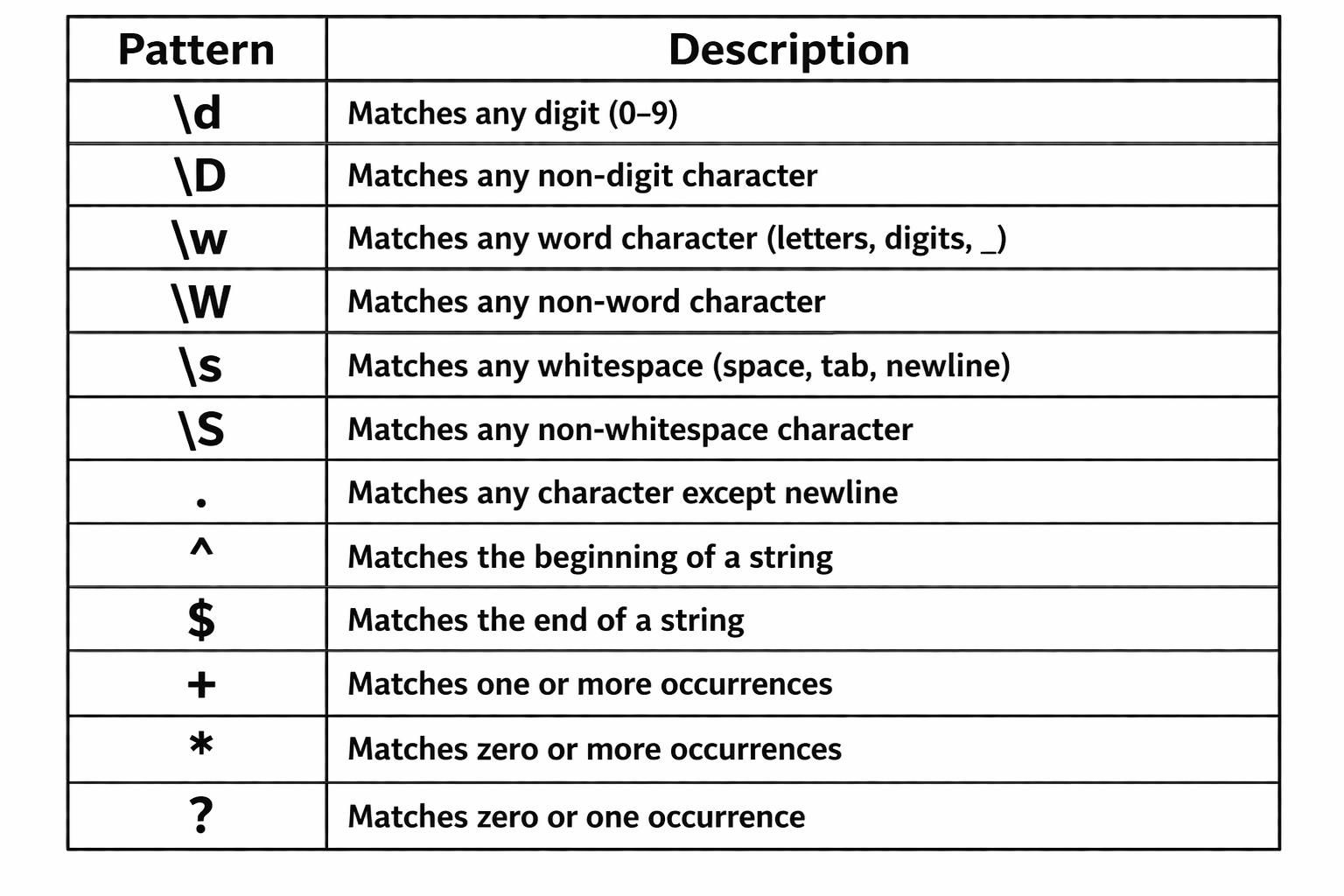
Regular Expressions (Regex) are patterns used to search, match, and manipulate text.
Instead of searching exact words, regex helps you find patterns.
Search complex patterns beyond exact text matching
Validate input formats like email and phone
Extract specific information from large text data
Perform advanced string manipulation and transformations


Common Regex Pattern Cheat Sheet
Core Concepts (Slide 7)
Core Concepts (.....Slide N-3)
Summary
5
Build strong branding
4
Use different marketing channels
3
Target the right audience
2
Create and communicate value
1
Understand customer needs
Choose cool, soft colors instead of vibrant colors
Max 5 Points for Summary & Min 2
Quiz
Which platform is mainly used for professional networking and B2B marketing ?
A. Facebook
B. Instagram
C. LinkedIn
D. Snapchat

Quiz-Answer
Which platform is mainly used for professional networking and B2B marketing ?
A. Facebook
B. Instagram
C. LinkedIn
D. Snapchat
