

Filters and Conditional Logic
Building and Controlling Workflows


Learning Outcome
5
Connect filters to credit savings and testing.
4
Apply filters to real business rules.
3
Recognize how AND and OR combine conditions.
2
Identify operators for each data type.
1
Understand what a Make filter does.
The Placement Drive

A placement drive needs 60%+, no backlogs, and a CS or IT degree. The officer checks every student against these rules.
Those who qualify are shortlisted; the rest simply aren’t forwarded. No error, no fuss.
What happens to students who don’t qualify?
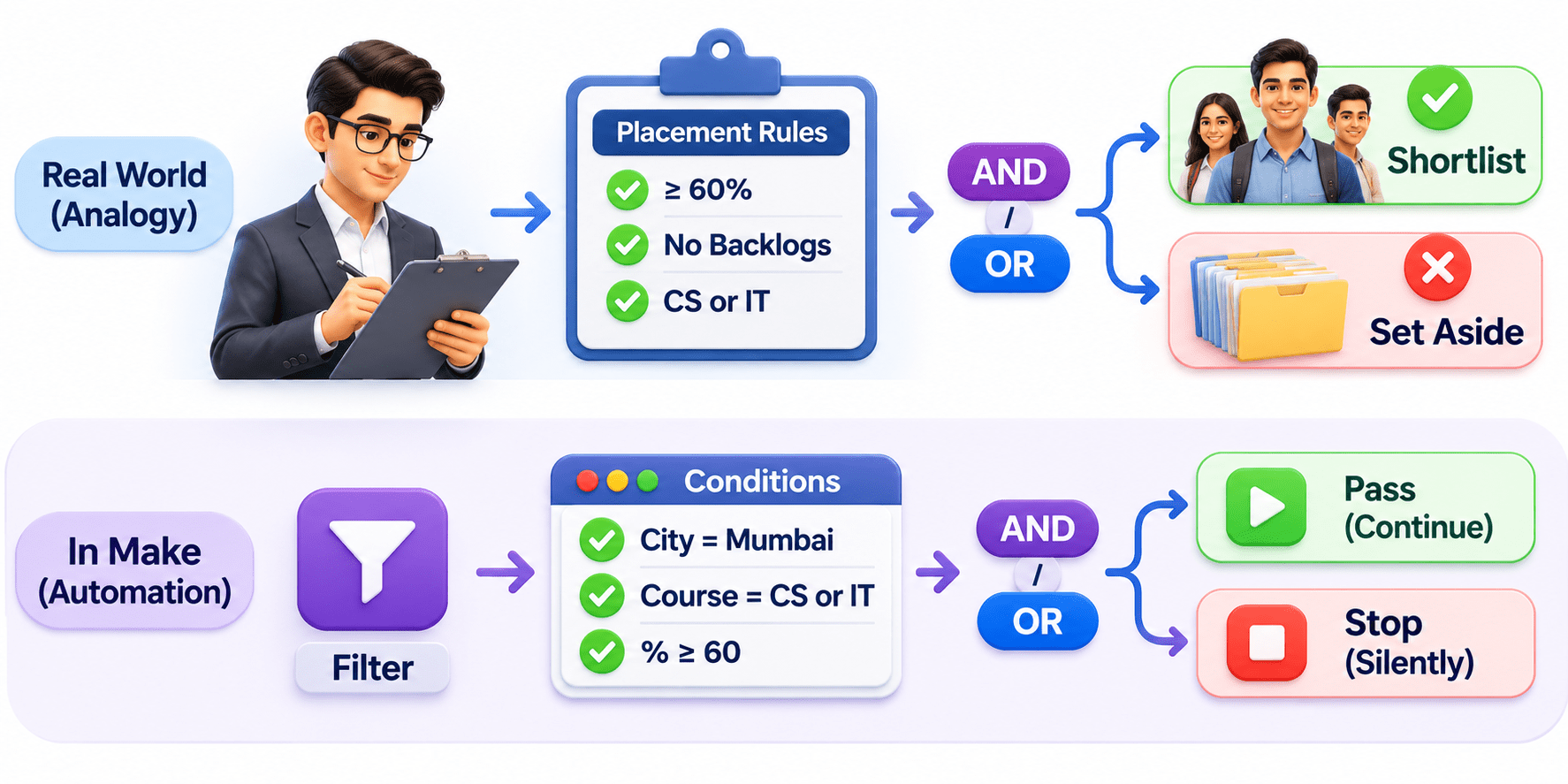
Clear rules decide who moves ahead, and the rest quietly stay back.
Similarly, a filter in Make lets only the records that meet your rules continue to the next module. Each rule is a condition, like “City is Equal to Mumbai”.
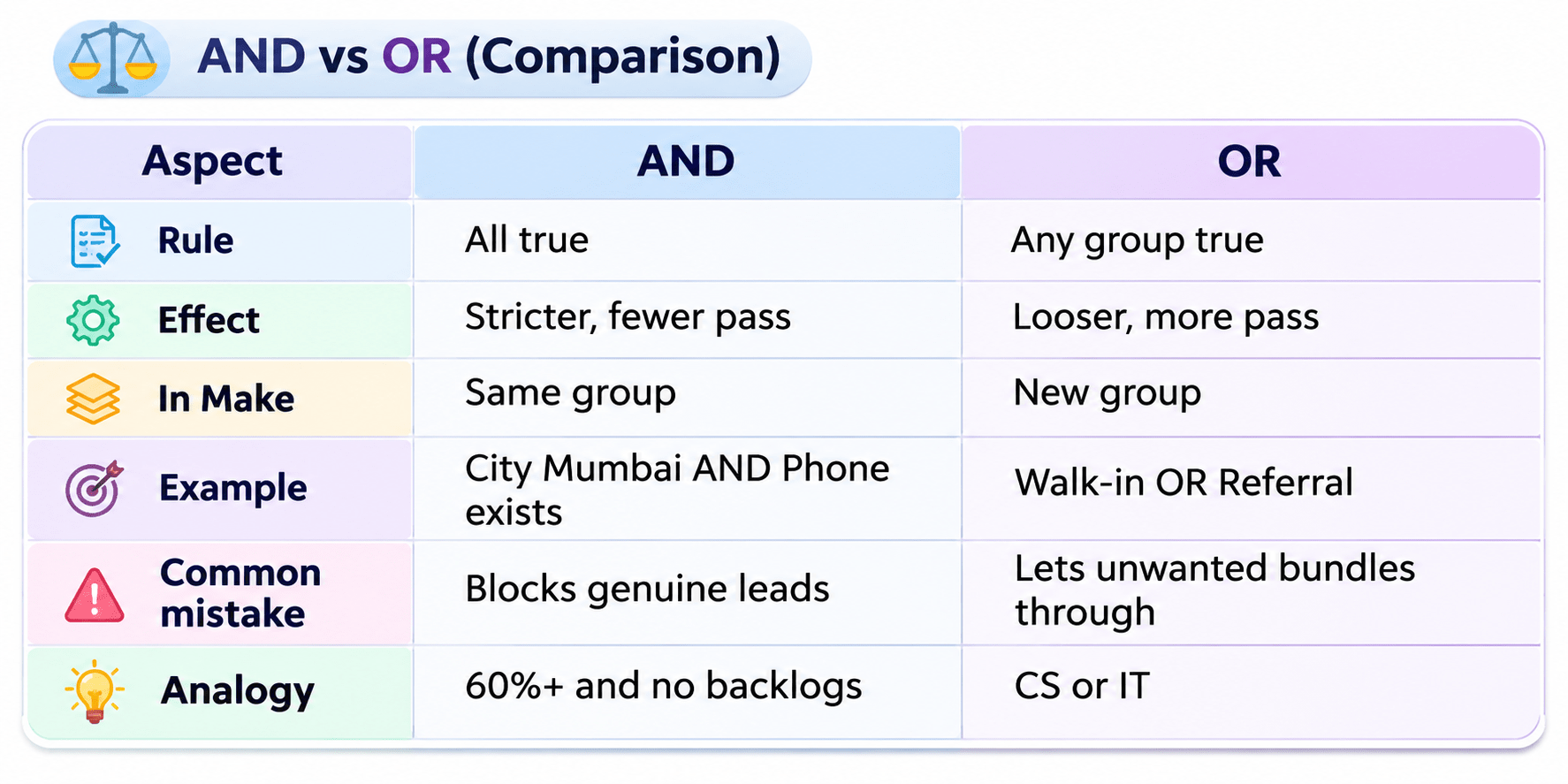
Conditions combine with AND (all must be true, like 60%+ and no backlogs) or OR (any one is enough, like CS or IT). Records that fail stop silently, without any error.
This is called Filters and Conditional Logic.
What is a Filter?
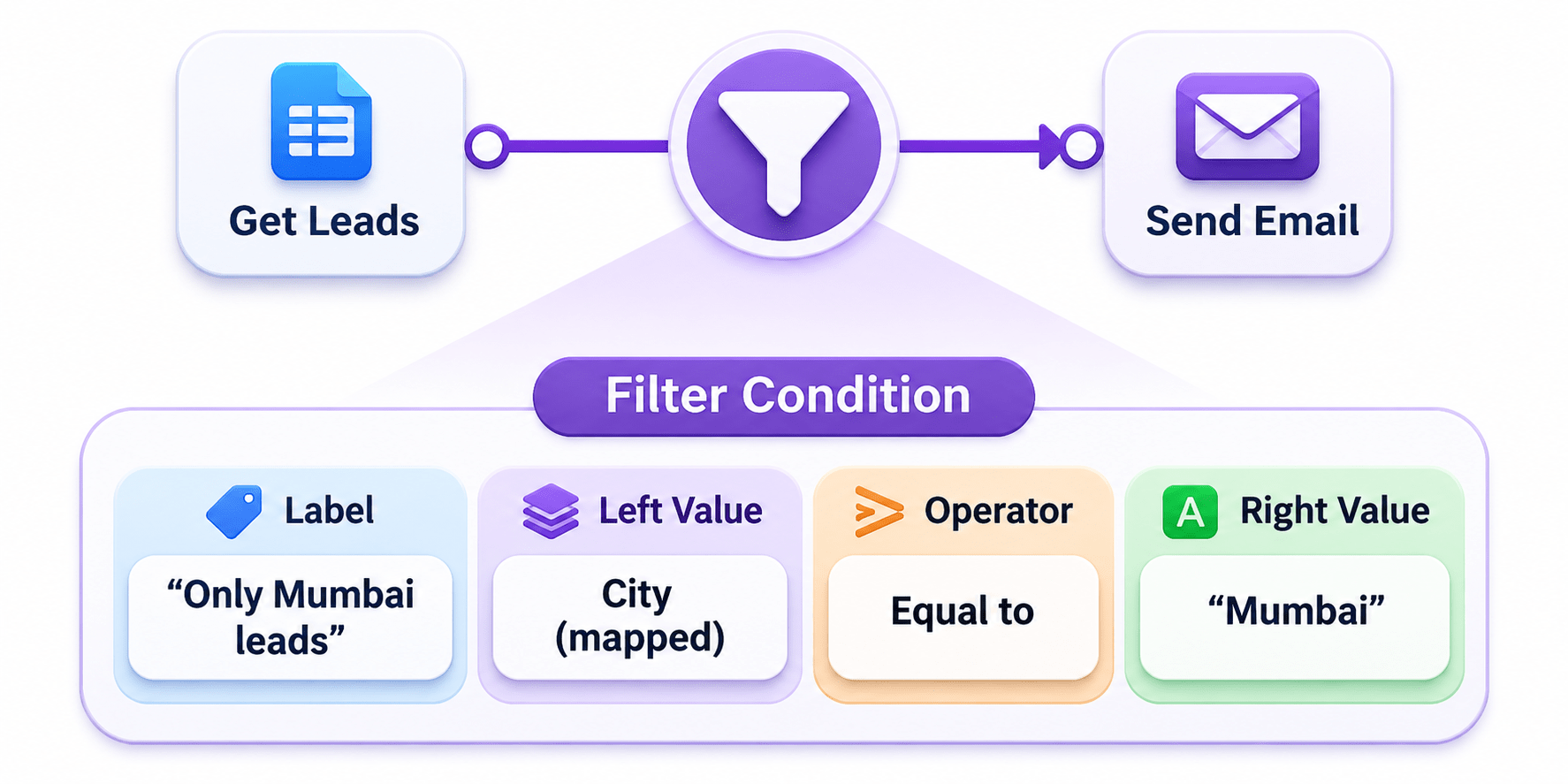
Lets only bundles that meet the criteria continue. Add one by clicking the line between modules.
Key Point: A condition reads like a sentence: “City is Equal to Mumbai.”
Types of Operators
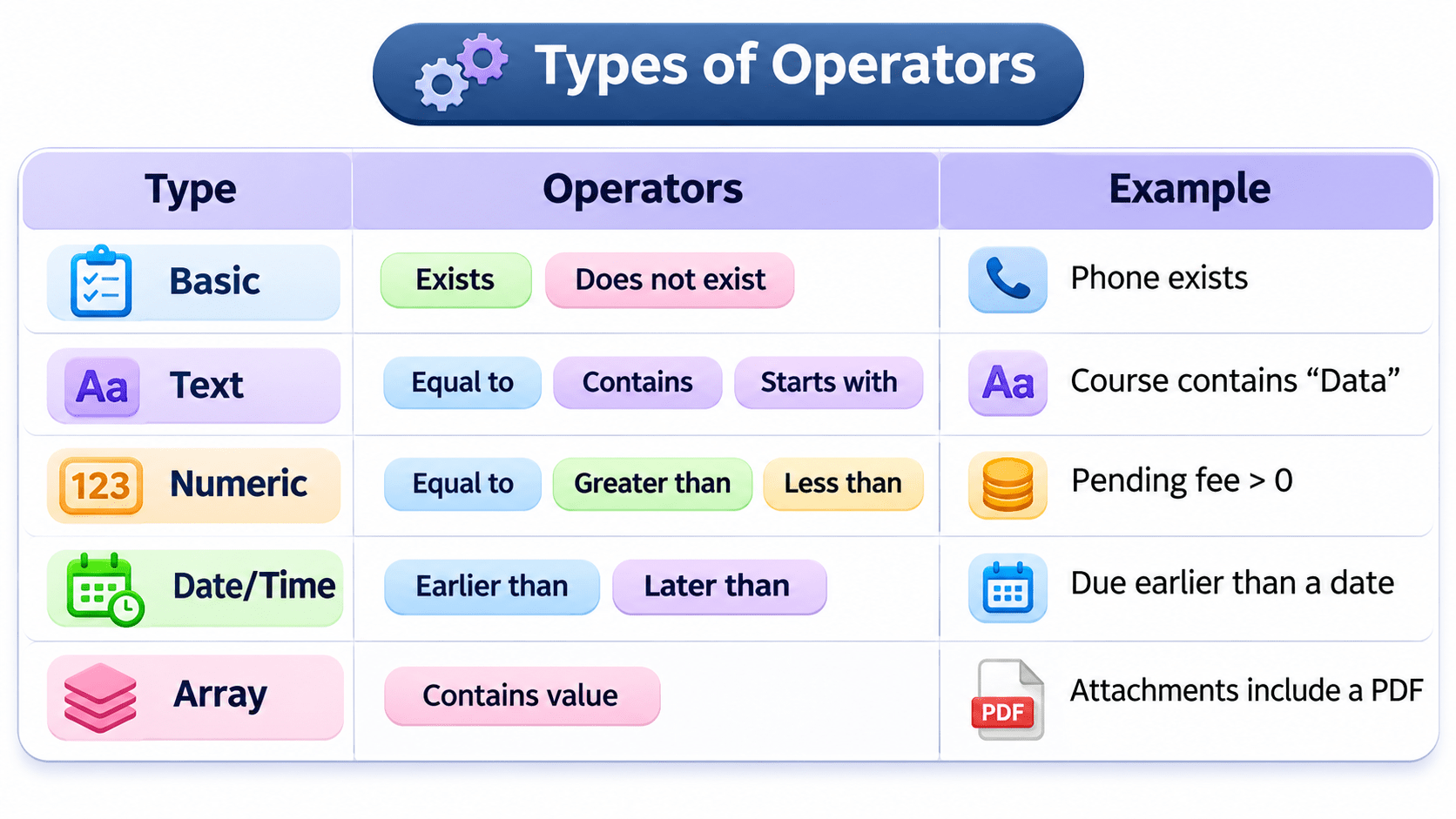
Key Point: Match the operator to the data type. “₹5,000” stored as text won’t compare as a number. Use case-insensitive text operators for typed data.
Combining Conditions with AND and OR
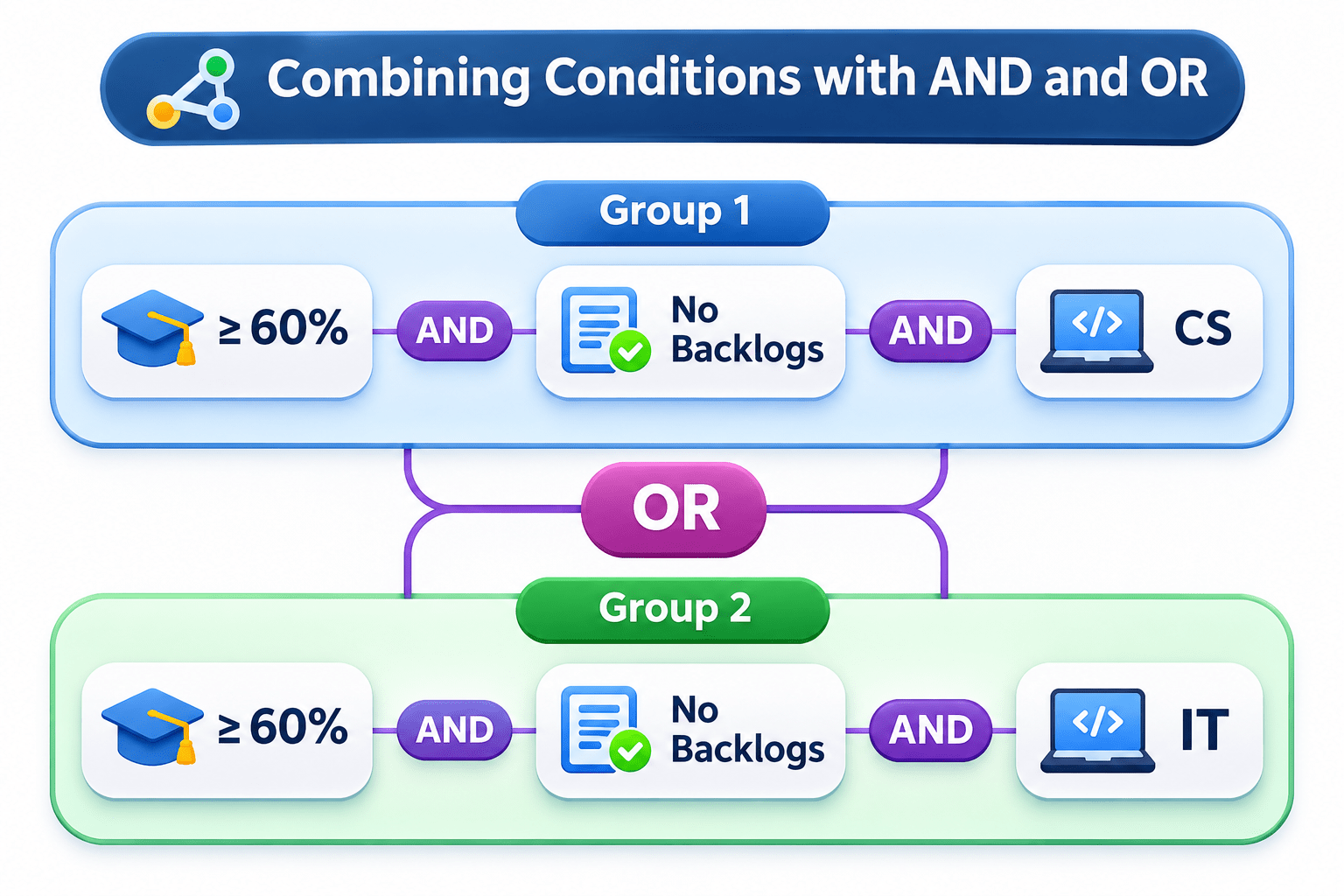
- AND: every condition must be true (same group)
- OR: any one group must be true (each OR starts a new group)
Example: “A AND B AND (C OR D)” becomes two groups: - Group 1: 60%+ AND no backlogs AND CS
- OR Group 2: 60%+ AND no backlogs AND IT
Conditional Values and Filter Behaviour
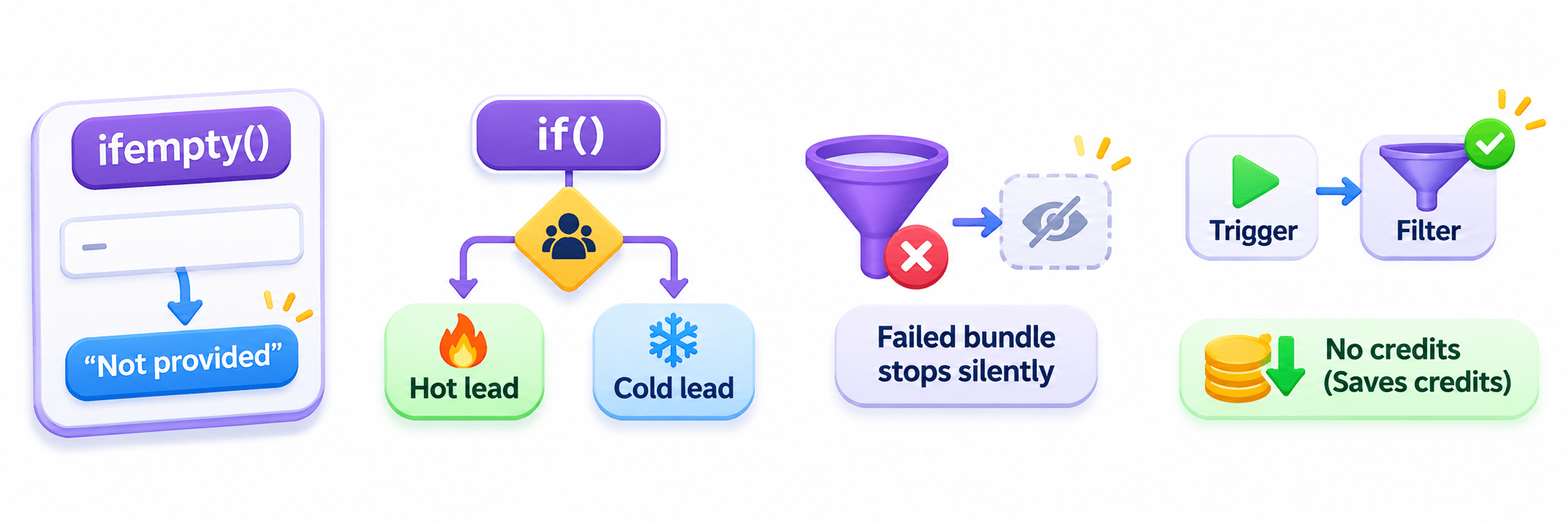
Filters use no credits and save credits, so place them early (right after the trigger)
ifempty(): fallback text, e.g. “Not provided” for a blank city
if(): choose between two values, e.g. “Hot lead” or “Cold lead”
Failed bundles stop silently: the run can still show success
AND vs OR (Comparison)
A Simple Way to Remember

AND means “all of these.” OR means “any one of these.” Unsure? Read the rule aloud as a sentence.
Think & Discuss: A case-sensitive “Mumbai” filter quietly drops “mumbai”, “Mumbai “, and “Navi Mumbai”. Why test filters with messy, real data?
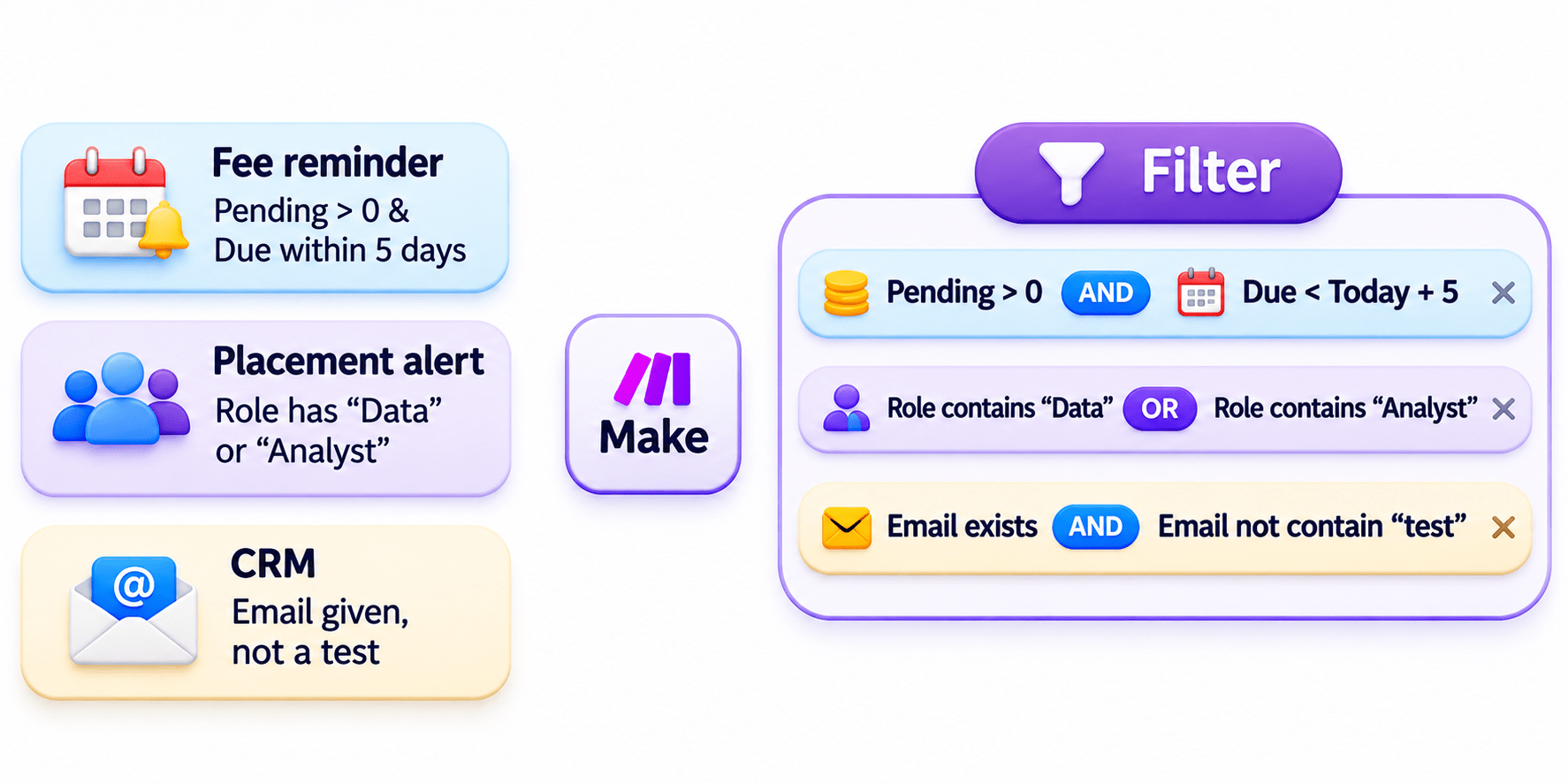
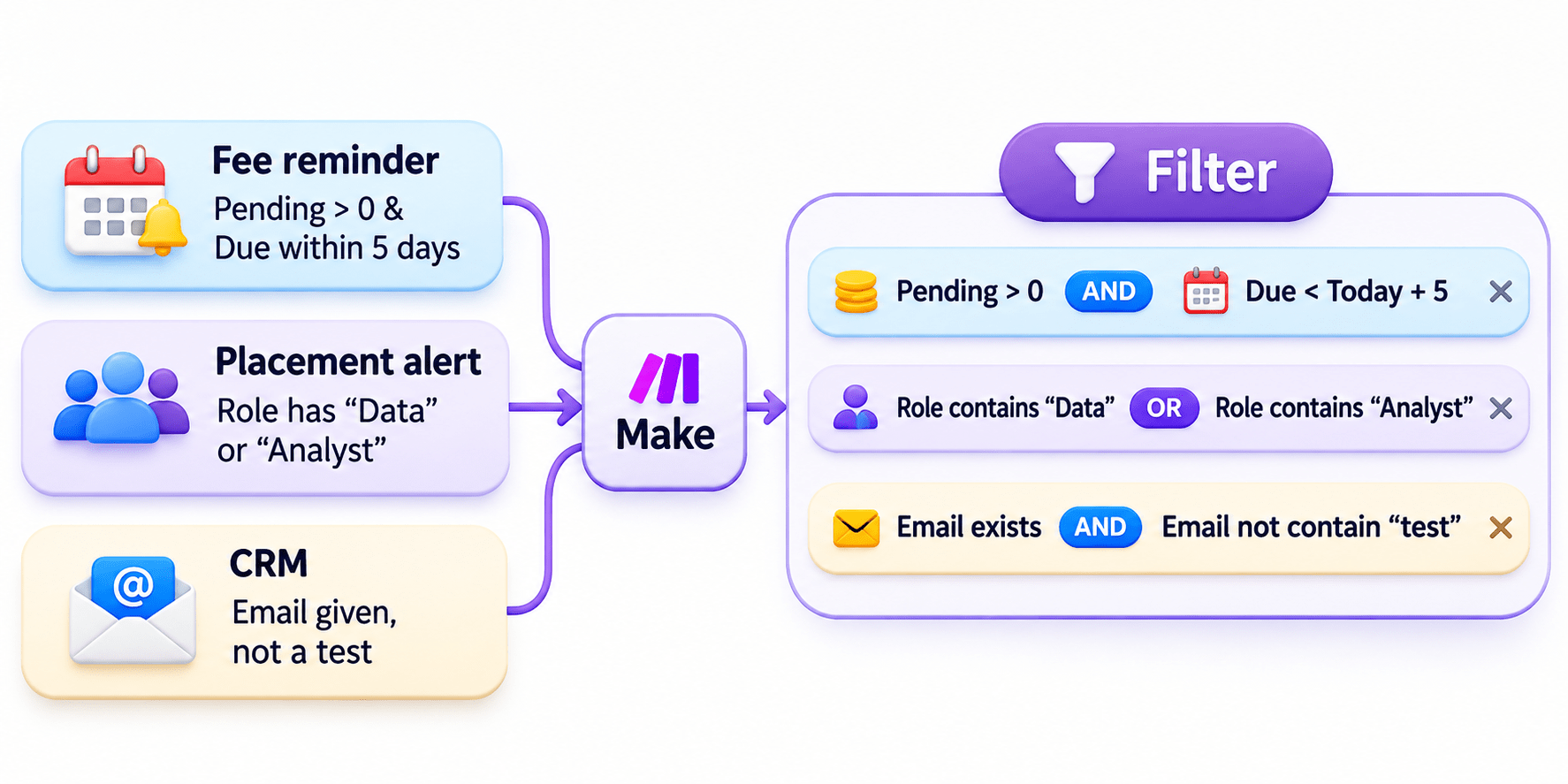
Real-World Applications: Pass or Stop?

Real-World Applications: Pass or Stop?
Summary
5
Filters save credits, but test them with messy data.
4
AND means all must be true; OR starts a new group.
3
Match the operator to the data type.
2
A condition is a left value, an operator, and a right value.
1
A filter lets only matching bundles continue.
Quiz
A case-sensitive filter checks City Equal to “Mumbai”. A lead typed “mumbai”. What happens?
A. It passes
B. It stops silently
C. It raises an error
D. It passes with a warning

A case-sensitive filter checks City Equal to “Mumbai”. A lead typed “mumbai”. What happens?
A. It passes
B. It stops silently
C. It raises an error
D. It passes with a warning
Quiz-Answer