Calculation of Liquidity Ratios

You are working as a financial analyst and have been asked to assess the short-term financial strength of Mahindra & Mahindra Ltd. (M&M).
Using the company's FY2025–26 standalone financial statements, you will extract the necessary data, input it into a spreadsheet, and calculate the Current Ratio and Quick Ratio. Finally, you will interpret whether the company has sufficient short-term assets to meet its current obligations, supporting your numerical findings with actual management commentary on liquidity found in the Annual Report.
Business Scenario

Pre-Lab Preparation
Topic : Fundamental & Ratio Analysis
-
Company analysis
-
Industry analysis
-
Macroeconomic analysis
-
Revenue and cost drivers
-
Liquidity ratios, Profitability ratios, Leverage ratios, Efficiency ratios
Task 1: Calculate Ratios:
1
Locate Data in the Annual Report
Open the MM-Annual-Report-2025-26.pdf file.
Lab File: Ratios
2
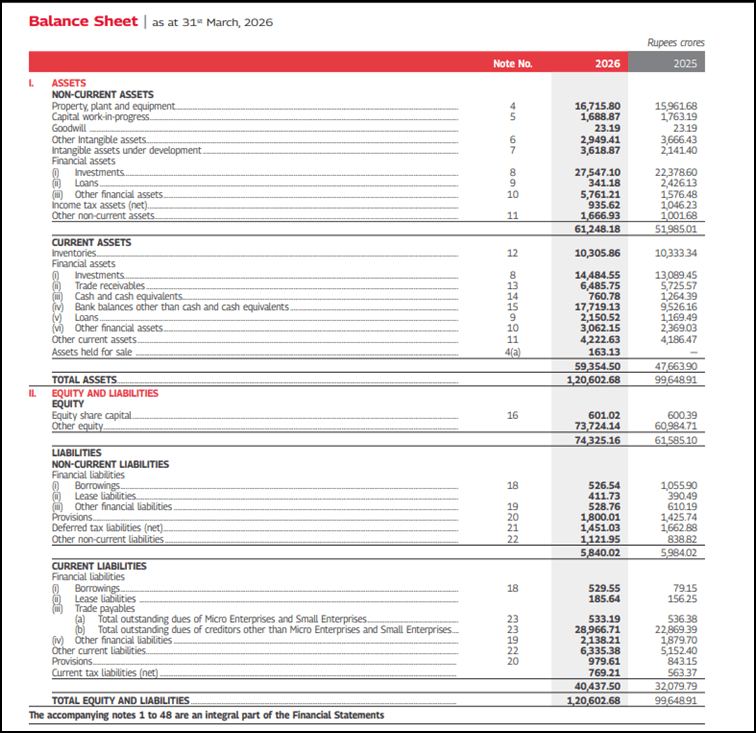
Navigate to Page 159 of the pdf to find the Standalone Balance Sheet.
3
Look under the "Current Assets" and "Current Liabilities" sections to record the following baseline figures for FY2026:
-
Current Assets: ₹59,354.50 crore
-
Inventories: ₹10,305.86 crore
-
Current Liabilities: ₹40,437.50 crore
4
Set Up the Financial Data in Excel
You must first build the data table using the actual FY2025–26 figures for Mahindra & Mahindra Ltd.
5
Create Headers
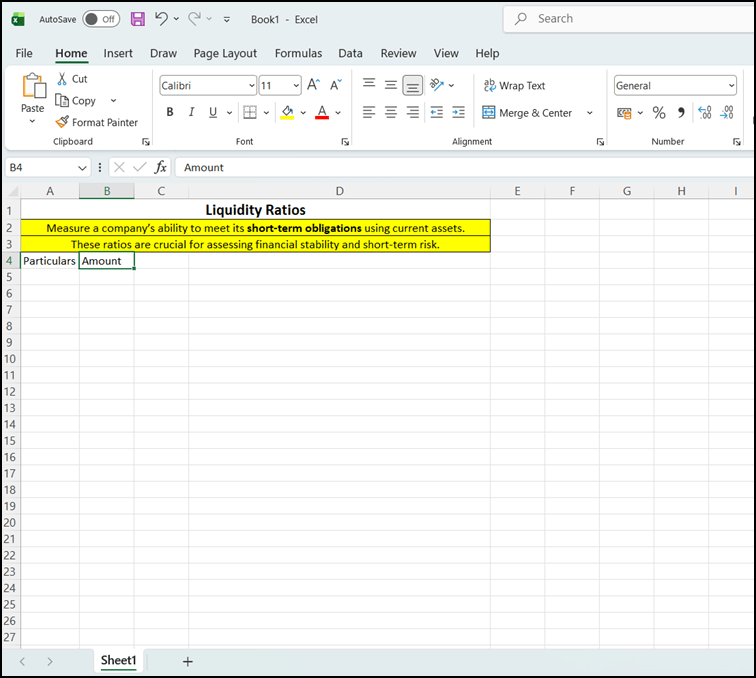
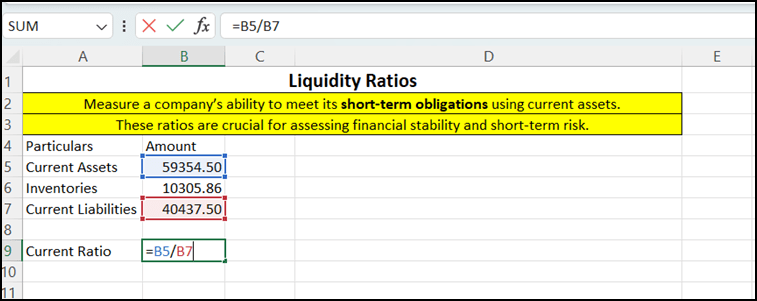
- In cell A4, type Particulars. In cell B4, type Amount
-
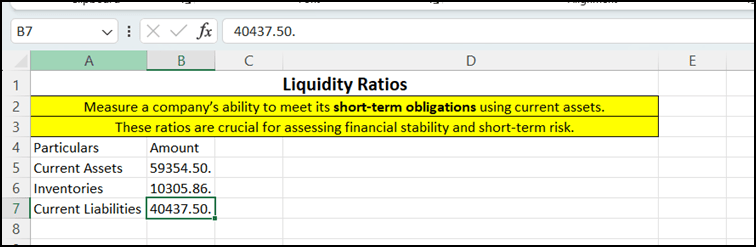
In cell A5, type Current Assets, In cell B5, enter 59354.50.
-
In cell A6, type Inventories. In cell B6, enter 10305.86.
-
In cell A7, type Current Liabilities. In cell B7, enter 40437.50.
6
Format the Numbers
-
Highlight cells B5 to B7.
-
Format these cells as "Number" or "Currency" with two decimal places so they are easy to read.
7
Calculate the Current Ratio
The Current Ratio measures whether the company has enough resources to pay its debts over the next 12 months.
In cell A9, type Current Ratio.
Select cell B9 and type the following formula to divide Current Assets by Current Liabilities:
=B5/B7
Press Enter. The result should display as 1.4678083 (or 1.47 if rounded).
Answer: The Current Ratio is 1.47.
Task 2 : Calculate the Quick Ratio
The Quick Ratio is a stricter test of liquidity because it removes inventory, which cannot always be quickly converted into cash.
1
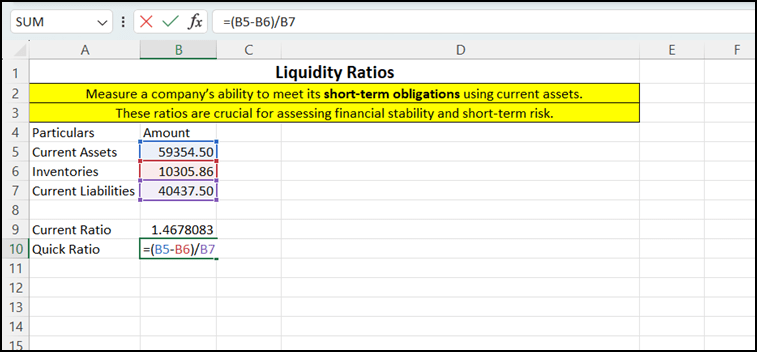
In cell A10, type Quick Ratio.
2
Select cell B10 and type the following formula to subtract Inventories from Current Assets, and then divide by Current Liabilities:=(B5-B6)/B7
3
Press Enter. The result should display as 1.2129494 (or 1.21 if rounded).
Answer: The Quick Ratio is 1.21.
Task 3 : Interpret the Liquidity Position & Annual Report Verification
Review the outputs in your spreadsheet and combine them with the management's commentary from the Annual Report. Write a short interpretation covering :
-
Numerical Interpretation: A Current Ratio of 1.47 indicates a comfortable buffer to meet immediate obligations. A Quick Ratio of 1.21 proves that even without selling a single unit of inventory, M&M still has ₹1.21 in highly liquid assets to cover every ₹1 of short-term debt.
-
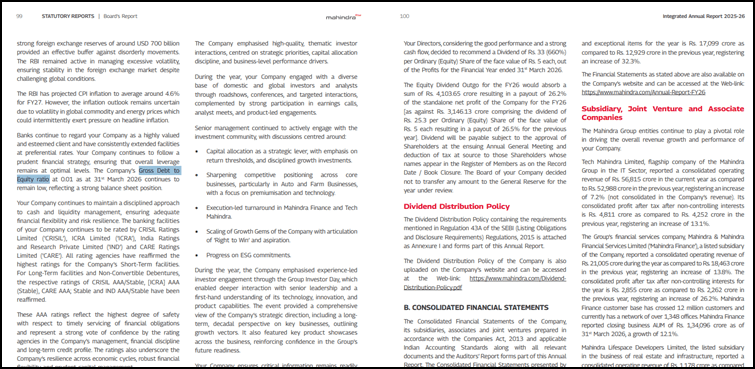
Annual Report Verification: Now, verify why the numbers look this strong by checking the Board's Report. Navigate to Printed Page 100 of the Annual Report, and look under the "Economic Overview" section.
The Reason: Read the top of the right-hand column. The management officially confirms this strong liquidity profile, stating: "Your Company continues to maintain a disciplined approach to cash and liquidity management, ensuring adequate financial flexibility and risk resilience."
Additional Structural Strength: Read the top of the left-hand column. The report highlights that this short-term liquidity is backed by incredible long-term solvency, noting a "Gross Debt to Equity ratio at 0.01 as at 31 March 2026,"
reflecting a massive, near debt-free balance sheet position. Furthermore, their short-term borrowing facilities hold the highest possible A1+ credit ratings, validating your calculated ratios.
AI-Based Analysis & Verification
Step 1: Prompt an AI Tool
Copy and paste the following prompt into an AI tool:
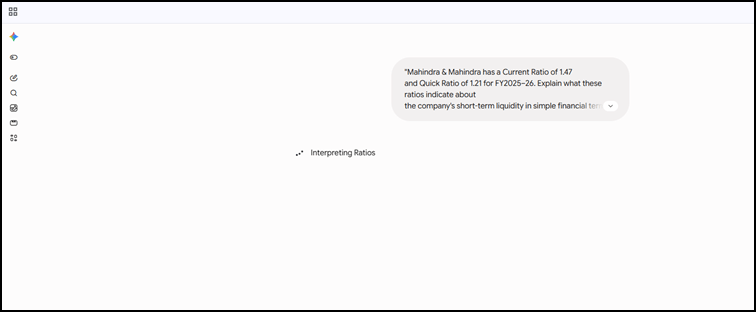
"Mahindra & Mahindra has a Current Ratio of 1.47 and Quick Ratio of 1.21 for FY2025–26. Explain what these ratios indicate about the company's short-term liquidity in simple financial terms. Mention two strengths and two areas of concern."
Step 2: Review AI response
Step 3 Interpret AI Response:
-
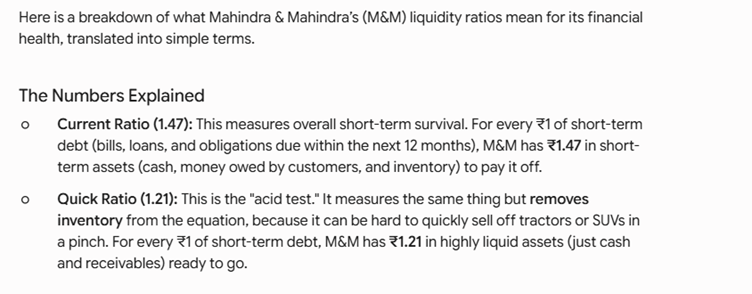
Current Ratio = 1.47: For every ₹1 the company needs to pay in the short term, M&M has ₹1.47 of current assets. This shows that the company has a good ability to meet its short-term obligations.
-
Quick Ratio = 1.21: Even after removing inventory, M&M has ₹1.21 of liquid assets for every ₹1 of short-term liability. This indicates good immediate liquidity.
Strengths
-
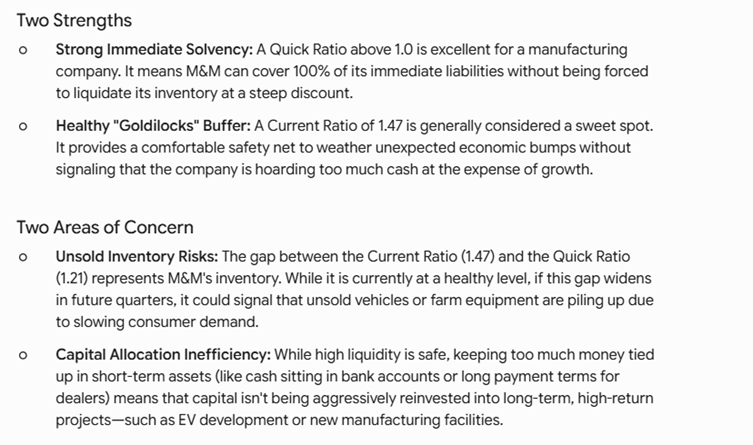
Good liquidity: A Quick Ratio above 1 means M&M can meet its short-term payments without depending heavily on selling inventory.
-
Healthy financial position: A Current Ratio of 1.47 provides a reasonable safety margin for unexpected short-term expenses.
Areas to Watch
-
Inventory: The difference between the Current Ratio and Quick Ratio shows the role of inventory. If inventory increases too much, it may indicate slower sales or unsold vehicles and equipment.
-
Use of funds: If the company keeps too much money in short-term assets, it may have less money available for long-term investments such as EVs, technology, or new manufacturing facilities.
Overall Conclusion: M&M has a healthy short-term liquidity position, but it should continue to manage inventory efficiently and use its available funds productively.